

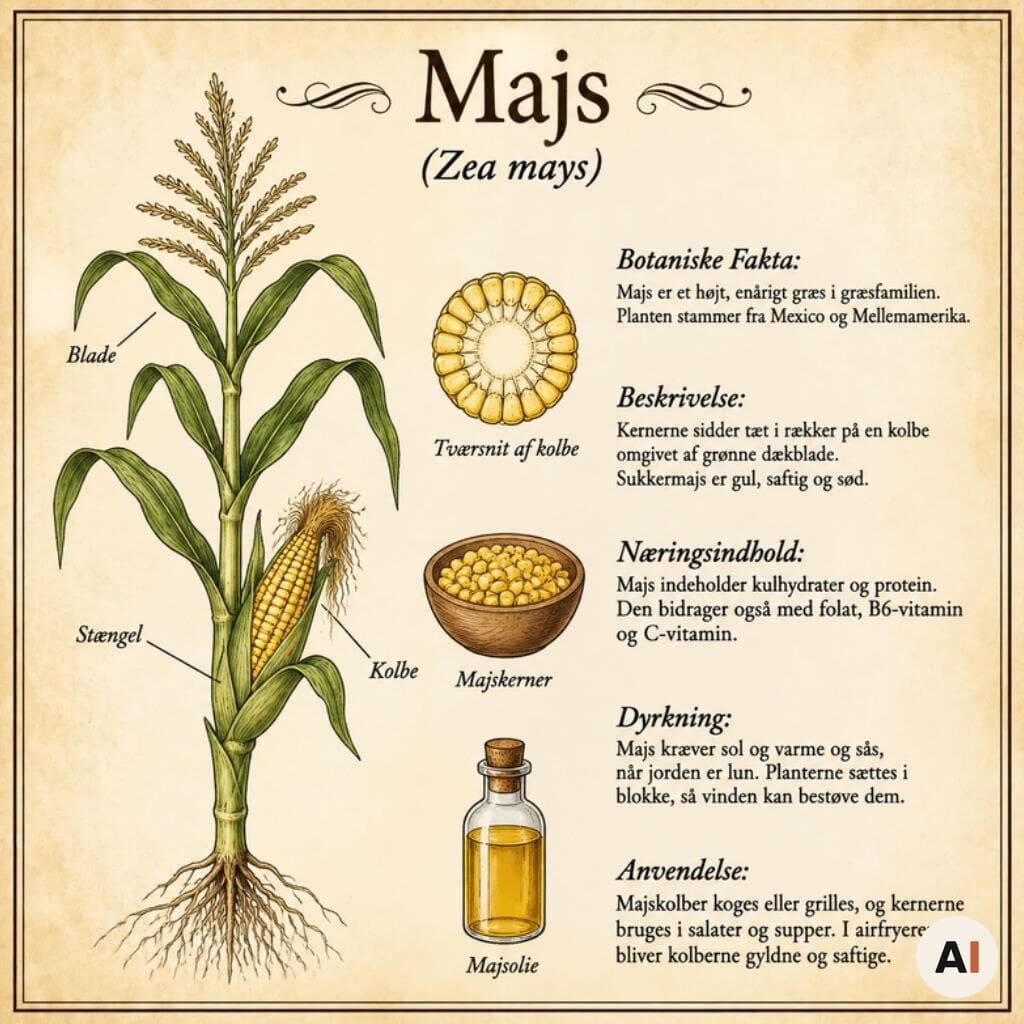
To me, corn is the very taste of late summer: a warm, golden cob with melted butter and a sprinkle of salt, eaten with your fingers. Botanically, corn (Zea mays, also known as maize) is a cereal grain – the plant belongs to the grass family, just like wheat and barley – but in the kitchen we use the sweet variety, sweet corn, as a vegetable.
The sweet, juicy cobs originate from Mexico and Central America, and today you’ll find corn everywhere: fresh cobs in season, kernels in cans and in the freezer all year round, and cornflour (cornstarch) in the cupboard. Baby corn and cornmeal have their own entries here in the Food Encyclopedia, and popcorn is made from a completely different type of corn.
Whole corn on the cob is one of my favourite vegetables in the air fryer: the kernels turn golden with lightly toasted spots, while staying juicy and sweet on the inside. Below you’ll find the history, the flavour, how to grow it, and my best tips for storage and cooking.
Estimated reading time: 6 minutes
History and origin
From wild grass to cereal crop
The cradle of corn lies in the region stretching from central and north-western Mexico to western Guatemala. Its wild ancestor, teosinte (Zea mays ssp. parviglumis), grows in southern Mexico and looks above all like a wild grass with small spikes and only a few hard kernels.
Over several thousand years of cultivation, the Indigenous peoples of Central America selected the best plants again and again, and slowly the slender grass became the sturdy plant with big cobs that is one of the world’s most important crops today.
Corn comes to Europe
Corn came to Europe with Columbus and other explorers in the 15th century. Sweet corn (Zea mays var. saccharata) is the sweet variety we eat as a vegetable – the kernels are sweeter and juicier than those of ordinary field corn, which is used mainly for animal feed, flour and starch.
The vast majority of the big cornfields you see from the road are grown as feed for livestock. Sweet corn for the kitchen is grown on a smaller scale, but it can do perfectly well in a sunny vegetable garden.
Flavour and aroma
Sweet, juicy and mild
Fresh sweet corn tastes sweet, mild and ever so slightly milky. The kernels give a little pop when you bite into them, and the juice inside is almost creamy. It is precisely the sweetness that makes corn popular with both children and adults, and a dab of butter and a sprinkle of salt is all it needs.
Freshness and roasting make the difference
The sweetness is fleeting, though. After harvest, the sugar in the kernels begins to turn into starch, so the cobs lose some of their sweetness the longer they sit. That is why corn from the garden or the farm shop often tastes noticeably sweeter than cobs that have sat for a long time in the shop’s chilled display.
When corn is grilled or cooked in the air fryer, the sugar on the surface caramelises, and the flavour becomes deeper, with nutty, roasted notes. Boiled corn is rounder and milder – both have their place.
Culinary uses
In everyday cooking
In the UK and the US, corn on the cob with butter and salt is a fixture on the barbecue table in summer. Kernels from a can or the freezer add colour and sweetness to pasta salad, tuna salad and hot dishes, and cornflour (cornstarch in the US; also sold as Maizena) thickens sauces and is an ingredient in pudding mixes.
Around the world
In Mexico, corn is the very cornerstone of the cuisine: tortillas are made from cornmeal, and elote is sold on the streets. In Italy, cornmeal is cooked into polenta, and in the US corn chowder is a beloved classic. Here are some of the classic corn dishes:
- Corn on the cob with butter and salt: the classic summer favourite from the grill.
- Pasta and tuna salad: with kernels from a can or the freezer.
- Elote (Mexico): grilled corn on the cob with mayonnaise, cheese, chilli and lime.
- Tortillas (Mexico) and polenta (Italy): made from dried corn and cornmeal.
- Corn chowder (USA): creamy soup with corn.
In the air fryer
Whole corn on the cob is made for the air fryer. I peel off the husks and silk, cut long cobs in half so they fit in the basket, and brush them with melted butter or a little oil. The cobs should lie in a single layer, and I turn them halfway through so they go golden all the way round.
They are ready when the kernels are golden with small toasted spots. Sprinkle with flaky salt just before serving – or give them the elote treatment with mayonnaise, grated cheese, chilli and a squeeze of lime.
Health benefits
Nutritional content
Corn is a little more energy-dense than many other vegetables because the kernels contain both starch and sugar. Here is the content per 100 g of raw sweet corn:
- Energy: 85 kcal
- Carbohydrates: 12.6 g, of which 7.5 g starch and 5.1 g sugars
- Dietary fibre: 3.0 g
- Protein: 3.2 g
- Fat: 1.7 g
- Potassium: 315 mg
- Phosphorus: 112 mg
- Magnesium: 37 mg
Fibre and minerals
The dietary fibre contributes to good digestion as part of a varied diet. Corn also provides potassium and magnesium, which are important for muscles and nerves, and phosphorus, which is part of bones and teeth.
Gluten-free and allergies
Corn is naturally gluten-free and fits in well when you need to avoid gluten – but do check the label on processed corn products. Corn is not among the allergens that must be highlighted on labels in the EU, and corn allergy does occur, but it is not common.
Growing
Growing conditions
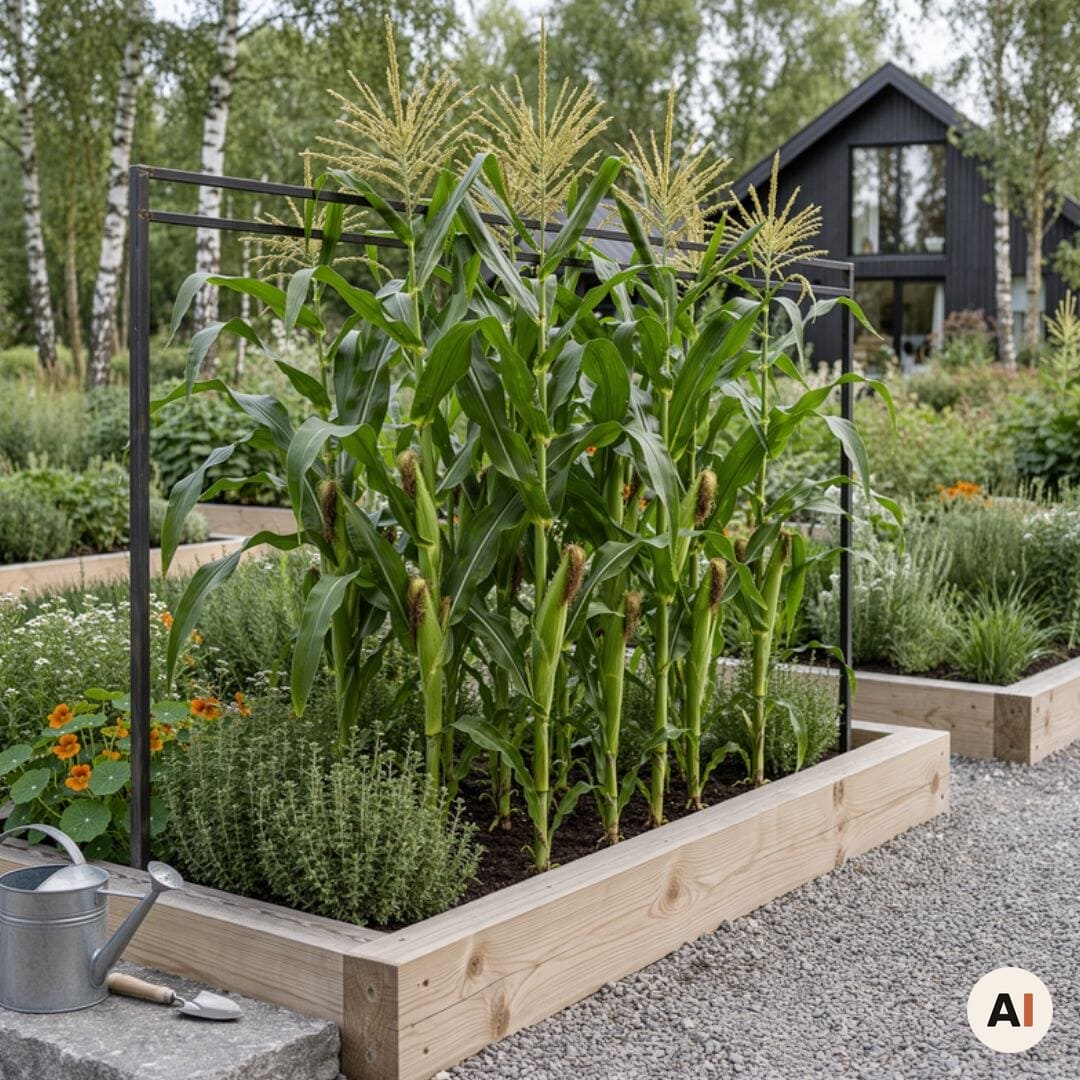
Corn is a heat-loving plant, but with a little care you can easily harvest your own cobs in a vegetable garden, even in a cool northern climate. Sweet corn grows 1.5–2 metres tall, so put it where it will not shade the rest of the bed.
- Light: a sunny spot with plenty of sun.
- Soil: well-fertilised soil – clay soil is better than sandy soil, and the pH should be at least 6.5.
- Watering: water thoroughly in dry summers.
- Hardiness: an annual and not hardy – tolerates neither frost nor cold weather.
Varieties and pollination
Among the varieties for the vegetable garden, you will find the old classic Golden Bantam as well as Damaun, Sugrano, Tramunt, Mellogold F1 and Double Standard. Plant the corn in a block of several short rows rather than one long row: corn is pollinated by the wind, and in a block the pollen lands more easily on the silk, so the cobs end up well filled with kernels.
How to grow sweet corn
Here is how I go about it, from seed to finished cob:
Total time: 3½-5½ months
- Start indoors
Sow the seeds in pots indoors around 1 May. They germinate at 20–32 °C in about a week.
- Plant out
Plant out in late May, once the risk of frost has passed – in mild regions around 20–25 May. Choose a sunny spot with well-fertilised soil, and plant in a block.
- Water and look after the plants
Water thoroughly in dry spells, and keep the bed free of weeds.
- Harvest
Harvest from mid-August to mid-October, when the silk withers and turns brownish. Press a fingernail into a kernel – if white, milky juice comes out, the cob is ready.
Storage
Eat the corn fresh
The most important advice is to eat the corn as fresh as possible. The sugar in the kernels turns into starch after harvest, and in the shop that process is often already well under way before the cobs even reach the checkout. So buy local corn in season whenever you can, and cook it as soon as possible.
My storage tips
- Store cold: put the cobs in the fridge with the husks on, so the kernels do not dry out.
- Freeze for winter: boil the cobs for 8 minutes, let them cool, and freeze them – that way they keep their quality well.
- Keep a stock: kernels from a can or the freezer are good to have on hand for salads and hot dishes.
Try this recipe
Corn’s natural sweetness also works well in baking, and Brazilians have known that for a long time. Try our recipe for Bolo de milho in the Air Fryer – juicy Brazilian corn cake for coffee – here corn takes the lead role, and the air fryer bakes a moist cake with a mild, sweet corn flavour. I like to serve it warm in slices with afternoon coffee, and it is good proof that corn can do much more than sit on the grill.
Frequently asked questions
Botanically, corn is a grain because the plant belongs to the grass family. In the kitchen, we use the sweet variety, sweet corn, as a vegetable.
The cob is ready when the silk withers and turns brownish. Press a fingernail into a kernel: if white, milky juice comes out, the corn is ripe.
Eat it as fresh as possible, because the sugar turns into starch after harvest, and keep it cold until use. If you want to keep it longer, you can boil the cobs for 8 minutes and freeze them.
Yes, whole corn cobs turn golden and lightly toasted in the air fryer. Brush them with butter or oil, lay them in a single layer in the basket, and turn them halfway through. They are ready when the kernels have small toasted spots.
Yes, corn is naturally gluten-free and is not among the allergens that must be highlighted on labels in the EU. Do check the label on processed corn products, though.
Facts about corn
| Fact | Value |
|---|---|
| English name | Corn (sweet corn) |
| Latin name | Zea mays; sweet corn: Zea mays var. saccharata |
| Family | Grass family (Poaceae) |
| Origin | Central and north-western Mexico to western Guatemala |
| Plant type | Annual, heat-loving grass – eaten as a vegetable |
| Height | 1.5–2 m (sweet corn) |
| Hardiness | Not hardy – does not tolerate frost |
| Light | Sunny spot with plenty of light |
| Soil | Well-fertilised soil, preferably clay soil; pH min. 6.5 |
| Sowing/planting | Start indoors around 1 May, plant out in late May |
| Harvest | Mid-August to mid-October |
| Calories per 100 g | 85 kcal (raw) |
| Flavour | Sweet, juicy and mild |
| Culinary use | Corn on the cob, salads, hot dishes, elote, tortillas and polenta |
| Storage | Eat fresh and store cold; can be boiled for 8 min. and frozen |
