

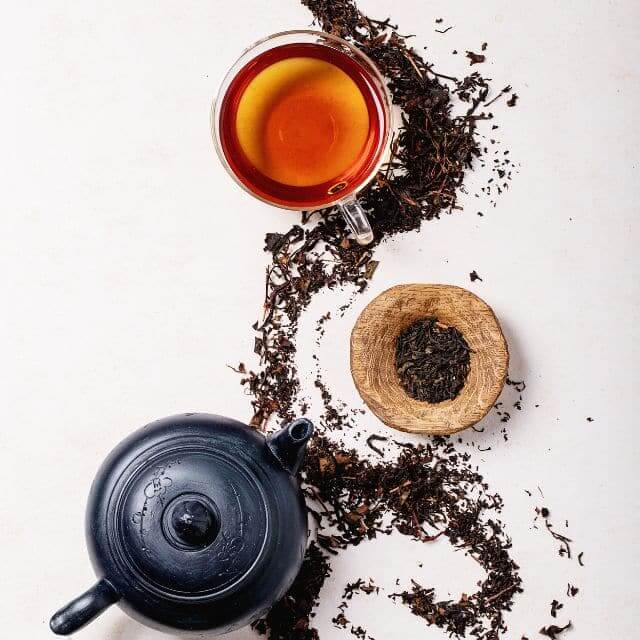
Black tea is one of the most popular types of tea in the world, known for its rich flavour, dark colour and unique aroma. Black tea is made by oxidising the tea leaves for longer than other types of tea, such as green or white tea. This oxidation gives it its characteristic dark colour and intense flavour profile.

Advertisement: The page displays ads and contains advertising links (affiliate links). See our advertisers here.
Estimated reading time: 10 minutes
What is black tea?
Black tea comes from the plant Camellia sinensis, just like green, white and oolong tea. What sets it apart from the others is how the leaves are processed after harvesting. The leaves are rolled, crushed and exposed to oxygen, which starts the oxidation process. This leads to the development of the complex flavour notes black tea is known for, including malty, fruity and sometimes smoky nuances.
Black tea can be enjoyed on its own or with additions such as milk, sugar, honey or lemon. Because of its higher caffeine content compared to green and white tea, it’s also a popular choice as a morning or afternoon tea for many people around the world.
History and origin
Its history
Black tea has a rich history spanning several centuries and continents. The origin of black tea can be traced back to China during the Ming dynasty, where the first black tea was produced. This type of tea, known as Lapsang Souchong, was originally developed in Fujian province and quickly became popular both locally and internationally.
During the 17th and 18th centuries, black tea began to gain popularity in Europe, particularly in England, where it became part of daily culture. The trade in black tea was one of the driving forces behind the economic growth of the British Empire, and it became an important trade commodity across the world.
In India, under British colonial rule, the Assam region became one of the largest producers of black tea. This led to the development of Assam tea, known for its bold, malty flavour. India’s tea production grew rapidly, and the country became one of the world’s largest exporters of black tea.
It has also played an important role in American history, particularly in connection with the Boston Tea Party in 1773, a protest against British tea taxation that helped spark the American Revolution.
Cultural significance
Black tea holds deep cultural significance in many parts of the world. In England, tea has become a central part of the social fabric, and “afternoon tea” is a well-known tradition where black tea is served with small sandwiches, scones and cakes. This tradition began in the 19th century and remains popular today, both in Britain and in many other countries.
In China, black tea is considered an important part of the traditional Chinese tea ceremony, where it’s enjoyed slowly and with great attention to flavour and aroma. Tea also holds symbolic meaning in Chinese culture, representing calm, health and wisdom.
In India, black tea, especially in the form of chai, is an integral part of everyday life. Chai is a spiced tea brewed with milk, sugar and various spices such as cardamom, ginger and cinnamon. It’s often drunk as part of the morning ritual or as a relaxing drink in the afternoon.
In many African countries, such as Kenya and Malawi, black tea is an important crop and export commodity, which matters greatly to those countries’ economies. Black tea is also grown in Japan, where it’s less common than green tea but still enjoys some popularity among tea enthusiasts.
Flavour and aroma
Black tea varies widely in flavour depending on origin and processing. Assam is bold and malty, Darjeeling light and floral, Ceylon fresh and citrusy, while Lapsang Souchong is distinctly smoky after being dried over pinewood fires. What they all have in common is a full body and a natural tannin content that gives the characteristic, slightly astringent sensation in the mouth – and which means black tea carries milk better than any other type of tea.
Types of black tea
If you want to dive deeper into the individual types, we have dedicated entries on the five most famous varieties here in the Food Encyclopedia:
- Assam tea – bold and malty
- Earl Grey – flavoured with bergamot
- Darjeeling tea – light and floral
- Ceylon tea – fresh and citrusy
- Lapsang Souchong tea – smoky and distinctive
Health benefits
Black tea isn’t just a tasty drink; it also has several health benefits. Black tea is rich in antioxidants, particularly flavonoids, which can help protect the body against damage from free radicals. These antioxidants may also help reduce the risk of chronic diseases, such as heart disease and certain forms of cancer.
It has also been shown to have a beneficial effect on brain health. Studies have shown that regular consumption of black tea can improve cognitive function and reduce the risk of neurodegenerative diseases such as Alzheimer’s and Parkinson’s.
It can also help improve digestion. The tannins in black tea can help ease digestive issues and promote healthy gut flora. It also has antibacterial properties that can help fight harmful bacteria in the digestive system.
Finally, black tea is a natural source of caffeine, which can provide an energy boost and improve focus and alertness. This makes black tea a good alternative to coffee, especially for those who want to cut down on their caffeine intake while still enjoying the benefits of a caffeinated drink.
Caffeine content
Black tea contains more caffeine than green or white tea, but still less than coffee. The exact caffeine content in black tea can vary depending on the type of tea, the brewing time and the amount of tea leaves used. Generally, a cup of black tea contains between 40 and 70 milligrams of caffeine, roughly half of what a cup of coffee contains.
For those sensitive to caffeine, it can be a good idea to choose a type with a lower caffeine content or to shorten the brewing time to minimise the amount of caffeine. Alternatively, you can choose to drink black tea earlier in the day so the caffeine doesn’t affect your sleep at night.
It’s also worth noting that black tea contains L-theanine, an amino acid that has a calming effect and can counteract some of the stimulating effects of caffeine. This means black tea can provide a more balanced energy that lasts longer and doesn’t lead to the same energy crashes that coffee sometimes can.
Brewing the perfect cup of black tea
Brewing tips
To brew the perfect cup of black tea, it’s important to start with fresh, cold water. Always use filtered water if possible to avoid impurities that can affect the tea’s flavour. Heat the water to around 90-95 degrees Celsius, which is the ideal temperature for black tea.
Once the water has reached the right temperature, pour it over the tea leaves in a teapot or cup. Use around 2-3 grams of tea leaves per 200 ml of water. Let the tea steep for 3-5 minutes, depending on how strong you want it. Remove the tea leaves after brewing to prevent the tea from becoming bitter.
How to brew black tea
Total time: 5 minutes
- Start with fresh water
Use fresh, cold and preferably filtered water for the cleanest flavour.
- Heat the water
Heat the water to 90-95 °C – just below boiling point.
- Measure the tea leaves
Use 2-3 grams of tea leaves per 200 ml of water in a pot or cup.
- Let the tea steep
Give the tea 3-5 minutes depending on the desired strength.
- Remove the leaves and serve
Take out the tea leaves so the tea doesn’t turn bitter, then add milk, honey or lemon if desired.
Best practices for brewing tea
It’s important to be aware that different types of black tea may require different brewing methods. For example, a delicate Darjeeling tea may need a shorter brewing time and lower temperature to preserve its subtle flavour nuances, while a robust Assam tea can steep longer to achieve the desired strength.
If you prefer to drink your tea with milk, add the milk after brewing to avoid the tea becoming too weak. Bear in mind, though, that adding milk can dull some of the tea’s subtle flavour notes, especially in finer teas like Darjeeling.
For the best tea experience, it’s also important to store your tea leaves correctly. Keep them in an airtight container in a cool, dry place away from direct sunlight. This will help preserve the tea’s freshness and aroma.
The tea master’s ultimate tips
1. Preheat the teapot or cup
To best preserve the tea’s temperature and flavour, it’s recommended to preheat your teapot or cup by rinsing it with hot water before brewing. This prevents the temperature from dropping too quickly once the tea is poured in.
2. Let the tea “bloom”
When brewing black tea, especially with whole leaves, you can achieve a richer flavour by letting the tea “bloom”. This means first pouring a small amount of hot water over the tea leaves and letting them sit for 30 seconds before adding the rest of the water. This helps release the essential oils in the leaves and improves the tea’s aroma and flavour.
3. Rinse the tea before brewing
For certain types of black tea, especially more delicate or older teas, a quick rinse of the leaves with hot (not boiling) water for 5-10 seconds before brewing can help remove any dust particles or impurities, while also making the tea more aromatic.
4. Experiment with water quality
The quality of your water can greatly affect the flavour of your tea. Use filtered or spring water instead of ordinary tap water, especially if your water contains a lot of lime scale or chlorine. Clean, fresh water free of impurities will bring out the tea’s natural flavour better.
5. Use the right water temperature
Although black tea is generally brewed at a high temperature, it’s important to consider the specific type of tea. For some delicate varieties, such as Darjeeling or first flush teas, a slightly lower temperature of around 85-90 °C can be ideal for preserving the subtle flavour notes. Using boiling water can make these teas bitter.
6. Account for season and humidity
When storing black tea, be mindful of seasonal effects. If you live somewhere with high humidity, it can affect the tea’s freshness. Store the tea in an airtight container, away from light, heat and moisture, to preserve its quality over time. Some tea enthusiasts use small silica gel packets in their tea containers to keep them dry.
7. Try double brewing
For teas like Lapsang Souchong or strong Assam teas, you can consider double brewing, where you brew the tea once, discard the first infusion, and then brew the tea again with fresh water. This can tone down some of the tea’s bitterness while still preserving its rich flavour.
By following these tips, you can take your black tea brewing to a new level and enjoy an even more refined and flavourful cup of tea.
The art of tea
Black tea and food
Black tea can be paired with a range of different foods to bring out the flavour of both the tea and the dish. For example, a strong Assam tea pairs well with rich, hearty dishes like beef or chocolate, while a light Darjeeling tea can be paired with delicate, light dishes such as fish or salads.
When pairing tea with food, it’s a good idea to consider the tea’s flavour profile and find foods that either complement or contrast with it. For example, the citrusy flavour of Earl Grey tea can be paired with fruity desserts or light snacks to create a balanced flavour experience.
In the Danish kitchen
In Denmark, black tea has a place at the breakfast table and as a calm alternative to afternoon coffee. A pot of strong Assam with milk is perfect with brunch, while a cup of Earl Grey suits sweet treats like buns, cake and biscuits – ideally baked or warmed in the air fryer.
Tea etiquette
In many cultures, there are specific rules of etiquette for how black tea is served and enjoyed. In England, for example, it’s traditional to pour the tea first and add milk afterwards, if desired. When attending a formal tea, it’s also common to hold the cup on its saucer and lift both cup and saucer together when drinking.
In China, it’s common to use small teapots and cups in tea ceremonies, where the tea is served in several small portions. It’s also important to appreciate each individual cup and take the time to enjoy the tea’s aroma and flavour.
Following this etiquette can help enhance the tea experience and turn it into a more ceremonial and mindful practice.
Storage
Black tea keeps for a long time, but gradually loses aroma if exposed to air, light, heat or moisture. Follow these simple rules of thumb:
- Store the tea leaves in an airtight container
- Choose a cool, dry place away from direct sunlight
- Keep the tea away from strong smells like coffee and spices – tea leaves easily absorb odours
- In high humidity, a small silica gel packet in the container can help keep the leaves dry
Conclusion
Black tea is a versatile and rich drink with a deep history and cultural significance. Whether you prefer a strong, malty Assam, a light and delicate Darjeeling or an aromatic Earl Grey, there’s a black tea for every taste. With the right brewing techniques and an understanding of tea’s many facets, you can enjoy the perfect cup of black tea, one that not only satisfies your taste buds but also benefits your health. Take the time to explore the different types and enjoy the rich world of black tea.
Try this recipe
Few things suit a fresh pot of black tea better than warm, home-baked buns. The soft yeast buns with apple and cinnamon are practically made for afternoon tea – try our Apple buns in the air fryer – soft yeast buns with grated apple and cinnamon.
Equipment and products
For the days when you or your guests want to mix things up, real cocoa is an obvious addition to the tea shelf. With Van Houten Cocoa Sachets, 100 pcs. you can quickly serve a cup of hot cocoa to those who don’t drink tea.
Frequently asked questions
A cup of black tea typically contains 40-70 milligrams of caffeine – roughly half that of a cup of coffee. The content depends on the type of tea, brewing time and the amount of tea leaves used.
Both come from the plant Camellia sinensis, but black tea is fully oxidised after harvesting, while green tea isn’t oxidised at all. This gives black tea a darker colour, stronger flavour and more caffeine.
3-5 minutes is the rule of thumb. A shorter time gives a milder cup, while a longer steeping time makes the tea stronger – and eventually bitter if the leaves aren’t removed.
90-95 °C is ideal for most black teas. Delicate varieties like Darjeeling first flush do best at 85-90 °C.
In an airtight container in a cool, dry and dark place, away from strong smells. Properly stored, black tea keeps its aroma for a long time.
Facts about black tea
| Field | Value |
|---|---|
| Plant | Camellia sinensis |
| Oxidation | Fully oxidised |
| Known types | Assam, Darjeeling, Ceylon, Earl Grey, Lapsang Souchong |
| Caffeine content | Approx. 40-70 mg per cup |
| Brewing temperature and time | 90-95 °C for 3-5 minutes (delicate varieties 85-90 °C) |
| Storage | Airtight, dark, cool and dry – away from strong smells |
