

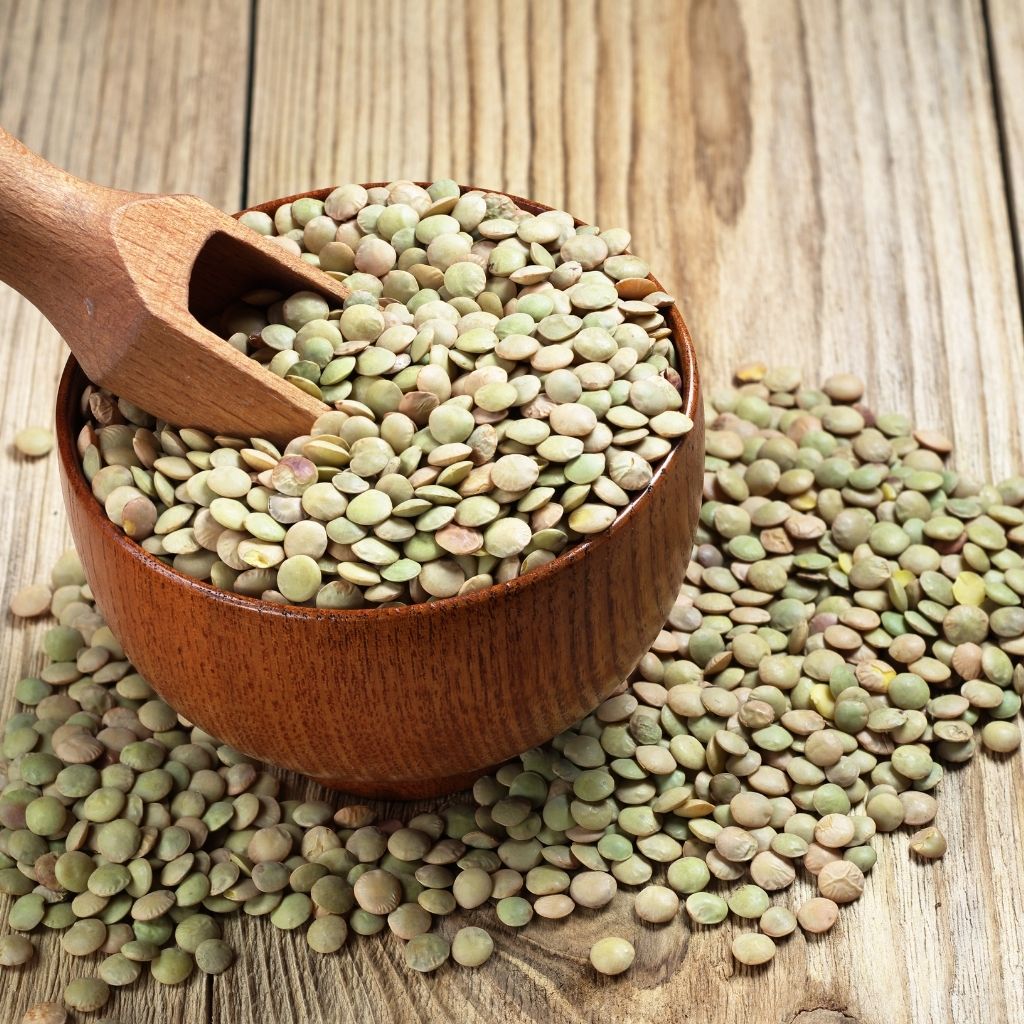
Green lentils are the small, marbled seeds that typically range in color from olive green to dark green. They belong to the species Lens culinaris and are part of the pea family. Green lentils hold their shape well during cooking and have a mildly peppery, earthy flavor that makes them popular in salads, soups and stews. They are an essential ingredient in many classic dishes around the world and a nutrient-rich addition to the modern kitchen.

Advertisement: The page displays ads and contains advertising links (affiliate links). See our advertisers here.
Green lentils are whole, mature seeds from the lentil plant. They are larger than red lentils and have a firm structure that holds up even when cooked. There are several subcategories, of which Le Puy from France is the most famous – these have a protected designation of origin and are especially small and dark green with a mineral note. Other varieties are grown in Canada, the USA and the Middle East. What they all have in common is that the whole seed is eaten, and that they don’t need to be hulled like many other legumes.
Estimated reading time: 8 minutes
History and Origin
One of the World’s Oldest Crops
The lentil is one of the world’s oldest cultivated plants. Archaeological finds show that wild lentils were gathered by humans more than 20,000 years ago, and that they were domesticated in Southwest Asia around 8,000-10,000 years ago alongside wheat and barley. From the Middle East, cultivation spread to the Mediterranean region, Central Asia and Europe. By the 5th millennium BC, lentils were already an important crop in Central Europe, and they are mentioned in biblical texts and ancient Greek writings as a common staple food.
Green Lentils Today
Green lentils – especially those from Puy in France – became known in the Middle Ages and are still used in classic French dishes such as «salade de lentilles du Puy». Today, green lentils are grown in many countries, including Canada, France, the USA and Turkey, and they are a staple in cuisines from the Middle East to India.
Flavor and Aroma
Green lentils have a robust, mildly peppery flavor with an earthy sweetness. The texture is firm and creamy inside, and the skin holds its shape even after longer cooking. This combination makes them well suited to dishes where you want the lentils to keep their structure – for example in salads, as a filling in soups, or as part of the main course.
The earthy flavor pairs well with many ingredients. Good pairings include:
- Herbs such as thyme, rosemary, sage and parsley
- Aromatic vegetables such as onion, garlic, leeks and carrots
- Acidic elements such as lemon, balsamic vinegar, apple cider vinegar or red wine
- Meat and fish, especially smoked bacon, sausage, salmon and lamb
- Cheese such as feta, goat cheese or parmesan, which adds salt and richness
- Spices such as cumin, coriander, paprika and garam masala
Culinary Uses
Green lentils are versatile and can be used in everything from hot main courses to cold salads. They absorb flavor from spices and herbs while providing a satisfying, filling texture.
In the Danish Kitchen
In the Danish kitchen, green lentils are used as a vegetarian protein in salads, stews and mince-based dishes. They’re popular for meal prep because they hold their shape and taste good both warm and cold. Serve them in a warm lentil salad with red onion, bell pepper, feta cheese and an olive oil and lemon juice dressing, or in a rustic lentil soup with carrots, celery, tomato and thyme.
Internationally
Green lentils are a staple ingredient in many countries. In the Middle East, they’re used in the classic dish mujaddara – a combination of lentils, rice and caramelized onions. In France, lentilles du Puy are often served as a side to sausage or duck. In India and Pakistan, lentils are used in dahl, where they’re cooked with spices such as cumin, coriander, turmeric and chili.
Classic Dishes
- As the base for a warm lentil salad with red onion, bell pepper and feta.
- In a rustic lentil soup with carrots, celery, tomato and thyme.
- In stews with lamb, beef or mushrooms, where the lentils cook along and thicken the sauce.
- As a filling for vegetarian patties – blend cooked lentils with spices and rolled oats.
- As part of an Indian dhal with garam masala, cumin and coriander.
Try them alongside our chicken tandoori:
Health Benefits
Nutritional Content per 100 Grams
Green lentils are a nutrient-dense food that provides a lot of nutrition relative to calories. A 100-gram serving of cooked green lentils contains approximately:
- 116 kilocalories
- 20 grams of carbohydrates, of which 8 grams are dietary fiber
- 9 grams of protein
- 0.4 grams of fat
- Important micronutrients such as folate, iron, magnesium, potassium, phosphorus, zinc and several B vitamins
The lentil’s protein content makes it an important plant-based protein source, and combined with whole grains such as rice or bulgur, you get a complete amino acid profile. The high fiber content – especially the soluble fiber – contributes to satiety, stable blood sugar levels and a healthy gut flora.
Benefits for the Body and Digestion
- Blood sugar control: Lentils have a low glycemic index and a significant amount of soluble fiber, so the carbohydrates are absorbed slowly and help stabilize blood sugar.
- Heart health: Fiber and potassium help reduce cholesterol and blood pressure, and lentils also contain polyphenols, which act as antioxidants.
- Digestion and satiety: The soluble and insoluble fiber supports a healthy gut flora, promotes regular digestion and provides lasting satiety.
- Nutrient-rich and affordable: Lentils are one of the most affordable sources of protein and folate and fit into everything from vegetarian to meat-based diets.
As with other legumes, a very high fiber intake can cause gas and bloating in some people. So increase the amount gradually, and drink plenty of water.
Rinsing and Cooking
Lentils require minimal preparation compared to many other legumes. Their small size and thin skin mean they don’t need to be soaked before cooking – you simply rinse them and cook them directly. Follow these steps for the best result.
Total time: 20-30 minutes
- Sort and Rinse
Spread the lentils out on a clean plate and sort out any small stones, plant debris or discolored seeds. Then rinse the lentils in cold water in a sieve. No soaking is necessary.
- Bring to a Boil
Use 3 parts water to 1 part lentils. Put the lentils and water in a pot and bring it slowly to a boil.
- Simmer Until Tender
Reduce to low heat and let the lentils simmer, covered, for about 20-30 minutes. For salads, 18-20 minutes is often enough; for a softer texture, you can cook for up to 35 minutes. Taste as you go – the lentils should be tender, but not mushy.
- Salt and Drain
Add salt only toward the end of cooking, otherwise the lentils risk becoming tough. Drain off any excess water, and let the lentils cool if they’ll be used cold.
Other Cooking Methods
- Canned lentils: Canned lentils are pre-cooked. Drain and rinse before using them in salads or hot dishes.
- Pressure cooker: In a pressure cooker, whole green lentils can be ready in 10-12 minutes – keep an eye on them so they don’t overcook.
- Sprouting: Green lentils can be sprouted like mung beans – soak them for 8 hours, rinse and drain, and let them sprout for 2-3 days. Sprouted lentils add a crisp texture to salads.
Food Safety and Antinutrients
Like other legumes, raw lentils contain small amounts of antinutrients such as trypsin inhibitors, phytic acid and tannins. These compounds can inhibit the absorption of certain minerals, but they break down during cooking or sprouting. It’s therefore important not to eat large amounts of raw, dried lentils. If you follow the cooking times above, the lentils are safe and easy to digest for most people.
Growing in Denmark
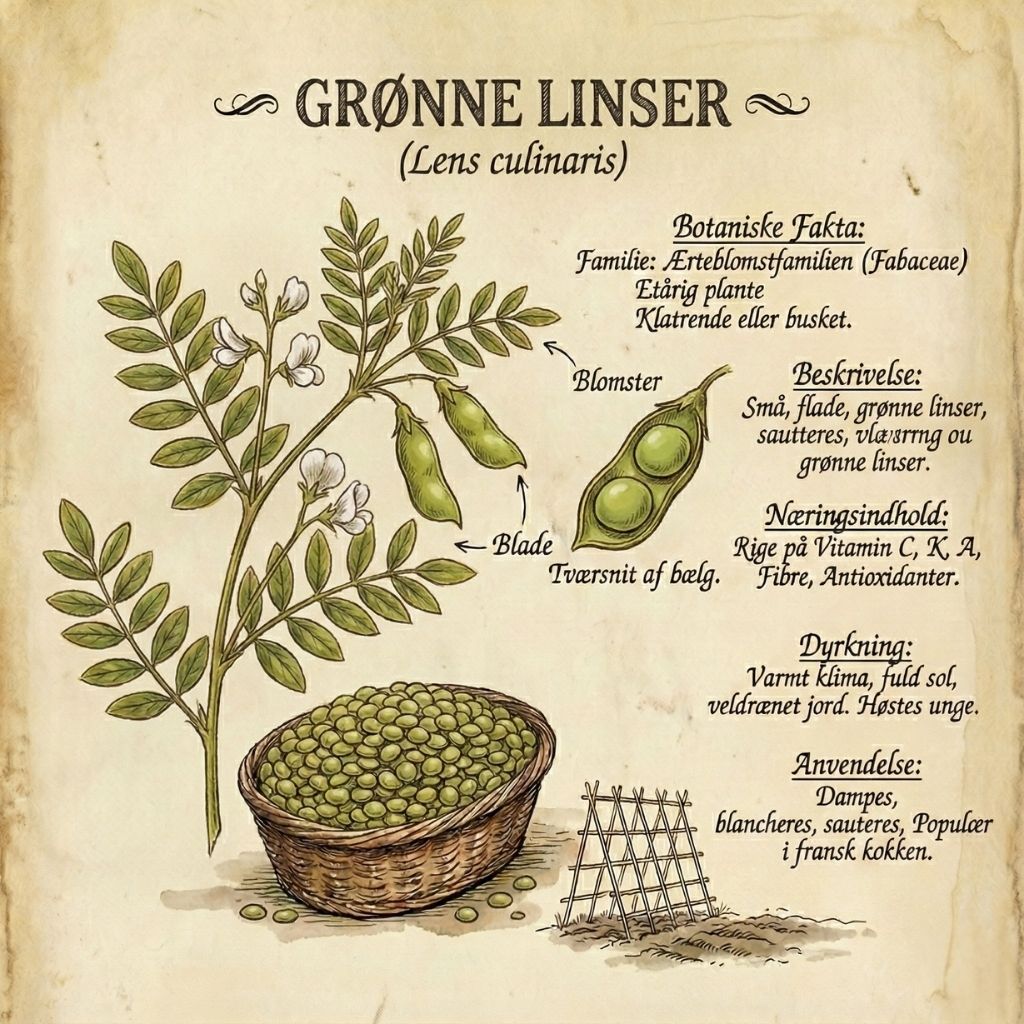
Lentils thrive best in cool, dry climates, which makes them well suited to growing in Denmark, provided the summer isn’t too wet. They’re relatively low-maintenance, but a good yield requires following a few basic principles.
How to Grow Green Lentils – Step by Step
- Choose a spot: Plant lentils in a sunny spot with light, well-drained soil. A pH around 6.0-6.5 is ideal. If the soil is heavy, you can improve drainage with compost or sand.
- Timing: Lentils are a cool-season crop. Sow seeds directly in the ground 2-3 weeks before the average last frost, when the soil is at least 10°C. Most varieties need 80-110 days to harvest.
- Seed preparation: Lentil seeds don’t need soaking before sowing. You can inoculate the seeds with rhizobium bacteria to ensure effective nitrogen fixation.
- Sowing: Sow the seeds 2-3 cm deep and about 2-3 cm apart in rows with 45-60 cm between rows. Thin out to about 10 cm between plants.
- Care: Keep the soil evenly moist, especially during germination and flowering. Reduce watering once the pods begin to ripen.
- Support and weeds: The plants grow 30-60 cm tall and can benefit from a low fence. Remove weeds regularly.
- Harvest: When the plants turn yellow and the pods brown and papery (typically August-September), pull up the plants and let them dry for a few days in a dry, sunny spot.
- Drying: Beat or roll the dried plants to release the lentils from the pods, and store them in an airtight container in a cool, dark place.
Growing Conditions
- Light: Full sun with at least 6 hours of sunlight daily.
- Temperature: Lentils prefer cool weather and germinate best at soil temperatures of 10-20°C. They tolerate light frost at night, but not hard frost after germination.
- Soil: Well-drained, loamy soil with moderate fertility. Too much nitrogen produces more leaf than seed.
- Water: Even watering during the growing season; less as the plants mature so the pods can dry.
- pH: A slightly acidic to neutral soil (pH 6-7) is ideal.
Storage
Lentils can be stored fresh, dried or cooked. Properly stored, dried lentils keep for a long time without losing quality.
- Fresh lentils: Eat them right away or store them in the fridge in an airtight container for up to a week.
- Dried lentils: Store in jars or containers with tight-fitting lids in a cool, dark cupboard. They keep for at least a year.
- Cooked lentils: Keep for 3-5 days in the fridge and can be frozen for up to 6 months.
Sustainability and Biodiversity
Lentils are a sustainable crop. As a legume, they form root nodules together with rhizobium bacteria that fix nitrogen from the air. This improves soil fertility, reduces the need for artificial fertilizer, and increases diversity in cropping systems, especially in grain-based crop rotations. Lentils require less water than many other protein sources and can be grown in semi-arid regions. In the kitchen garden, they can contribute to a more diverse ecosystem and attract pollinating insects when they flower.
Try This Recipe
Green lentils’ firm texture and earthy flavor make them perfect for creamy lentil dishes, where they hold their shape and soak up the spices. If you want a warm, filling dish starring lentils, get inspired by our recipe for Creamy Lentils in the Air Fryer – an easy way to get the best out of the lentils’ texture.
Equipment and Products
For green lentils, you’ll get by with very little equipment. A fine-mesh sieve is handy for rinsing the lentils and sorting out small stones, and a heavy-bottomed pot gives an even simmer, so the lentils cook evenly without falling apart. A pressure cooker can cut the cooking time down to 10-12 minutes if you’re in a hurry. If you keep dried lentils on hand, a few airtight storage jars can keep them fresh for months.
Frequently Asked Questions
No. Green lentils don’t need to be soaked before cooking. Their thin skin and small size mean they cook quickly. You can, however, rinse them and sort out any debris.
Whole green lentils should simmer for 20-30 minutes. For salads, 18-20 minutes is often enough, while a softer texture requires a bit more time.
Puy lentils are a type of green lentil grown in Le Puy-en-Velay in France and have a protected designation of origin. They’re slightly smaller and darker than regular green lentils and have a more mineral flavor.
Yes. Their high fiber and protein content provides a lasting feeling of fullness, which can help with weight control when the lentils are part of a balanced diet.
Yes. Cooked green lentils can be frozen in freezer bags or containers for up to 6 months. Cool them first, and thaw them in the fridge or directly in a hot dish.
Facts About Green Lentils
| Field | Value |
|---|---|
| English name | Green lentils |
| Latin name | Lens culinaris |
| Family | Pea family (Fabaceae) |
| Plant type | Annual, cool-season legume |
| Height | 30-60 cm |
| Hardiness | Tolerates light frost; thrives in cool climates |
| Light | Full sun |
| Soil | Well-drained, light to medium soil, pH 6-7 |
| Sow/Plant | Sow 2-3 weeks before last frost; seeds 2-3 cm deep |
| Flowering/Harvest | Flowers in early summer; harvest 80-110 days after sowing |
| Flavor | Earthy, mildly peppery, nutty |
| Nutrition (100 g cooked) | 116 kcal, 9 g protein, 8 g fiber |
| Culinary use | Soups, stews, salads, dahl, vegetarian patties |
| Soaking time | Not necessary – just rinse before cooking |
| Cooking time | 20-30 minutes for whole green lentils |
| Storage | Dried lentils in an airtight container for a year; cooked lentils 3-5 days in the fridge |
