

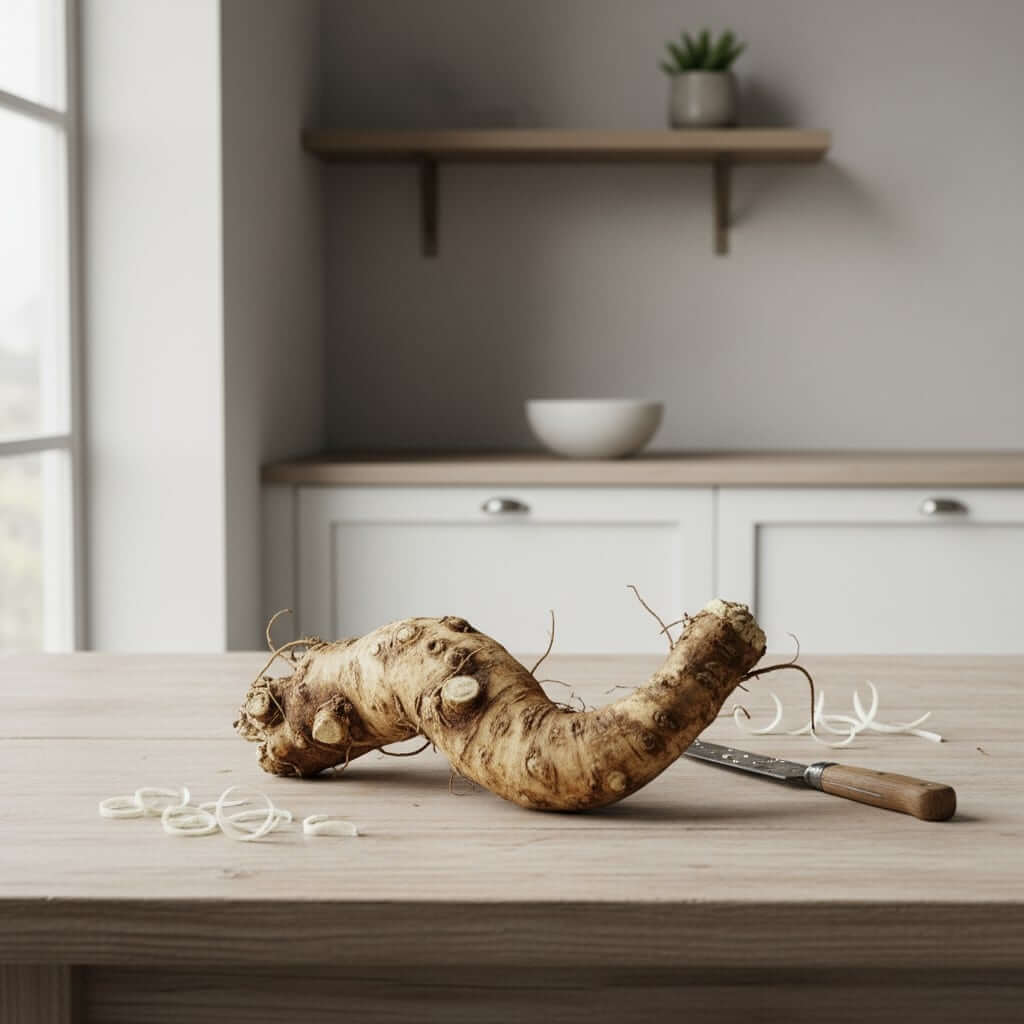
Horseradish is the powerful root that can bring tears to your eyes – the Nordic answer to chili. It belongs to the cabbage family and is grown for its white, cylindrical taproot. The root is used as a culinary herb in Nordic cuisine and contains three times as much vitamin C as lemons. When grated, it releases mustard oils that give it its characteristic sharp aroma and flavor.

Advertisement: The page displays ads and contains advertising links (affiliate links). See our advertisers here.
In this guide, you’ll learn everything about horseradish: its botanical background, history, culinary uses, growing methods, health aspects, and storage. We’ll also look at why horseradish is often confused with wasabi – and how the two actually differ.
Estimated reading time: 9 minutes
What Is Horseradish?
Horseradish (Armoracia rusticana) is a perennial herb in the cabbage family (Brassicaceae). The plant forms a rosette of large, long-stalked leaves that can grow 60-80 cm long. The main root is long, white, and cylindrical with a diameter of 4-5 cm. In its second growing year, horseradish sends up a flower stalk around a meter tall with small, four-petaled white flowers. The plant is vegetative: most horseradish plants don’t produce viable seeds, so propagation happens via root cuttings.
Horseradish’s sharp flavor and smell come from sulfur-containing glucosinolates, especially sinigrin, which convert to allyl isothiocyanate when the root is grated. This enzymatic reaction is the plant’s natural defense against grazing animals, but for us it’s a culinary strength. When the root is exposed to air or heat, it quickly loses its sharpness – so grated horseradish should be used immediately or mixed with acid, such as vinegar, to slow the breakdown.
History and Origin
From Southeastern Europe to Medieval Europe
Horseradish most likely originates from Southeastern Europe and Western Asia. It has been known in Europe since the Middle Ages and came to Denmark around the year 1300. Old herbals used the name “Mirredicke” and described it as a remedy for scurvy, kidney stones, and digestive troubles. Both Greek and Roman writings mention the plant, and Pliny the Elder recommended horseradish as medicine.
Horseradish in Denmark
In Denmark, horseradish has been cultivated since the 17th century and has since been a fixture of Danish manor gardens and kitchen gardens. Today, horseradish is used both as a seasoning and an ornamental plant; its fragrant white flowers appear in June and July and give off a sweet, spicy aroma.
Traditional Use in Cooking and Folk Medicine
In the Middle Ages, horseradish was regarded as a medicinal plant and used against scurvy, kidney stones, and digestive troubles. It was also used as a seasoning for meat in Germany, Scandinavia, and Britain, and in Eastern Europe, beet-and-horseradish salad (kren) is a traditional Easter dish. In Jewish Passover traditions, grated horseradish is included as a bitter herb (maror). These traditions show that horseradish isn’t just a Danish phenomenon, but a seasoning with deep roots in many cultures.
Flavor and Aroma
Horseradish’s flavor is intense, sharp, and hot – it’s often nicknamed the Nordic chili. It has a high content of allyl isothiocyanate, which attacks the mucous membranes, but when combined with fat, acid, or sweetness, the flavor becomes more balanced. Fresh horseradish pairs well with rich meat dishes, smoked fish, beets, and apples. Its bright, clean heat also enhances the flavor of potatoes, root vegetables, and cream-based sauces.
Great Pairings
- Beef brisket, beef flank, and grilled veal
- Smoked salmon, herring, and mackerel
- Potatoes, beets, carrots, and parsnips
- Apples, pears, and celery in salads
- Cocktail sauce, Bloody Mary, and tomato-based marinades
Avoid overdoing it: too much horseradish can mask other flavors. Grate the root just before serving to preserve the aromatic oils, and add it last in hot dishes, since heat reduces its potency.
Culinary Uses
Horseradish is considered a culinary herb in Danish cuisine. It’s rarely used as a vegetable, but rather as a flavoring in both hot and cold dishes. Raw horseradish has an intense, biting flavor that suits cold sauces, dressings, and toppings for smørrebrød. When horseradish is heated, the flavor becomes milder; it’s therefore often added toward the end of cooking.
In Danish Cuisine
In Denmark, horseradish is inseparably linked to the cold table and smørrebrød. Some classic uses:
- Grate fresh horseradish over boiled beef brisket or smoked salmon.
- Mix grated horseradish with cream or crème fraîche for a classic Danish horseradish cream sauce (great with smørrebrød topped with roast beef).
- Make a sharp horseradish sauce for fish or chicken by stirring the root into a roux-based sauce with milk and lemon.
- Use slices of horseradish in pickling jars with beets, cucumbers, or hokkaido squash – the sharp oils have a preserving effect.
- Mix grated horseradish into butter and freeze in small portions; the butter can be melted over new potatoes or grilled meat.
Internationally
Beyond the Nordic region, horseradish is widely used in Central and Eastern European cuisine. Horseradish sauce (grated root mixed with vinegar) is produced industrially and served extensively with roast beef, hot dogs, and in cocktail sauce. There are also variants with beetroot (chrain) and with cream cheese. Gourmet restaurants use grated horseradish as a topping on tartare and ceviche to add a clean, sharp finish, and horseradish foam – whipped cream with horseradish – has become popular in New Nordic cuisine.
Preparation
Short cooking times preserve the sharpness, while long cooking produces a mild, earthy flavor. If you want to preserve its full strength, grate the horseradish raw and add it just before serving. Small amounts can also be added to cocktails (such as Bloody Mary) or marinades to add warmth and depth. In hot dishes, stir it in at the very end so the aroma doesn’t evaporate.
Health Benefits
Vitamins and Minerals
Horseradish is rich in vitamin C and several B vitamins. The energy content in 100 g of raw horseradish is around 105 kcal, made up of 7.7 g protein, 0.7 g fat, and 20.5 g carbohydrate. It is also a good source of several minerals:
- Potassium – important for blood pressure and fluid balance
- Phosphorus and calcium – supports bones and teeth
- Iron and zinc – contribute to blood and immune function
- Manganese – part of the body’s enzyme systems
Digestion and Caution
Traditionally, horseradish is used against colds and coughs because its volatile mustard oils can open up the sinuses, and in folk medicine it was used as a digestive aid. Research into horseradish’s health effects is limited, but there are indications that glucosinolates may have antimicrobial properties. Horseradish can stimulate appetite and digestion, but large amounts can irritate the mucous membranes. People with stomach ulcers or kidney disease should therefore be cautious and limit the amount. Pregnant and breastfeeding women should also exercise caution; consult a healthcare professional if in doubt. This section is not a substitute for medical advice.
Growing
Horseradish thrives in the Nordic climate. Give it deep soil and water, and keep an eye on its tendency to spread.
How to Grow Horseradish
Total time: 1-2 seasons
- Plant root cuttings
Plant root cuttings or side roots early in spring. Use root pieces 25-35 cm long and 8-12 mm thick. Lay them at an angle: the thin root end about 12 cm deep and the thick top end 3-5 cm below the soil surface. Row spacing 60-70 cm.
- Contain the bed
Horseradish spreads via underground root runners and can become invasive. Grow it in a large bottomless bucket or in a contained corner. Bury the bucket so its rim is level with the ground, and fill it with deep, rich soil.
- Water and feed
Water regularly, especially in July and August when growth is greatest. An organic fertilizer high in nitrogen boosts growth; mix compost into the soil in spring.
- Weed and pinch
Weed a few times a year, especially during the establishment phase. If you want smooth roots, you can pinch back the plants in July: gently pull the plant up, cut off the vigorous side roots below the crown, and replant it.
- Overwinter and harvest
Horseradish is fully hardy in the Nordic region and withstands frost without covering. Harvest from August to April – leave the roots in the ground, or dig them up and store in moist sand at 0-1°C.
Growing Conditions
Horseradish requires deep, humus-rich soil with good water retention. Light sandy soils work if irrigation is available. The soil should be workable to a depth of at least 30-40 cm to give the root room to grow. The plant thrives in full sun but tolerates partial shade, and a neutral to slightly alkaline pH (6.5-7.5) is optimal. Horseradish is a heavy feeder: a maintenance fertilization of 150 kg N/ha is sufficient on humus-rich soils. It should be grown in rotation with at least 4-5 years before other brassica crops to avoid disease.
For home growers, a less intensive system is suitable. Dig a deep hole in a corner of the garden, fill it with compost, and plant a few root cuttings. Let the plant fend for itself; it can hold its own against ground elder and other weeds. An annual compost top-dressing gives fine roots; if the plant spreads too much, cut away the side roots and use them as new plants.
Storage
Harvest and Whole Roots
Horseradish can be harvested from August to April. Many home growers leave the roots in the ground over winter and dig them up as needed – cover the bed with spruce branches or straw to make digging easier during frost periods. Alternatively, you can dig up the roots in November and store them in moist sand in boxes at cool temperatures. The root is best in its second growing season; older roots become woody and less flavorful. Intact roots keep for several weeks in a plastic bag in the refrigerator.
Grated Horseradish and Freezing
- Grated horseradish should be used right away – it quickly loses its potency.
- Mix grated root with white wine vinegar in a tightly sealed jar in the fridge to preserve the sharpness.
- Freeze grated horseradish in small portions (e.g. in ice cube trays).
- Make horseradish butter and freeze it – melt over potatoes or grilled meat as needed.
Mix-Ups and Quality
Horseradish Is Not Wasabi
Japanese wasabi is often confused with horseradish, but they’re two different things. True wasabi (Wasabia japonica, also called Eutrema japonicum) is grown in running water and is difficult and expensive to produce. Horseradish (Armoracia rusticana) is a robust land plant. Both belong to the cabbage family and share the same pungent compound, allyl isothiocyanate, but wasabi has a cleaner, more velvety heat, while horseradish is rawer and more penetrating. In the West, most “wasabi” products are actually made from dyed, grated horseradish mixed with mustard – so if you buy wasabi in a tube, you’re most likely eating horseradish.
Other Mix-Ups and Buying Tips
Horseradish’s large, simple leaves can be confused with docks (genus Rumex) or some hostas, but horseradish has a distinctly white root and a strong mustard-like smell when the leaves or roots are cut. Other members of the cabbage family, such as radishes and daikon, are similar in flavor but have smaller, tuber-shaped roots. When buying fresh horseradish – typically in autumn and winter – choose root stocks that are smooth, firm, and white, without dark spots or branching. The root should be 25-30 cm long and 2-3 cm in diameter for top grade. Avoid roots that are dried out or rubbery; they’ve lost their moisture and potency.
Sustainability and Biodiversity
Horseradish is robust and winter-hardy, which makes it well suited to self-sufficiency in the Nordic region. Its large root absorbs water and nutrients efficiently, but requires deep soil cultivation. Growing horseradish at home reduces the need for imported horseradish, which often comes from China. The plant is valued by pollinators: its small white flowers attract bees in June. However, horseradish can become invasive; to protect biodiversity, roots should be dug up carefully so they don’t spread into natural areas. Grow it in a bucket or a contained bed to avoid weed problems, and use compost and rainwater instead of peat-based soil to reduce the carbon footprint.
Try This Recipe
Smoked and fresh salmon are among horseradish’s very best partners – the sharp root cuts through the fish’s richness and adds a clean, Nordic freshness. Grate a little fresh horseradish into a crème fraîche dip on the side, or mix it into the patty mixture. Try it with our Salmon Patties in the Air Fryer – Crispy Without Oil in 12 Minutes, where a dollop of horseradish cream lifts the crispy patties to a whole new level.
Equipment and Products
If you love the sharp, peppery heat that horseradish gives, you can build on it with ready-made sauces in your dishes. Our Lee Kum Kee Black Pepper Sauce 350 g delivers the same deep, peppery sharpness to wok dishes, beef, and marinades – a great addition when fresh horseradish is out of season.
Frequently Asked Questions
Yes. Horseradish is fully hardy and can stay in the ground all winter. You can cover the bed with spruce branches for easier harvesting in winter.
No. True wasabi (Wasabia japonica) is an expensive aquatic plant, while horseradish (Armoracia rusticana) is a robust land plant. They share the same pungent compound, allyl isothiocyanate, but most Western wasabi products are actually dyed horseradish.
Small culinary amounts are generally not a problem. However, horseradish contains strong mustard oils that can irritate the mucous membranes in large amounts. People with stomach or kidney problems should limit their intake and consult a doctor.
When the root is grated, an enzymatic reaction begins that releases allyl isothiocyanate and oxidizes other compounds. Oxidation turns the horseradish brown and bitter. So grate horseradish just before use and mix it with acid (vinegar or lemon) to slow the color change.
If you want uniform roots, you can pinch back the plant in July: pull it up slightly, remove the vigorous side roots, and replant it. It’s labor-intensive but gives a smoother root. Alternatively, you can accept gnarled roots, which taste just as good.
Facts About Horseradish
| Field | Value |
|---|---|
| English name | Horseradish |
| Latin name | Armoracia rusticana |
| Family | Cabbage family (Brassicaceae) |
| Plant type | Perennial, often grown as an annual crop |
| Height | 60-100 cm (flower stalk up to 1 m) |
| Hardiness | Fully hardy in the Nordic region; withstands frost |
| Light | Full sun to partial shade |
| Soil | Deep, humus-rich, moist but well-drained; neutral pH |
| Sow/plant | Plant root cuttings in early spring or autumn |
| Flowering | May-June; small white flowers |
| Harvest | August-April; best after the first frost |
| Calories per 100g | Approx. 105 kcal |
| Key nutrients | Vitamin C, potassium, manganese, iron |
| Flavor | Intense, sharp, mustard-like |
| Culinary use | Raw grated in sauces and salads; sauces, herb butter, pickling |
| Storage | Roots in soil or the fridge; grate and mix with vinegar to preserve potency |
