

Nutmeg is an exotic spice that combines a unique, warm aroma with a dramatic history. It comes from a large tropical tree, where both the seed and its red seed casing (mace) are used as spices. In Denmark, fresh nutmegs are a luxury item, but the ground, dried kernel is a staple in everything from mashed potatoes to mulled wine.

Advertisement: The page displays ads and contains advertising links (affiliate links). See our advertisers here.
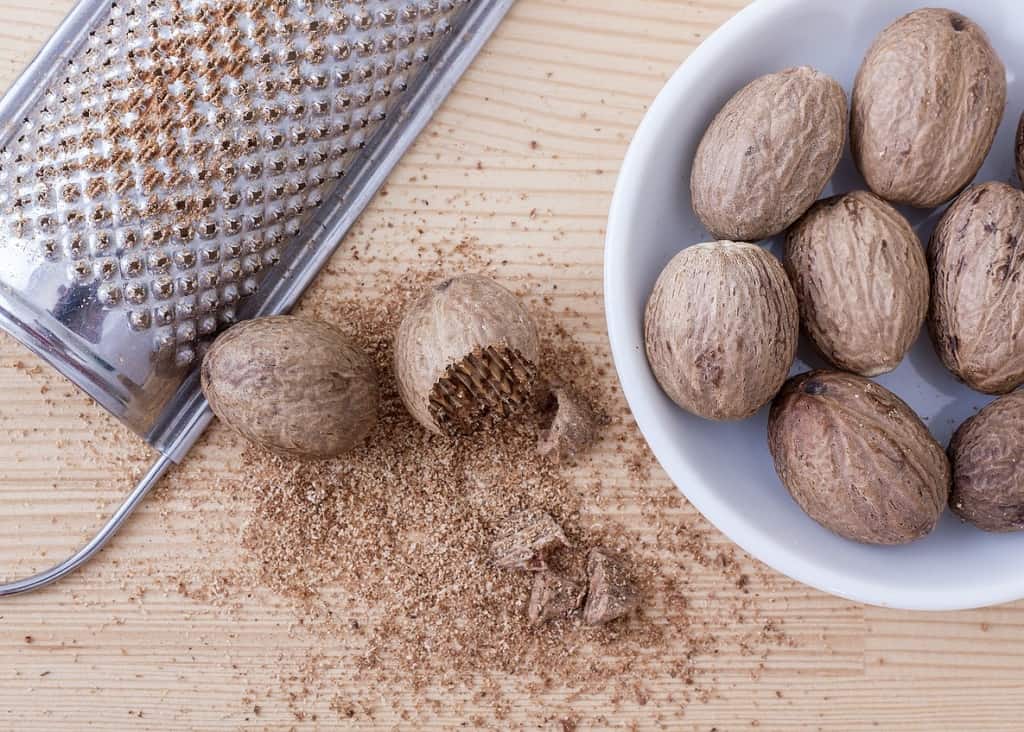
The nutmeg itself is the kernel from the fruit of the nutmeg tree, while mace is the red seed casing that surrounds the same kernel. Nutmeg is grated fresh on a grater and used sparingly – just a small pinch goes a long way. In this guide, you’ll get an in-depth look at the plant, its origin, uses, cultivation and the safety considerations you should know.
Estimated reading time: 8 minutes
History and Origin
Nutmeg is the seed of Myristica fragrans – an evergreen tree in the nutmeg family (Myristicaceae). The tree originates from the Banda Islands in Indonesia and grows naturally in tropical rainforests. The history of nutmeg is closely tied to the spice trade and European colonization.
Botany and Plant
The tree usually grows 5–15 m tall, but can reach 20 m in its native habitat. It forms a dense, conical crown with glossy, dark green leaves 5–15 cm long and 2–7 cm wide. The tree is mostly dioecious, meaning male and female flowers grow on separate plants, though a few trees can bear both sexes. The flowers are bell-shaped, pale yellow and grow in small clusters.
Female trees develop smooth, yellow fruits 6–9 cm in size that split into two halves when ripe. Inside lies a glossy brownish seed (the nutmeg itself) surrounded by a bright red aril, which dries into the spice mace. Trees begin bearing fruit from around 15 years of age. Due to its tropical origin, the tree is not hardy in Denmark; nutmeg can only be grown here in a greenhouse or conservatory as an ornamental plant.
From the Banda Islands to Europe
The eastern Moluccas (the Banda Islands) were for centuries the only source of nutmeg and mace. Arab traders brought nutmeg to Europe in the Middle Ages, where it was used against plague and digestive troubles. In the 1600s, the Portuguese, Dutch and British fought for control of the islands, and Dutch plantation owners tried to monopolize the spice. In the 1770s, French botanists smuggled the plant out and established plantations on Mauritius, Réunion and in the West Indies. Today, nutmeg is grown in Indonesia, Sri Lanka, India, Grenada and Tanzania.
Nutmeg was so valuable that it was used as a form of payment and as gifts for royalty. It is mentioned in the Bible and was famed for its supposed aphrodisiac properties. In Denmark, nutmeg became a status symbol in the kitchens of the wealthy during the 1700s and was used in aquavit and honey cakes.
Flavor and Aroma
Nutmeg has a sweet, warm and slightly camphor-like flavor with a bitter nuance. The flavor comes from essential oils such as myristicin, sabinene and eugenol. The aroma is intense and spicy with notes of clove and camphor, and it comes through best when the nut is grated fresh shortly before use. Ready-ground nutmeg quickly loses its aroma.
Mace has a finer, more floral and milder flavor than the nut itself. It pairs well with rich, creamy dishes such as mashed potatoes, risotto and cheese sauces, and also enhances spinach, kale, carrots and root vegetables. In sweet cooking, nutmeg suits pumpkin pies, apple cakes, rice pudding, eggnog and mulled wine. Feel free to combine it with cinnamon, cardamom, vanilla and ginger – but avoid using too much, as excessive amounts make the dish bitter.
Culinary Uses
Nutmeg is used in both sweet and savory dishes and should always be dosed with a light hand. A fine grater or a nutmeg mill gives the best, freshest aroma.
In Danish Cuisine
In Danish kitchens, nutmeg is indispensable in mashed potatoes, creamed spinach and gratinated cauliflower, where it adds a warm, aromatic note. It is also a staple spice in mulled wine, eggnog and Christmas baking alongside cinnamon and cloves.
- Grate nutmeg over mashed potatoes, spinach or gratinated cauliflower for a warm, aromatic note.
- Add a pinch of nutmeg to béchamel sauce, creamed dishes and cheesy pasta.
- Use nutmeg in cakes, cookies, apple cakes and fruit tarts along with cinnamon and cloves.
- Spice up drinks like mulled wine, eggnog and chai to add depth and warmth.
Around the World
Nutmeg is used widely in international cuisine – in French béchamel sauces, Italian lasagne, Moroccan tagines and Scandinavian Christmas cookies. Mace is used in fine sausages, pâtés and pickles, as well as in preserved fruits and colonial curry blends. In the liqueur industry, nutmeg flavors spice blends such as Chartreuse and vermouth.
Preparation
The nut should be grated fresh just before use, as ready-ground spice quickly loses its flavor. Add nutmeg last when preparing hot dishes, so the volatile aromas are preserved. Always use small amounts – typically a light pass over the grater – as the flavor is intense and can easily become overpowering.
Health and Safety
Nutmeg contains a complex mix of essential oils, primarily myristicin and elemicin, along with minerals such as magnesium, copper and manganese and small amounts of vitamins B6 and folate. In traditional medicine, nutmeg has been used as a carminative (against bloating) and to relieve nausea, but the documented effects stem mainly from cell and animal studies and cannot be directly applied to humans.
Nutrients
Since nutmeg is used in such small amounts, it does not contribute significantly to daily nutrient intake. The spice should therefore be regarded as a flavoring – not as a source of vitamins or minerals.
- Magnesium, copper and manganese in small amounts
- Vitamin B6 and folate
- Essential oils: myristicin, elemicin, sabinene and eugenol
Warning: Large Doses Are Toxic
Nutmeg is safe in culinary amounts, but large doses are toxic. Intake equivalent to just a few whole nutmegs can cause serious poisoning due to the compound myristicin. Symptoms include hallucinations, severe nausea and vomiting, heart palpitations, dizziness and, in severe cases, seizures. The effect can set in hours after intake and last for up to 24 hours. Therefore, always use nutmeg only as a flavoring – never as a dietary supplement or in large amounts. Pregnant women should stick to ordinary culinary amounts, as nutmeg has traditionally been used to stimulate menstruation.
Cultivation and Harvest
Due to its tropical origins, the nutmeg tree is demanding under Danish conditions. Below are general cultivation principles that mainly apply to tropical and subtropical regions, but which can be adapted for greenhouse growing in Denmark.
Growing Conditions
- Light: Full sun to partial shade. Young plants tolerate light shade but should be gradually acclimated to more light.
- Soil: Light, well-drained sandy loam with plenty of organic matter. The tree cannot tolerate waterlogged or heavy clay soil.
- Water: Keep the soil evenly moist but not wet. Tropical cultivation requires 2,000–3,500 mm of annual rainfall.
- Temperature: Thrives at 25–30 °C and dies in frost. In Denmark, it is overwintered in a heated greenhouse (at least 18 °C).
- Wind protection: Young trees should be placed in a sheltered spot, as the root system is relatively shallow.
How to Grow Nutmeg
Total time: 7-10 years
- Sow fresh seeds
Nutmeg seeds are short-lived and must be sown immediately after harvest. Remove the aril (mace) and sow the seed in moist sphagnum, 2-3 cm deep in a pot with drainage holes.
- Pre-sprout and transplant
Keep the soil moist at 25-30 °C. Germination usually takes 4-6 weeks. When the seedling is about 20 cm tall, transplant it into sandy, humus-rich soil and protect it from direct midday sun.
- Thin to male and female
Nutmeg is dioecious. Plant 2-3 seedlings together; when they flower after 6-8 years, remove surplus male plants so only one male remains per 8-10 females to ensure pollination.
- Water, feed and overwinter
Water evenly and apply organic liquid fertilizer every 4 weeks during the growing season. Avoid overfertilizing, as it increases leaf growth at the expense of fruit set. In Denmark, the plant is overwintered in a bright, frost-free room.
- Harvest after 7-10 years
The first fruit appears after 7-10 years. Pick the fruits when they turn yellow and begin to split, remove the husk and aril, and dry the seed and mace separately.
Storage
Nutmeg keeps longest as whole, dried nuts. Dry the nutmeg at 35–45 °C for several weeks, until it rattles inside the shell, and then store it in a dark, cool place. Grate only the amount needed, just before cooking.
- Store whole nuts in a sealed jar or an airtight container away from heat and light.
- Whole nuts retain their aroma for several years; ready-ground powder loses flavor within a few months.
- Mace is stored dry and airtight in the same way.
Look-Alikes and Quality
There are several species in the genus Myristica with similar nuts. Bombay nutmeg (Myristica malabarica) and false nutmeg (Myristica argentea) are sometimes sold as a cheap substitute, but have a weaker flavor. Choose whole seeds from Myristica fragrans – they should feel heavy and solid with an oily, glossy surface. Avoid pale or wrinkled shells, as they are old and dry. The nut smells strongly when scratched with a fingernail.
In Danish shops, nutmeg is available as whole nuts or ready-ground powder. Whole nuts preserve the aroma best. Mace (the red aril) is sold less often and is frequently imported in ground form. Buy small amounts at a time, as freshness is crucial for flavor and aroma, and consider choosing organic or fair-trade products that support sustainable cultivation in the countries of origin.
Try This Recipe
Nutmeg is made for Christmas and autumn baking, where its warm, sweet note plays perfectly together with apple, cinnamon and puff pastry. A single touch of grated nutmeg in the filling lifts the flavor and gives it that characteristic spiced depth. Try it in our Air Fryer Apple Turnovers – Crispy Puff Pastry Pockets with Warm Apple Filling, where the warm apple filling gets extra character from a pinch of nutmeg.
Equipment and Products
Nutmeg is also classic in fish forcemeat and fishcakes, where a small pinch rounds off the flavor and ties the delicate fish flavors together. If you feel like making fishcakes with local fish, you can pair the spice with Danske bundgarns makreller fra Skagen for a delicious, homemade dish with a touch of nutmeg.
Frequently Asked Questions
Nutmeg is the dried seed kernel of Myristica fragrans, while mace is the red aril that surrounds the seed. Nutmeg has a stronger, warmer flavor, while mace is milder and more floral.
Yes. Culinary amounts are safe, but large doses equivalent to several whole nutmegs can cause poisoning with hallucinations, vomiting, heart palpitations and seizures due to the compound myristicin. Always use nutmeg only as a flavoring.
No, the tree requires a tropical climate with high temperatures and humidity. Nutmeg can be grown as an ornamental plant in a heated greenhouse, but the tree will rarely bear fruit here.
Store whole, dried nuts in an airtight container away from heat and light, and grate only the amount needed when using it. Whole nuts keep for several years, while ground powder loses its aroma within a few months.
Yes, freshly grated nutmeg has significantly more aroma than ready-ground powder. Grate it on a fine grater or a nutmeg mill immediately before use for the best flavor.
Facts About Nutmeg
| Field | Value |
|---|---|
| English name | Nutmeg |
| Latin name | Myristica fragrans |
| Family | Myristicaceae |
| Plant type | Evergreen tropical tree |
| Origin | Banda Islands, Indonesia |
| Height | 5–15 m, up to 20 m |
| Hardiness | Tropical only (USDA zone 11–12) |
| Harvest | First fruit after 7–10 years |
| Flavor | Warm, sweet, slightly bitter and spicy |
| Culinary use | Baking, sauces, soups, mulled wine, vegetables, desserts |
| Safety | Toxic in large doses (myristicin) – use only small amounts |
| Storage | Dried whole nuts in an airtight container; grate when using |
