

Peppermint is one of the most iconic mints in the world. Its fresh, cooling flavour and intense aroma make it an indispensable herb in everything from sweets and toothpaste to tea and cocktails. In Denmark, we know it as a strongly scented perennial that grows readily in beds and pots, attracting pollinators with its violet flowers. Peppermint is both a pleasure in the kitchen and an exciting plant to grow yourself.

Advertisement: The page displays ads and contains advertising links (affiliate links). See our advertisers here.
Peppermint (Mentha × piperita) is an almost sterile hybrid between water mint (Mentha aquatica) and spearmint (Mentha spicata). The genus Mentha contains more than 25 species, but peppermint is the most widely used globally. It is precisely the high content of essential oils – primarily menthol – that gives peppermint its powerful, cooling flavour and sets it apart from the milder spearmint, which lacks peppermint’s sharp menthol bite.
Estimated reading time: 8 minutes
History and Origin
Mints have been cultivated since antiquity. In ancient Egypt, Greece and Rome, various Mentha species were used as spices and medicine, but peppermint as a specific hybrid is far younger.
Botany and Characteristics
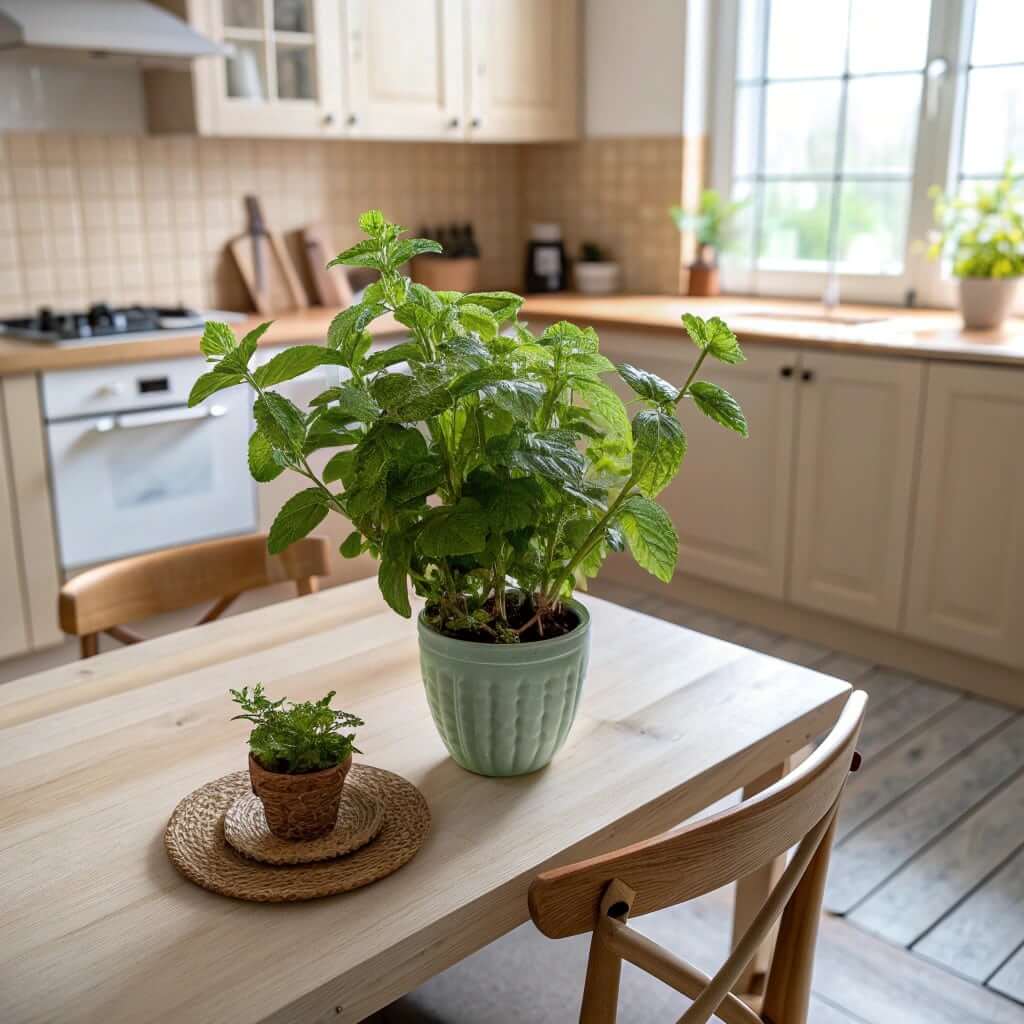
The plant is perennial and rhizomatous, growing 30–90 cm tall. The stems are smooth and square, and the broad 4–9 cm leaves have reddish-violet veins and serrated edges. The flowers are purple and sit in dense spikes that bloom in midsummer. Peppermint is almost sterile, rarely sets seed, and propagates mainly vegetatively via underground runners. This makes it easy to grow, but also invasive if not kept in check. In Denmark, it is grown as a perennial and copes well with winter, especially in light, moist soil.
From English Field to Danish Monastery Garden
Peppermint as a hybrid was first identified in Hertfordshire, England, in the late 1600s, where Dr. Eales described the plant, and it was included in the London Pharmacopoeia in 1721. Carl von Linné named it Mentha piperita in 1753. Commercial cultivation gained momentum shortly after, particularly in Bavaria and Thuringia, where it was grown for pharmaceutical use. In Denmark, peppermint has traditionally held a place in monastery and apothecary gardens as a medicinal plant, known for relieving digestive troubles and headaches in tea or as a tincture. Today it is found in many gardens and pots, where it serves as both an ornamental and a useful plant.
Flavour and Aroma
Peppermint has a fresh, cooling and slightly sweet flavour with a distinct menthol note. The cooling sensation comes from menthol, which affects the body’s cold receptors, and it is precisely this effect that makes peppermint so refreshing in both tea and drinks. The flavour is stronger and more medicinal than the soft, sweet spearmint, so it should be dosed thoughtfully – too much can quickly dominate a dish.
The flavour pairs especially well with:
- Lamb, poultry and pork
- Chocolate, cocoa and coffee
- Citrus fruits such as lemon, lime and orange
- Fresh berries and melon
- Carrots, peas and cucumber
- Yoghurt, cream and honey
Culinary Uses
Peppermint’s aromatic oils are best released in hot liquids, but the leaves can also be used fresh, where they add a crisp and refreshing element. Add them towards the end of cooking so the aroma doesn’t evaporate.
In Danish Cuisine
In Danish cuisine, peppermint is especially known as a flavouring in tea, sweets and mint jelly for lamb. The fresh herb is also sprinkled over fruit salads, mixed into skyr or yoghurt, and used in desserts together with chocolate and berries.
Internationally
Internationally, peppermint plays a major role. In the Middle East and Mediterranean cuisine, mint appears in tabbouleh, in yoghurt sauces and as an accompaniment to grilled lamb, where its fresh coolness cuts through the rich meat. In cocktails it is indispensable – a Mojito is built on crushed leaves, sugar and lime – and in confectionery we find it in everything from pastilles to mint chocolate. Special cultivars such as ‘Chocolate Mint’ and ‘Candymint’ each have their own nuances of aroma.
How to Use Peppermint
Avoid overdosing – too much peppermint can taste medicinal and dominate the dish. Add fresh leaves late in the cooking process, and let whole sprigs steep in hot drinks rather than boiling them. A few ideas:
- Add fresh peppermint sprigs to a mug of boiling water for a soothing tea
- Make mint jelly as an accompaniment to lamb or grilled meat
- Mix chopped leaves into salads, fruit salads or couscous as in tabbouleh
- Crush leaves with sugar and lime for a classic Mojito
- Use peppermint in ice cream, sorbet, or together with chocolate in homemade confectionery
- Stir together a mint sauce with yoghurt and cucumber for fried fish
- Infuse oil or vinegar with peppermint for marinades and dressings
Health Benefits
The following is general knowledge about the plant’s constituents and not medical advice.
Essential Oils
Peppermint is rich in essential oils such as menthol, menthone, menthofuran and 1,8-cineole. It is precisely these compounds that give it its characteristic scent and a traditionally attributed antispasmodic and digestion-promoting effect. The German Commission E once assessed peppermint tea favourably for gastrointestinal cramps and complaints of the gallbladder and bile ducts.
- Menthol and menthone – provide the cooling aroma
- Menthofuran and 1,8-cineole – contribute to the scent profile
- Antioxidants and flavonoids from the mint family
Traditional Use and Caution
Traditionally, peppermint is used to relieve digestive troubles, headaches and nausea, and modern research suggests that peppermint oil may have a short-term effect on irritable bowel syndrome. High doses can, however, cause heartburn or irritation. Peppermint oil is highly concentrated: infants and young children should not be treated with the pure oil. Always seek medical advice for serious or persistent symptoms, and consider peppermint first and foremost as a delicious spice.
Growing
Peppermint is easy to grow but requires management, because it spreads aggressively via underground roots. Plant it in pots or buried containers without a bottom to keep it in place.
Growing Conditions
- Light: full sun to partial shade; the flavour is strongest in sun
- Soil: moist, nutrient-rich and well-drained to avoid root rot
- Watering: regular, especially during warm periods, but avoid standing water
- Hardiness: fully hardy in Denmark and tolerates down to around -20 °C
- Position: pots or buried buckets without a bottom limit the spread
How to Propagate and Grow Peppermint
Total time: 8-14 days
- Propagation
Sow indoors from March to April, or take cuttings and divide the root network for a quicker result. Cover the seeds lightly with soil, water carefully, and keep the pot moist. Germination takes 8-14 days.
- Dividing
Bought plants are often densely packed. Divide them into smaller sections and plant in larger pots with fresh soil to promote vigorous growth.
- Planting out
Plant out after the last frost, typically mid-May, in a sunny to partially shaded spot in moist, well-drained soil. Keep 40-50 cm apart, or plant in large pots to limit spreading.
- Watering and Fertilising
Keep the soil moist and water regularly, especially during warm periods, but avoid standing water. Fertilise sparingly with organic fertiliser if growth is slow.
- Pruning and Control
Prune regularly for bushy growth, and remove flower buds early if you want leaves rather than flowers. Restrict the roots with buried containers.
- Overwintering
The plant is fully hardy in Denmark and returns every year. Cover the root network lightly with compost or leaves in harsh winters, and place pots in a sheltered spot.
Storage
Harvest leaves and top shoots just before flowering for the strongest aroma. Cut in the morning once the dew has gone – the best flavour is achieved from June to August. Don’t be afraid to cut the plant right back to 5–10 cm; it shoots up again quickly.
Fresh, Dried and Frozen
- For fresh use, rinse the leaves lightly and use them immediately
- For drying, tie small bunches and hang them in a shaded, airy spot, or dry them in a dehydrator at a low temperature
- Store dried leaves in airtight metal or porcelain containers rather than plastic, so the essential oils don’t evaporate
- The leaves can also be frozen chopped in ice cube trays with a little water, or in small bags
Look-Alikes and Quality
Possible Confusions
Peppermint is most often confused with spearmint (Mentha spicata). Spearmint has a milder, sweeter flavour, and its leaves sit closer to the main stem. Peppermint, on the other hand, has leaves on distinct little stalks and a far stronger menthol scent. Among the peppermints, black peppermint has darker, reddish-violet stems and a higher menthol content, while white peppermint is greener and milder. In short: if the herb smells and tastes sharp and cooling, it’s peppermint; if it’s soft and sweet, it’s spearmint.
Buying and Quality
Fresh peppermint is sold in pots and as cut sprigs year-round in Danish supermarkets. Choose plants with healthy, green leaves and a strong scent, and avoid yellow or wilted leaves. If you buy dried leaves, they should be stored hermetically sealed to preserve the oils – feel free to smell the bag to ensure a fresh aroma. Consider organically grown mint, where the scent and flavour are often more intense.
Sustainability and Biodiversity
Peppermint is a nectar-rich plant that attracts bees and butterflies during the flowering period. If you grow it yourself in the garden or on the balcony, you reduce the need for imported mint and avoid plastic packaging from the supermarket. The plant thrives on rainwater, so avoid overusing water, and use organic soil without peat where possible. Let a few plants flower for the pollinators’ sake, but harvest the rest regularly to keep the spread in check – surplus plants can easily be divided and passed on.
Try This Recipe
Peppermint’s fresh, cooling bite is tailor-made for grilled meat from the Mediterranean, where it’s often stirred into a cool yoghurt sauce on the side. Stir a handful of freshly chopped mint into a yoghurt dip for our Air Fryer Souvlaki – Juicy Greek Chicken Skewers with Crispy Edges, so the mint cuts through the spiced meat and lifts the whole dish.
Equipment and Products
The combination of peppermint and dark chocolate is a classic – the coolness of the menthol plays beautifully against the bitterness of the cocoa. If you want to taste the pairing without moulding confectionery yourself, our Chocolate Sticks in Dark Chocolate – 44g is an obvious choice alongside a couple of fresh mint sprigs and a cup of tea.
Frequently Asked Questions
Yes. Peppermint is fully hardy in Denmark and returns every year. Cover the root network lightly in cold winters.
It prefers sun, but also copes with partial shade. In shade, the flavour becomes milder and growth weaker.
Culinary amounts are typically unproblematic. High doses of peppermint oil can irritate the stomach or cause heartburn. Pregnant women should limit their intake of strong extracts and seek medical advice if in doubt.
Plant it in large pots or a buried container without a bottom. Prune regularly and remove runners.
Harvest leaves just before flowering, from June to August, and use them fresh or dry them immediately.
Facts About Peppermint
| Field | Value |
|---|---|
| English name | Peppermint |
| Latin name | Mentha × piperita |
| Family | Mint family (Lamiaceae) |
| Plant type | Perennial, rhizomatous |
| Height | 30–90 cm |
| Hardiness | Fully hardy in Denmark |
| Light | Full sun to partial shade |
| Soil | Moist, nutrient-rich, well-drained |
| Sow/plant | Sow indoors March–April; plant out in May |
| Flowering | July–August |
| Harvest | June–August, before full flowering |
| Flavour | Cooling, sweet, menthol |
| Culinary use | Tea, jelly, cocktails, salads, desserts |
| Storage | Dry in airtight containers; freeze chopped leaves |
