

Red onion is the red-purple form of the common onion, Allium cepa, and it’s the one I reach for most often when an onion is going to be eaten raw. The flavor is milder than that of yellow onions, the color is beautiful, and a few thin rings can lift anything from a green salad to a slice of smørrebrød, the Danish open-faced sandwich.
I use red onion in three ways: raw in salads, as quick-pickled red onions for burgers and grilled food, and roasted in wedges in the air fryer, where they turn sweet and soft. In this entry you’ll get the history behind the onion, its flavor, how to grow it, how to store it, and my best tips for using red onion in everyday cooking.
One important detail from the start: red onion is not the same as shallot. Shallots grow in clusters, while the red onion grows as a single bulb, just like the yellow onion you know from everyday cooking.
Estimated reading time: 6 minutes
History and origins
One of the oldest cultivated plants
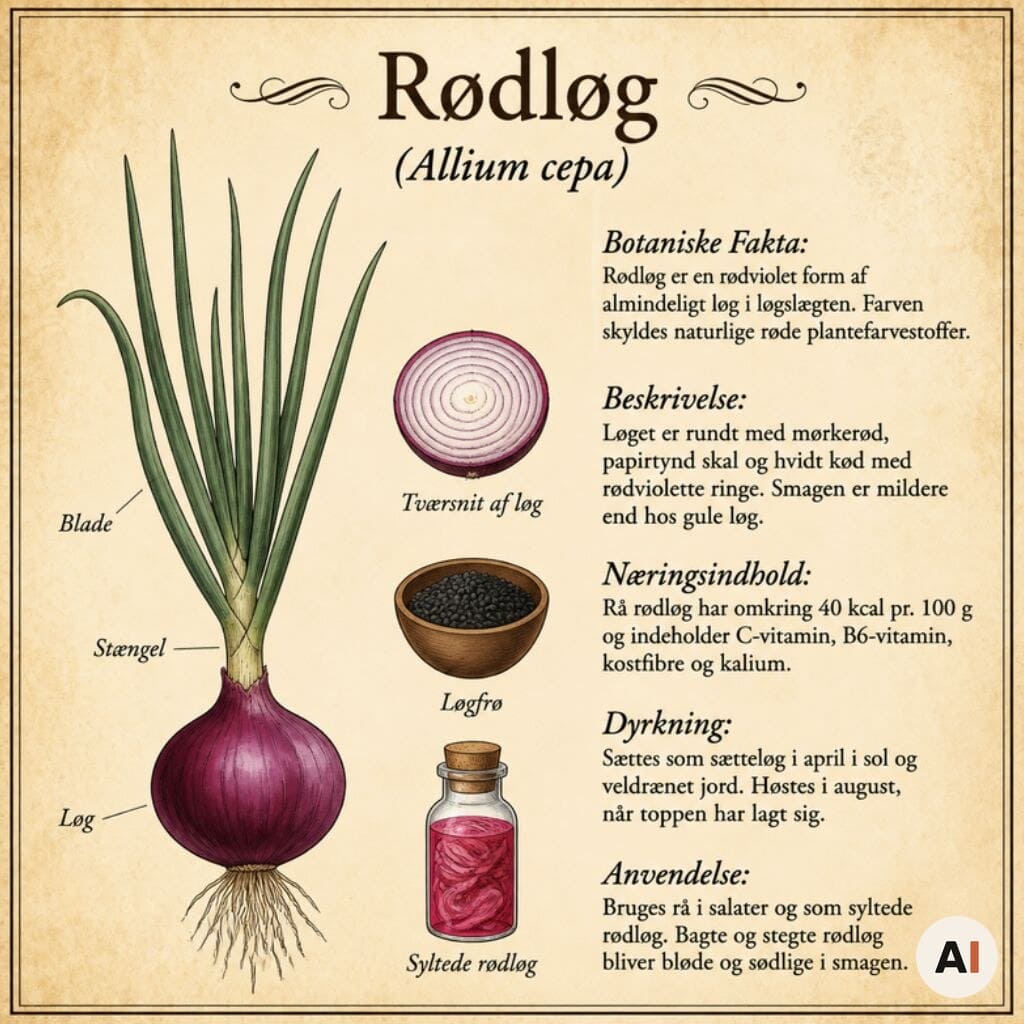
Onions are believed to originate in Central Asia and are a very old cultivated plant. Onions have been cultivated for food since around 3000 BC, which says something about how closely the onion has followed people through thousands of years.
Red onion is not a separate species, but a red form of the same onion as the yellow one. Botanically, the onion belongs to the amaryllis family (Amaryllidaceae), subfamily Allioideae, where you’ll also find garlic and leeks.
Kepa onions, Zittau onions and well-known varieties
Red onions are the red kepa onions (kepaløg in Danish), while the yellow ones are called Zittau onions (zittauerløg). It’s useful to know the two names when you buy onion sets for the vegetable garden.
Two varieties are particularly worth knowing: Red Baron, which keeps well in storage, and the Italian Tropea, Cipolla Rossa di Tropea. Tropea is a well-known local variety that in Italy is both eaten raw and cooked into jam.
Flavor and aroma
Milder than yellow onions
Red onion has a milder flavor than yellow onions. The fresh onion bite is still there, but it is more rounded, which is why red onion works so well raw. Cut into thin rings or fine dice, it adds crunch and flavor without taking over.
When you cut the onion, sulfur compounds are released, and they are what irritate the eyes. I always use a sharp knife, because it crushes fewer cells than a dull one, and then I finish cutting the onion quickly.
Sweetness when the onion is heated
When red onion is roasted or baked, the sharpness disappears and the sweetness comes forward. The edges caramelize, and the onion becomes soft and almost jam-like in the middle. That is exactly why red onion wedges make such a good side dish from the air fryer.
Tangy and crisp when pickled
Quick-pickled red onions are a third flavor experience altogether. They become tangy, slightly sweet and still crisp, and the color turns a vivid pink as the brine soaks in. A small bowl of pickled red onions in the fridge makes everyday food a little more festive.
Culinary uses
Red onion is one of the most versatile onions in the kitchen, because it can be used raw, pickled and hot. Here are the ways I use it myself, and some of the dishes where red onion plays the leading role.
In Danish cooking
In Denmark, you’ll most often meet red onion raw, in thin rings or diced, on marinated herring, on smørrebrød and in salads. The mild flavor and the beautiful color make it a garnish that has real flavor too.
Pickled red onions have become a staple in many Danish kitchens. They are quick-pickled in vinegar, sugar and water and served as an accompaniment to smørrebrød, burgers and grilled food.
- Marinated herring: raw red onion in thin rings on top.
- Smørrebrød: raw or pickled red onion adds freshness and color.
- Burgers and grilled food: quick-pickled red onion cuts through the richness.
- Salads: finely sliced red onion adds crunch and a mild onion flavor.
- Side dishes: roasted or baked red onion wedges from the oven or air fryer.
Internationally
Outside Denmark, red onion plays a big role in several cuisines. Here are three classics that I have drawn inspiration from myself:
- Italy: Tropea red onions are eaten raw and cooked into jam.
- Peru: thinly sliced red onion in ceviche and salsa criolla.
- Mexico (Yucatán): cebollas encurtidas, meaning pickled red onions, served with dishes such as cochinita pibil.
In the air fryer
In the air fryer, red onion wedges turn into a sweet and lightly caramelized side dish. I cut the onion into wedges so the root end holds the layers together, toss them in a little oil and salt and roast them until the edges are brown and the middle is soft. Remember to shake the basket along the way so they brown evenly.
Red onion is also a classic part of fajitas and grilled skewers, where it roasts together with bell pepper and meat. Here it adds color, sweetness and a lovely contrast to the spicy flavors.
Health benefits
Nutritional content per 100 g
Onion is a light vegetable with a high water content that also contributes dietary fiber and minerals such as potassium. The figures below apply to 100 g of raw onion:
- Energy: 124 kJ (30 kcal)
- Carbohydrates: 4.4 g, of which sugars 4.4 g
- Dietary fiber: 4 g
- Protein: 1 g
- Fat: 0 g
- Water: 91 g
- Potassium: 185 mg
- Phosphorus: 30 mg
- Calcium: 19 mg
Fructans and a sensitive stomach
Onions contain fructans, which belong to the so-called FODMAPs. They can cause stomach problems in people with irritable bowel syndrome, so if you have a sensitive stomach, it is a good idea to pay attention to how much onion agrees with you.
Good to know
Onions are toxic to dogs and cats, so never give your pet leftovers containing onion. Onion is not an allergen that must be declared on food labels in the EU, and true onion allergy is rare.
Growing
Growing conditions
Red onion is easiest to grow from onion sets, because growing from seed is unreliable. Onions are not particularly nutrient-hungry, so you don’t need the richest soil in the garden to get a good harvest. Here is what they need:
- Light: full sun.
- Soil: preferably soil with a fairly high pH.
- Fertilizer: go easy on nitrogen, since too much increases the risk of mold and onion gray mold.
- Water: the soil must never become bone dry during the growing season.
- Spacing: 8–10 cm between the onions, e.g. 5 rows in a 125 cm wide bed.
How to plant onion sets
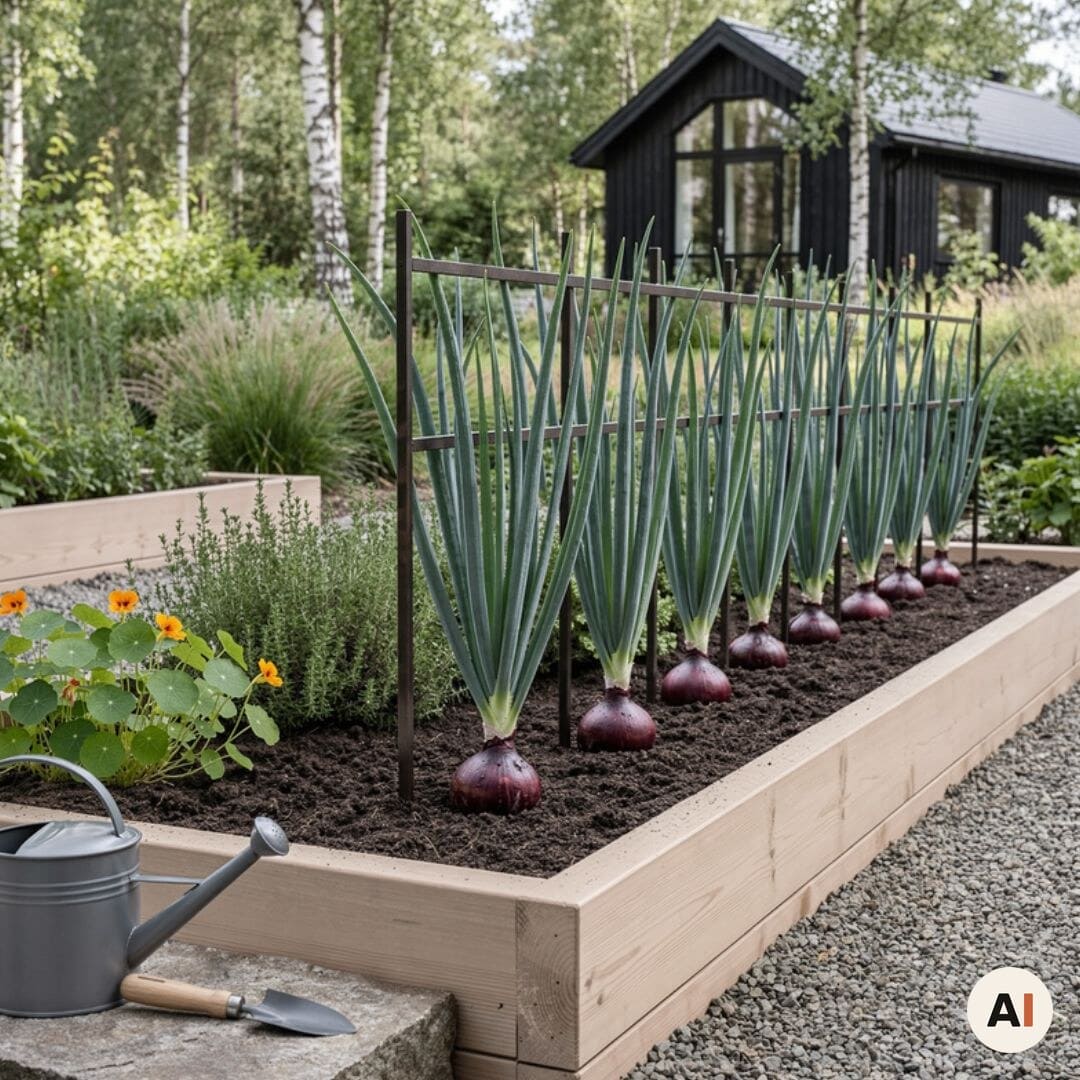
The onion sets are planted in April, as soon as the soil is workable, with the top end level with the soil surface. They are harvested in late summer, and here are the steps from bed to storage:
Total time: 4-5 months
- Prepare the bed
Choose a bed in full sun with soil that has a fairly high pH. Don’t fertilize too heavily, since too much nitrogen increases the risk of mold and onion gray mold.
- Plant the onion sets
Plant the onion sets in April, as soon as the soil is workable. The top end should be level with the soil surface, and there should be 8-10 cm between the onions.
- Water and weed
Keep the soil evenly moist so it never becomes bone dry during the growing season, and keep the bed free of weeds.
- Harvest the onions
Lift the onions in August-September, when the onion stalks begin to go limp. Don’t wait until the tops have withered all the way down.
- Dry the onions
Dry the onions hanging in a dry, airy place before they go into storage.
Season
In the Nordic countries, field-grown red onions are harvested in August–September. As storage onions and imports, red onions are available all year round, so you can use them in the kitchen in every season.
Storage
Whole onions
Whole red onions should be stored cool, dry, dark and airy. Don’t put them in a plastic bag, because the onions need to be able to breathe, otherwise they keep less well.
Home-grown onions
If you have grown your own red onions, dry them hanging in a dry, airy place. Once they are dry, they can hang in the shed or carport, even in frosty weather. The Red Baron variety is known for keeping well.
Cut onions
Cover half a red onion and put it in the fridge. Use it quickly, so the flavor and crispness are at their best. Here are my go-to rules:
- Whole onions: cool, dry, dark and airy.
- No plastic bag: the onions need to breathe.
- Cut onions: cover and refrigerate, and use quickly.
- Home-grown onions: dry them hanging up, after which they can hang in a shed or carport, even in frosty weather.
Try this recipe
Red onion is one of the vegetables that gains the most from the air fryer’s dry heat, because the edges caramelize while the middle turns sweet and soft. Try our recipe for Chicken fajitas in the air fryer – roasted edges without a skillet. I always cut a large red onion into wedges and let it roast along in the basket, because it adds color and a mild sweetness. Serve some quick-pickled red onion on the side, and you get both the soft and the crisp.
Frequently asked questions
Red onion is a red-purple form of the common onion and has a milder flavor than yellow onions. That is why red onions are especially good raw in salads, on smørrebrød and as pickled red onions.
No. Red onion is a red form of the common onion, while shallots grow in clusters. They can often be used in the same way in the kitchen, but they are not the same onion.
Yes. Cut the red onion into wedges, toss them in a little oil and salt, and roast them in the air fryer until the edges are brown and the middle is soft. Then they turn sweet and work as a side dish for meat, fish and vegetables alike.
Whole red onions are stored cool, dry, dark and airy, but not in a plastic bag. Cut red onions are covered and placed in the fridge, and then they should be used quickly.
Cut red onion into thin slices and quick-pickle them in a brine of vinegar, sugar and water. Pickled red onions are a fresh and tangy accompaniment to smørrebrød, burgers and grilled food.
Facts about red onion
| Property | Value |
|---|---|
| English name | Red onion |
| Latin name | Allium cepa |
| Family | Amaryllis family (Amaryllidaceae), subfamily Allioideae |
| Plant type | Bulb plant – the red kepa onions (kepaløg) |
| Well-known varieties | Red Baron, Tropea (Cipolla Rossa di Tropea) |
| Light | Full sun |
| Soil | Not particularly nutrient-hungry, preferably a fairly high pH |
| Planting | Onion sets are planted in April, 8–10 cm apart |
| Harvest | August–September |
| Calories per 100 g | 30 kcal (raw onion) |
| Flavor | Milder than yellow onions, sweet when roasted |
| Culinary use | Raw in salads and on smørrebrød, pickled, roasted in the air fryer |
| Storage | Cool, dry, dark and airy – not in a plastic bag |
| Season | All year round as storage onions and imports |
