

Shallots are the small, elegant relatives of the ordinary yellow onion. They are milder, more aromatic and a touch sweeter, and they grow in a special way: a single planting bulb (a set) divides over the summer into a whole cluster of side bulbs. Botanically they are called Allium cepa var. aggregatum, which makes them the same species as the everyday cooking onion.
I love having a bag of shallots in the kitchen. Finely chopped, they melt into a sauce or a dressing and give a soft onion flavour without the sharp edge, and roasted whole in the air fryer they turn soft, sweet and lightly caramelised. They are small, so they fit perfectly in the air fryer basket.
Here you get the history, the flavour, the culinary uses, the nutritional content, how to grow them and how to store them – and a recipe where shallots really come into their own.
Estimated reading time: 6 minutes
History and origin
Name and origin
The name “shallot” has travelled a long way. It comes via Old French eschalotte from Latin Ascalōnia caepa, meaning “onion from Ascalon” – named after the ancient city of Ascalon. The connection lives on in the older botanical name Allium ascalonicum.
The plant itself originates in Asia and belongs to the amaryllis family (Amaryllidaceae) and the onion genus (Allium). The closely related French grey shallot, Allium oschaninii, which the French call griselle, still grows wild from Central Asia to Southwest Asia.
An old cultivated plant in Denmark
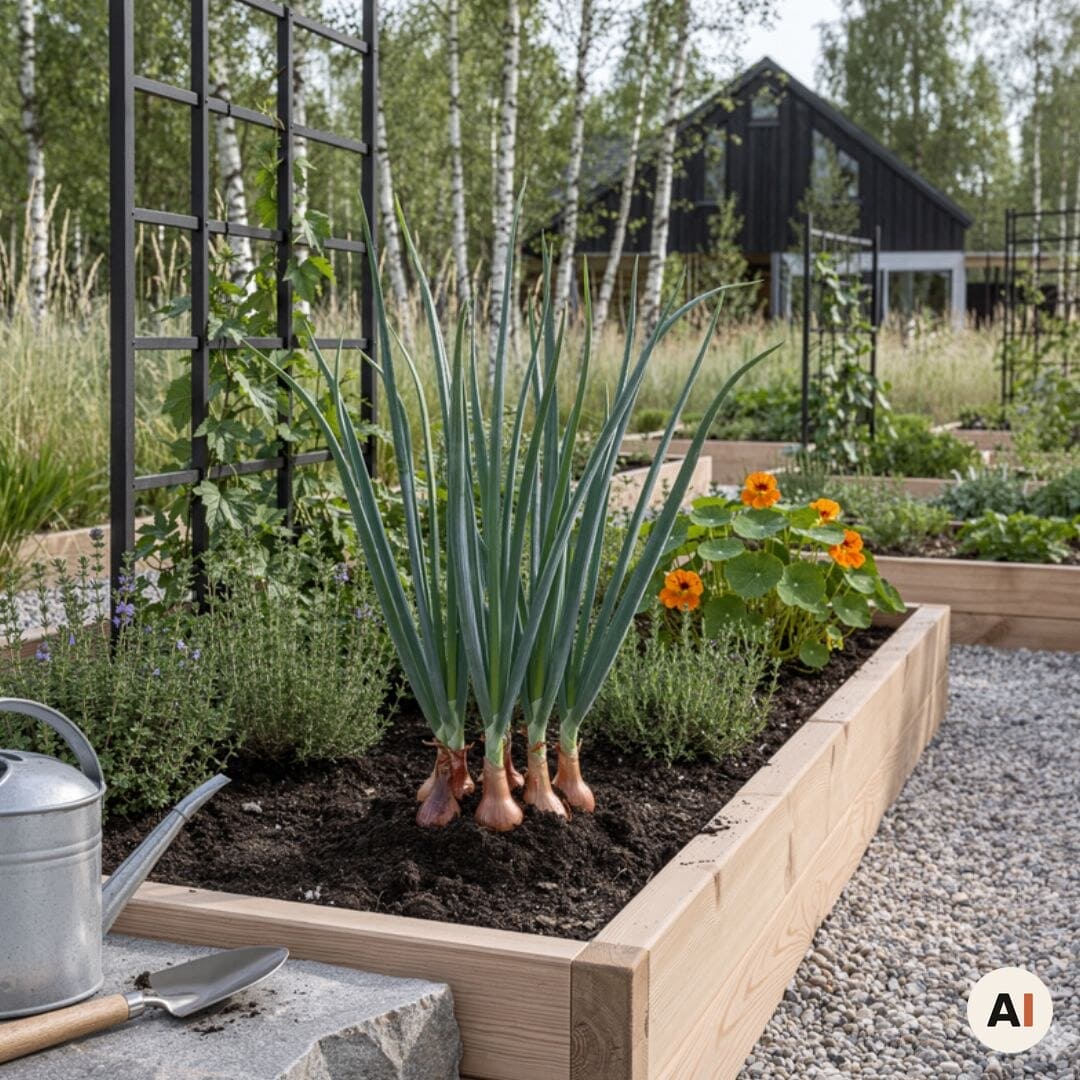
Shallots are not a new trend in Denmark but an old cultivated plant, and the local strains are taken seriously. In 2001, Danmarks JordbrugsForskning (the Danish Institute of Agricultural Sciences) collected 28 onion samples from Danish plantings – among them the so-called Læsø strain – and 25 of them are preserved today as part of Denmark’s plant heritage.
Varieties you may come across
There are many varieties, including yellow ones such as Golden Gourmet and Dutch Yellow, red ones such as Red Sun and French Red Shallot, and elongated ones such as Zébrune and Chicken Leg Shallot. Griselle is the French grey shallot, and the Læsø strain is Denmark’s very own strain, well worth preserving.
Flavour and aroma
Mild, sweet and aromatic
Where an ordinary yellow onion can be sharp and biting, shallots are more subdued. The flavour is mild and aromatic with a distinct sweetness, and even raw shallots in a vinaigrette are far gentler than a regular onion.
That is why they are classically used finely chopped in sauces and dressings, where they add depth without taking over.
How the flavour changes with heat
When shallots are sautéed or roasted, the sweetness becomes even more pronounced. Slow, gentle heat makes them soft and caramelised, while thin slices at a higher heat turn crisp and golden – just like the crispy fried shallots known from Indonesian cooking.
Get ready for a few tears: when you cut raw shallots, they release compounds that irritate the eyes and make them water. I always use my sharpest knife so it goes quickly.
Culinary uses
In European cooking
Shallots are best known from béarnaise sauce, where they are finely chopped and reduced with vinegar and tarragon before the butter is whisked in. They are also used in many other sauces, and pickled shallots are a classic accompaniment to a roast.
In everyday cooking, I use them as a milder, sweeter alternative to ordinary yellow onions – especially when the onion is to be eaten raw or only just warmed through.
Around the world
Elsewhere in the world, shallots play an even bigger role, especially in Southeast Asia, Iran, India and Sri Lanka. Here are some of the classic dishes where they are absolutely central:
- Béarnaise sauce: finely chopped shallots in the vinegar reduction are the very foundation.
- Bawang goreng: thinly sliced, crispy fried shallots from Indonesia and Southeast Asia, sprinkled over rice porridge and fried rice dishes.
- Iranian classics: grated shallot stirred into thick yoghurt as an accompaniment to grilled dishes and kebabs – and pickled shallots as torshi.
- Sambar: an Indian lentil stew with small shallots, which are also used in many curries.
- Pol sambol and lunu miris: spicy side dishes from Sri Lanka made with shallots and chilli.
In the air fryer
The air fryer is tailor-made for shallots. I peel them, toss them whole in a little oil and salt, and halve only the very largest. In the basket they turn soft and sweet inside and lightly caramelised on the outside – perfect alongside a steak, chicken or a tray of root vegetables.
I also make crispy shallots in the air fryer: thin rings tossed in a touch of oil and cooked at a moderate temperature while the basket is shaken regularly. Keep an eye on them towards the end – they go from golden to burnt quickly.
Health benefits
Nutritional content
Shallots are used in small amounts, so they are first and foremost a flavouring. Even so, they contribute a little of everything. Here is the content per 100 g of raw shallots:
- Energy: 24 kcal (100 kJ)
- Protein: 1.5 g
- Fat: 0.2 g
- Carbohydrate: 3.3 g
- Dietary fibre: 1.0 g
- Vitamin C: 13 mg
- Vitamin B6: 0.2 mg
- Folate: 17 µg
- Vitamin E: 0.3 mg
Good to know
Shallots are high in fructans (FODMAPs), which can cause digestive problems if you have irritable bowel syndrome. They are not among the EU’s main allergens that must be declared.
Keep them away from dogs and cats
Like other species in the onion genus, shallots are toxic to dogs and cats. So never give your pet leftovers containing onion – not even when the onions are cooked.
Growing
Growing conditions
Shallots are one of the easiest crops in the vegetable garden. You plant a single set in spring, and over the summer it divides into a whole cluster of new bulbs.
- Light: a sunny spot.
- Soil: loose, crumbly, light soil.
- Fertiliser: never fresh manure.
- Watering: water during dry spells, because the root system is very shallow.
- Spacing: 12–15 cm between the bulbs in the row.
From set to harvest
In the Nordic climate, the sets go into the ground in April, once the risk of frost has passed, and the harvest falls in July–August. Save some of the finest bulbs from the harvest – then you will have your own sets for next spring.
Total time: 3-4 months
- Prepare the soil
Choose a sunny spot with loose, crumbly, light soil. Do not fertilise with fresh manure.
- Plant the sets
Plant the bulbs in April, once the risk of frost has passed, with the tip just visible at the soil surface and 12–15 cm between the bulbs in the row.
- Water and care
Water during dry spells, as the root system is very shallow, and keep the bed free of weeds.
- Harvest
Lift the bulbs when the tops begin to fall over and the roots loosen their grip – typically in July–August.
- Dry the bulbs
Hang the bulbs in a cool, dry place and let the skins dry completely before you put them into storage.
Storage
Whole and dry shallots
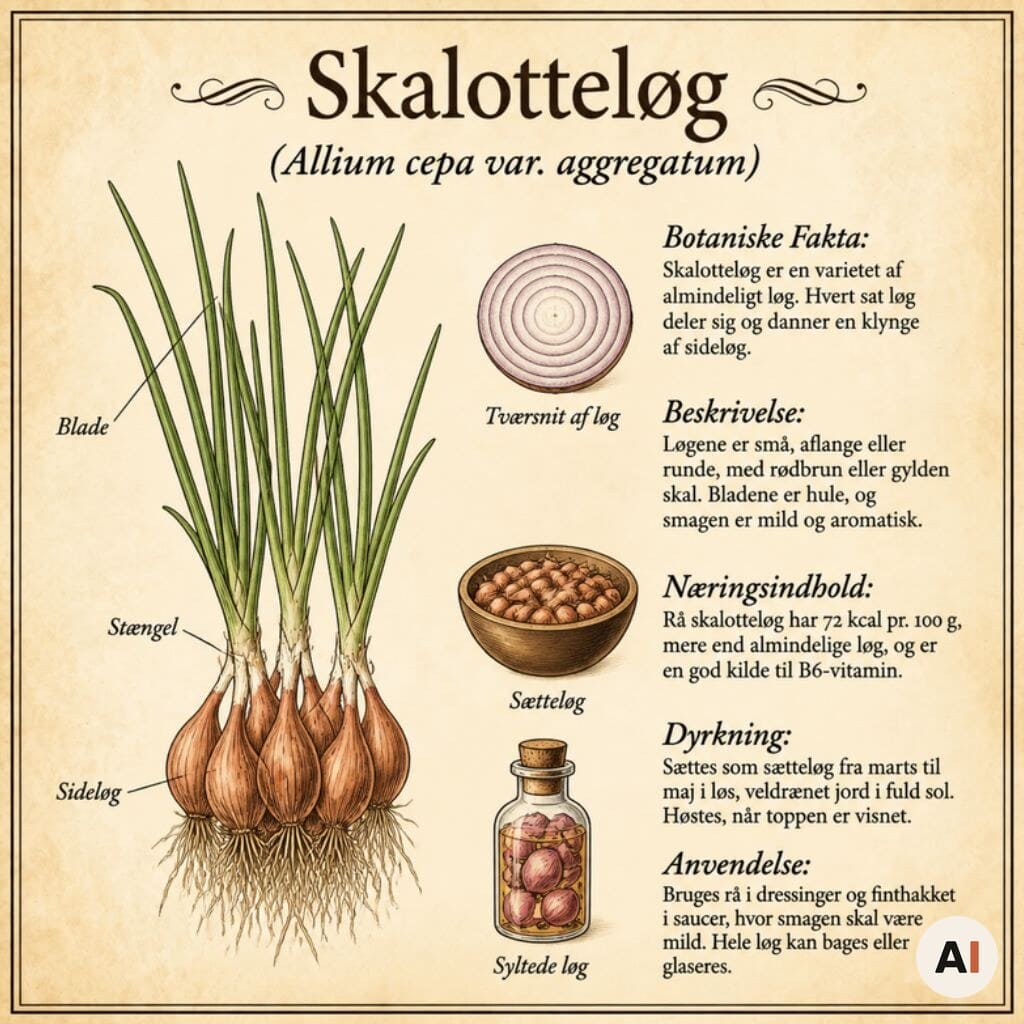
Shallots keep for a long time if they have been properly dried. Whole, dry bulbs can keep for six months or longer.
- Dry them well: freshly lifted bulbs should hang in a cool, dry place before they go into storage.
- Cool and dry: 0–4 °C and 60–70% relative humidity give the longest shelf life.
- Whole bulbs keep best: leave the bulbs together, and peel them only when you are going to use them.
- Air around them: use a mesh or paper bag rather than plastic, so moisture does not build up.
In the kitchen
At home, my shallots sit in a mesh bag in a cool, dark, dry place. If half a shallot is left over, I wrap it up, put it in the fridge and use it quickly.
If you have a lot of shallots, pickling is a classic way to preserve them. Sweet-and-sour pickled shallots go well with a roast and on a cold buffet.
Try this recipe
Shallots are onions in their mildest and sweetest form, which is why they work especially well in a dish where the onions play the leading role. Try our recipe for Onion Tart in the Air Fryer – I like to swap some of the regular onions for shallots. The filling becomes milder and a touch sweeter, and the tart gets a softer, rounder onion flavour.
Frequently asked questions
Shallots are smaller, milder and sweeter than ordinary yellow onions and have a more aromatic flavour. They grow in clusters, where a single set divides into several new bulbs.
Classically, they are used finely chopped in béarnaise sauce, other sauces and dressings. They can also be pickled, roasted whole in the air fryer or fried crisp as a topping.
Yes. Peel the shallots, toss them in a little oil and salt, and halve only the very largest. Roast them until they are soft inside and lightly caramelised on the outside, and shake the basket a couple of times along the way.
Whole, dry shallots should be stored in a cool, dry place. At 0–4 °C and 60–70% relative humidity, they can keep for six months or longer.
Yes. Like other species in the onion genus, shallots are toxic to dogs and cats, so never give your pet leftovers containing onion.
Facts about shallots
| Property | Value |
|---|---|
| English name | Shallot |
| Latin name | Allium cepa var. aggregatum (syn. Allium ascalonicum) |
| Family | Amaryllis family (Amaryllidaceae) |
| Plant type | Bulb plant that forms a cluster of side bulbs; grown from sets |
| Light | Sunny spot |
| Soil | Loose, crumbly, light soil without fresh manure |
| Planting | Sets are planted in April with 12–15 cm between the bulbs |
| Harvest | July–August, when the tops fall over |
| Calories per 100 g | 24 kcal (raw) |
| Flavour | Mild, aromatic and slightly sweet |
| Culinary use | Sauces, dressings, pickling and roasted whole in the air fryer |
| Storage | Cool and dry at 0–4 °C and 60–70% relative humidity for six months or longer |
