

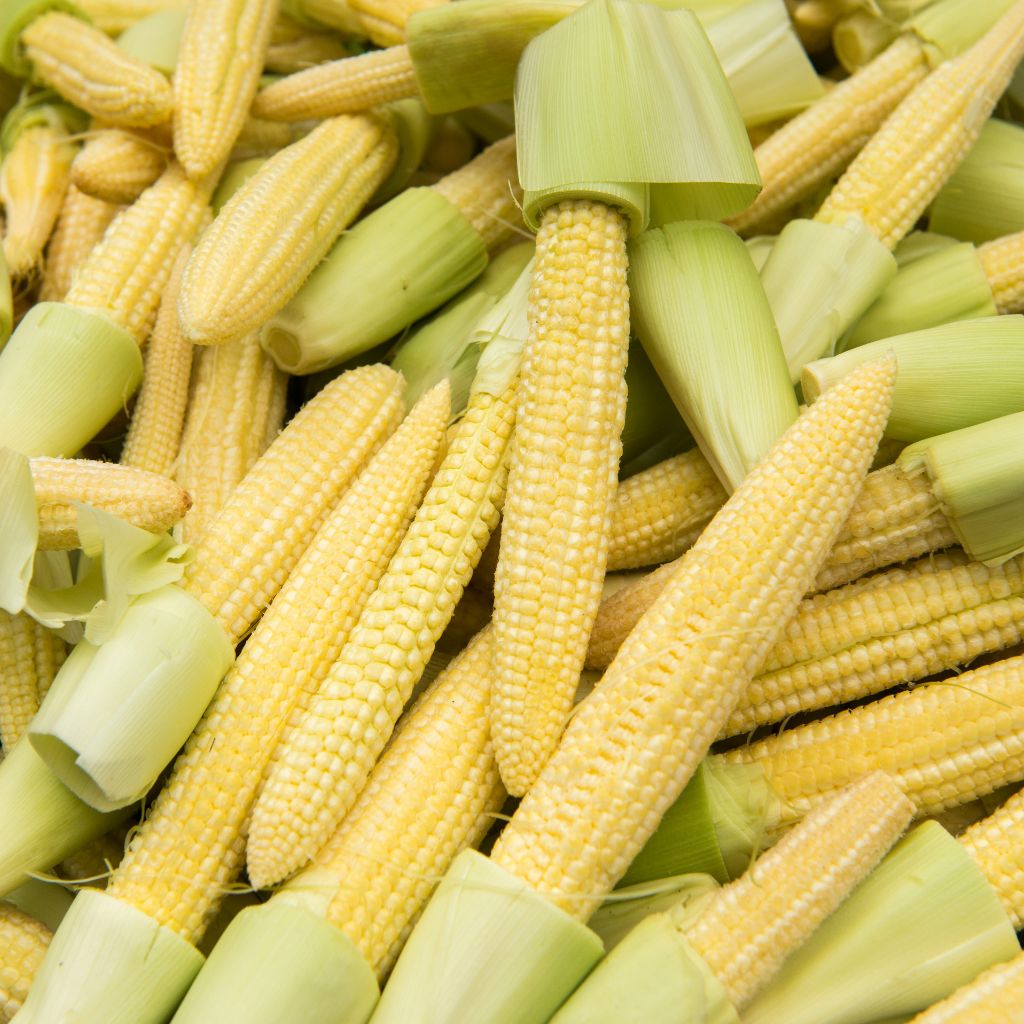
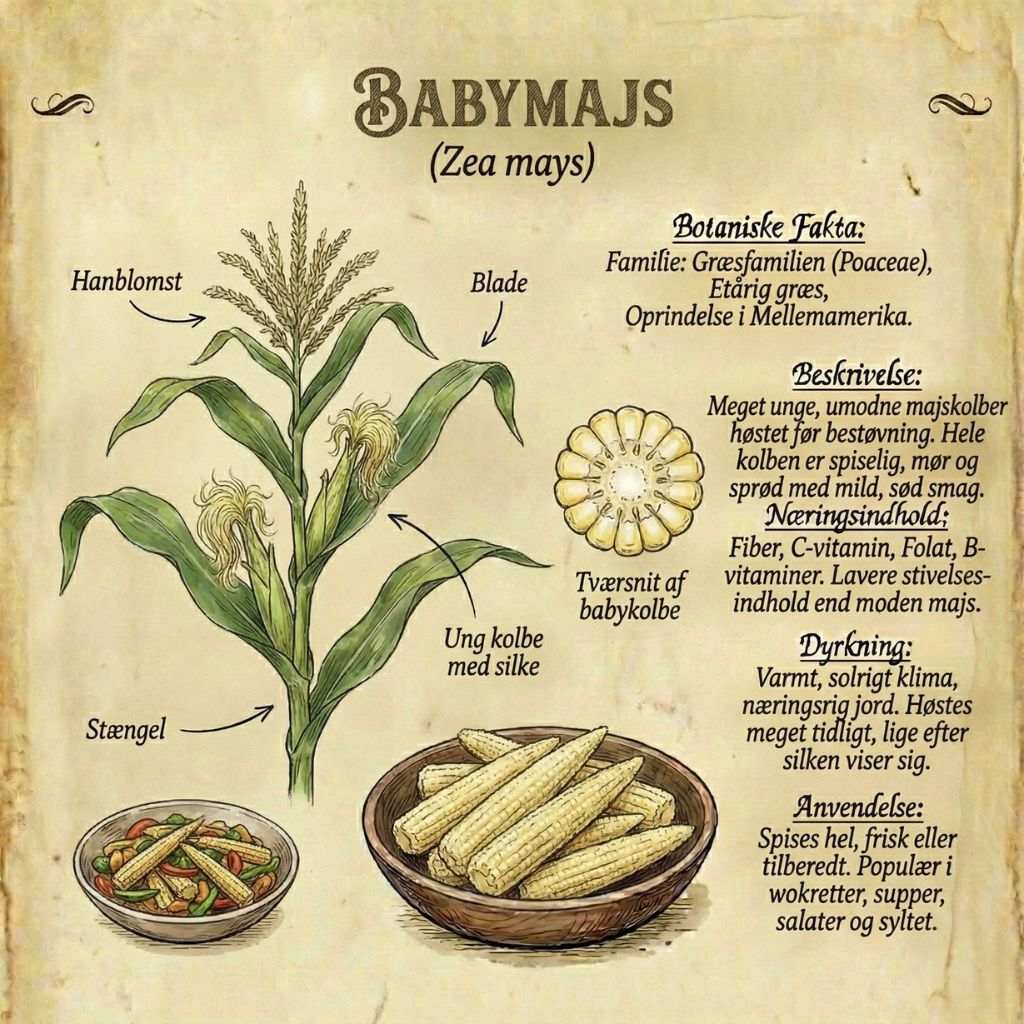
Baby corn is the miniature version of an ordinary corn cob (Zea mays), harvested before the plant is pollinated and before the kernels develop. These small cobs, 2–4 cm long and 1–2 cm in diameter, are eaten whole, including the tender, crunchy tip.

Advertisement: The page displays ads and contains advertising links (affiliate links). See our advertisers here.
Baby corn is therefore not a special species, but ordinary corn picked at a very young stage. This gives it a mild, slightly sweet flavor, a crunchy texture and a high water content. In Denmark, baby corn has become popular in recent decades, especially in Asian dishes, salads and as a garnish for grilled food.
Estimated reading time: 7 minutes
History and Origin
The origins of corn cultivation can be traced to Mesoamerica, where indigenous peoples bred the grass into the cobs we know today. The practice of harvesting the cobs very early – “baby corn” – is believed to have originated in Southeast Asia, where small, whole cobs fit perfectly into wok dishes and pickled specialties.
Today, baby corn is produced mainly in China, Thailand, India and Taiwan, from where it is exported both fresh and canned. Eaten fresh, it retains its slightly sweet flavor and crunch; the canned variety has a softer texture. Most of the baby corn in Europe is imported, but interested gardeners can also grow it themselves.
Flavor and Aroma
Baby corn has a mild, vegetal flavor reminiscent of young snap peas, with a hint of nuttiness and sweetness. The texture is crunchy – the whole cob, including the core, is edible because the kernels haven’t yet turned starchy. The mild flavor means baby corn doesn’t dominate other ingredients in a dish, but instead adds crunch and texture.
Culinary Uses
Baby corn is versatile and has a short cooking time; steaming or blanching for 2–5 minutes makes the cobs tender, after which they can be added to a dish. Overcooking makes them limp, especially if they’re already canned.
In the Danish Kitchen
- Salads and raw snacks: The small cobs can be eaten raw; cut them into pieces in green salads or serve them whole as a snack with dip.
- Grill and oven: Grill the cobs briefly or bake them with oil and spices, such as garlic and chili.
- Soups and stews: Add them in the last few minutes of cooking so they keep their bite.
- Pickling: Baby corn pickled in vinegar or brine adds tangy crunch to tapas and sandwiches.
Internationally
Baby corn is a classic ingredient in Asian cuisines – in Chinese and Thai wok dishes and stir-fries, in curries, masala, ramen, and as a topping on sushi and noodle bowls. The small cobs are also used in South and Central American stews, as well as in Western fusion cuisine, where they’re eaten raw, pickled, deep-fried as finger food, or grilled on skewers.
Preparation Methods
Fresh baby corn is often sold with its husk. Remove the green outer leaves and the fine silk threads, and rinse the cobs in cold water – there’s no need to peel anything further. If using canned baby corn, simply drain and rinse to remove excess brine.
- Boiling and blanching: Place the cobs in lightly salted, boiling water for 2–3 minutes, until just tender, and transfer them immediately to cold water to stop the cooking.
- Steaming: Steam the cobs for 3–5 minutes; they’re done when the color shifts from pale yellow to a warmer yellow.
- Sautéing or grilling: Sauté them in oil or butter for 3–4 minutes, until lightly golden, or grill them on skewers for 4–5 minutes, turning as you go.
- Airfryer and wok: Baby corn cooks lightning-fast in the airfryer and wok, picking up a light color while keeping its bite.
After cooking, they can be seasoned with lemon juice, garlic, chili, soy or herbs. The small kernels absorb marinades and sauces well.
Nutrition and Health Aspects
Nutritionally, baby corn is relatively low in calories. A serving of about 110 g (0.5 cup) contains around 25 kcal, 1 g protein, 5 g carbohydrate, 3 g dietary fiber, 2 g sugar and virtually no fat. It’s made up of about 94.5% water, making baby corn a light vegetable that also fits calorie-conscious diets.
Vitamins and Minerals
Baby corn is a good source of folate and potassium. A serving of about 113 g provides around:
- Folate: about 31% of the recommended daily intake
- Vitamin C: about 17%
- Vitamin B6: about 14%
- Potassium: about 13%
- Dietary fiber: about 11%
- Riboflavin (B2): about 10%
The cobs also contain B vitamins such as thiamine and niacin, as well as small amounts of calcium, magnesium and iron. The fiber content supports digestion and contributes to satiety; folate is important for cell division and especially relevant during pregnancy; potassium regulates fluid balance and blood pressure; and vitamin C acts as an antioxidant. Baby corn is harvested so early that its content of antinutrients such as phytic acid and lectins is lower than in fully grown corn cobs. However, people with a corn allergy should avoid baby corn, and if you follow a low-sodium diet, be aware that canned baby corn is often packed in brine.
Growing and Harvesting in Denmark
Although baby corn is usually imported, it can easily be grown in a Danish kitchen garden. You can either sow a dedicated baby corn variety or harvest the lower cobs of an ordinary sweet corn plant early, letting the top cob ripen as sweet corn.
Growing Conditions
- Light: Baby corn needs full sun (at least 6–8 hours a day) to develop cobs.
- Soil: Well-drained loam or sandy soil with a pH of 5.8–7.0 is ideal. Heavy, waterlogged soils prolong germination and reduce yield.
- Watering: Keep the soil evenly moist with about 2 cm of water per week. Water at the root system and avoid spraying the plants directly.
- Temperature: Don’t sow before the soil is at least 10 °C; optimal growth occurs at 15–25 °C.
- Fertilizing: Baby corn has moderate nutrient needs. Too much nitrogen produces vigorous plants with few, coarse cobs.
How to Grow Baby Corn – Step by Step
Total time: 6-8 weeks from sowing to harvest
- Planning and variety selection
Baby corn can be grown from most corn varieties, but dedicated baby corn cultivars produce more ears per plant and uniform, tapered cobs. If you want both miniature cobs and regular corn, you can grow a sweet corn variety and harvest one or two lower cobs as baby corn.
- Prepare the soil
Baby corn thrives in well-drained, nutrient-rich soil with a pH of 5.8–7.0. Work in well-rotted compost before sowing, and avoid too much nitrogen, since baby corn is harvested before the plant uses large amounts of nitrogen.
- Sow the seeds
When the soil temperature reaches at least 10 °C – in Denmark often in May – sow the seeds directly, 2.5–5 cm deep. If growing baby corn as your main crop, sow the seeds close together, about 10 cm apart, in rows 90 cm apart. If instead the top cob is to ripen as sweet corn, sow the seeds with more spacing (20–25 cm).
- Water and care
Keep the soil moist with about 2 cm of water per week, and water regularly during dry periods. In cold spring weather, the rows can be covered with garden fleece to protect against birds and cold – remove the fleece once the plants are about 15 cm tall. Remove weeds until the plants are about 60 cm tall.
- Harvest
Baby corn is harvested by hand, usually 1–3 days after the silk becomes visible. The cobs should be 2–4 cm long for a mild, juicy flavor. Pick each cob, and continue harvesting every 2–3 days; the cobs grow quickly and become tough after 4–5 days. A single planting can yield 9–12 harvests over 3–4 weeks.
Storage
Baby corn tastes best fresh, but can be stored in several ways depending on how long it needs to keep.
- Refrigerated: Keep the husk on until just before use; it helps retain moisture. Store in a perforated plastic bag in the refrigerator for 3–5 days.
- Freezing: Blanch the cobs for 2 minutes and freeze them in airtight bags, where they’ll keep for 6–8 months.
- Canned: Canned baby corn has a long shelf life, but the salt content is relatively high – rinse before use.
Look-Alikes and Quality
Baby corn is sometimes confused with ordinary corn cobs in miniature form, or with cobs that were never pollinated. The cobs develop on completely ordinary corn plants, but are harvested very early. Quality cobs have pale yellow to cream-colored kernels, even rows and no discoloration. They should be firm but flexible, with no dark spots. Larger cobs with developed kernels can be tough and have a less mild flavor. Growing baby corn is space- and labor-intensive, precisely because the cobs must be picked by hand.
Great Pairings
- Vegetables: bell peppers, broccoli, cauliflower, carrots and snap peas.
- Herbs: cilantro, basil, parsley and chives.
- Spices: garlic, ginger, chili, curry and cumin.
- Sauce: soy, oyster sauce, teriyaki, peanut and coconut milk.
- Protein: chicken, pork, beef, fish, shrimp and tofu.
Sustainability and Biodiversity
Since baby corn is the corn plant in a young stage, growing it doesn’t necessarily mean a higher resource use than other corn crops. By harvesting the lower cobs as baby corn and letting the top one ripen as sweet corn, you can increase the yield from a single plant. In the kitchen garden, it’s recommended to rotate corn with nitrogen-fixing plants such as beans and peas to preserve soil fertility. Without pesticides, and with mulching and hand-weeding, baby corn can be grown in a relatively environmentally friendly way.
Try This Recipe
Baby corn’s mild sweetness and crunchy bite make it perfect for Asian-inspired dishes. Sliced, it adds both color and texture – try it, for example, in our Airfryer Tofu – Crispy Asian Salad with Marinated Tofu.

Equipment and Products
A good teriyaki glaze is the shortcut to the sweet-salty, Asian flavor that baby corn loves. Toss the small cobs in the glaze after a quick turn in the airfryer or wok. Check out Kystfiskens Teriyaki Glaze in our shop.
Frequently Asked Questions
You can use sweet corn, field corn, or special baby corn varieties. Choose varieties that produce many small cobs with even, neat rows.
Once the silk appears, the cobs are typically ready after 1–3 days. Pick a few and remove the husk to check the length and diameter.
Yes, fresh cobs can be eaten raw or added to salads. Canned baby corn should be rinsed before use to remove the brine.
Yes. Baby corn is low in calories and contains folate, potassium, dietary fiber and vitamin C, while its fat content is negligible.
There’s no botanical difference; the terms are used synonymously for immature corn cobs harvested before pollination.
Facts about Baby Corn
| Field | Value |
|---|---|
| English name | Baby corn |
| Latin name | Zea mays (immature cobs) |
| Family | Grass family (Poaceae) |
| Plant type | Annual grass (corn plant) |
| Height | Up to 1.5–2 m depending on variety |
| Hardiness | Not frost-tolerant; requires warm summers |
| Light | Full sun – at least 6–8 hours daily |
| Soil | Well-drained, nutrient-rich soil, pH 5.8–7.0 |
| Sow/plant | Direct sowing when soil temp. is above 10 °C |
| Flowering/harvest | Silk appears 6–8 weeks after sowing; harvest 1–3 days after silk appears, over 3–4 weeks |
| Calories per 100g | About 22 kcal |
| Key nutrients | Folate, potassium, vitamin C, B6, dietary fiber |
| Flavor | Mild, slightly sweet and crunchy; vegetal |
| Culinary use | Wok dishes, salads, pickled cobs, grilling, soups, snacks |
| Soaking time | None – baby corn doesn’t require soaking |
| Cooking time | About 2–5 minutes depending on method |
| Storage | Fresh cobs with husk in the refrigerator for up to 1 week; blanching and freezing for longer storage |
