

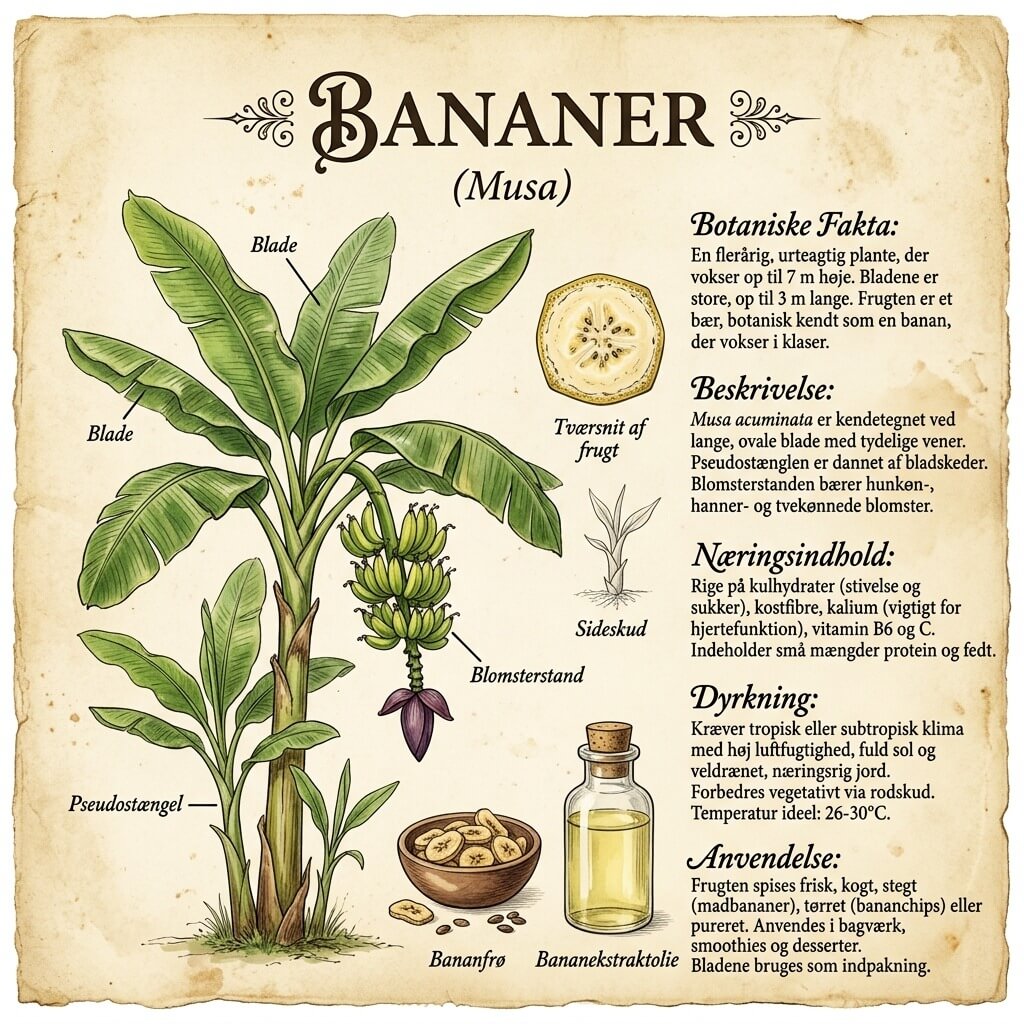
Bananas are without a doubt one of the world’s most popular fruits, and for good reason. This elongated, slightly curved fruit with its characteristic yellow peel is a staple in most Danish homes. Botanically, the banana belongs to the genus Musa, and the most common eating banana is Musa acuminata, which belongs to the banana family (Musaceae). Interestingly, the banana is technically a berry — a fact that often surprises people.

Advertisement: The page displays ads and contains advertising links (affiliate links). See our advertisers here.
The banana originally comes from tropical Southeast Asia, where it has been cultivated for over 8,000 years. Today, it is one of the most widely traded fruits in the world and a vital source of nutrition for millions of people. In Denmark, the banana is the most consumed fruit of all, and each year enormous quantities are imported from countries such as Ecuador, Colombia, and Costa Rica.
The banana is much more than just a convenient snack. It is incredibly versatile in the kitchen, rich in nutrients, and has a natural sweetness that makes it indispensable in everything from smoothies and baked goods to desserts and even savory dishes.
Estimated reading time: 12 minutes
History and origin
The banana’s history stretches far back into human civilization. The earliest traces of banana cultivation date back to New Guinea around 8,000 years ago, making the banana one of the very first cultivated fruits in the world. From there, cultivation spread to Southeast Asia, India, and onward to Africa via Arab trade routes during the Middle Ages.
It was Portuguese seafarers who, in the 15th and 16th centuries, brought the banana to the Canary Islands and from there onward to South America and the Caribbean. The plant thrived magnificently in these tropical regions, and it is precisely from this region that most of the bananas eaten in Denmark today originate.
A fascinating detail of the banana’s history is that the bananas we know today are the result of thousands of years of selective breeding. Wild bananas contain large, hard seeds and very little flesh. Through careful cultivation, the modern eating banana has become seedless and filled with the soft, sweet flesh we love. The Cavendish variety, named after William Cavendish, 6th Duke of Devonshire, has dominated the global banana market since the 1950s, when it replaced the then-popular Gros Michel variety, which was nearly wiped out by Panama disease.
In Denmark, bananas have been available since the late 1800s, but it wasn’t until the post-war era that they truly became an everyday fruit for Danes. Today, bananas are grown in over 135 countries, with India and China as the largest producers.
Flavor and aroma
The banana’s flavor profile is unique and unmistakable. A ripe banana has a soft, creamy texture and a characteristic sweet taste with notes of honey and vanilla. The flavor is due to a complex blend of more than 50 different aroma compounds, of which isoamyl acetate is the most dominant — it’s this compound that gives the banana its iconic scent.
The banana’s flavor changes markedly during the ripening process. A green banana tastes starchy and slightly astringent, almost like a potato. As it ripens, the starch converts into natural sugars — primarily sucrose, glucose, and fructose. A fully ripe banana with brown spots is therefore noticeably sweeter than a recently yellowed banana.
There are actually over 1,000 banana varieties in the world, and they vary enormously in flavor. The Cavendish banana, the variety most commonly found in Danish supermarkets, has a mild, pleasant sweetness. But there are also mini bananas (also called sugar bananas), which are even sweeter and more aromatic. Plantains, or cooking bananas, are on the other hand starchy and used primarily for cooking — they have a more neutral flavor reminiscent of potatoes.
Culinary uses
The banana is one of the most versatile fruits in the kitchen. Its natural sweetness, creamy texture, and ability to bind ingredients together make it indispensable in countless dishes.
Traditional and everyday use
The most obvious way to enjoy a banana is, of course, to eat it raw as a quick and nutritious snack. But bananas are also fantastic in:
- Breakfast: Sliced on top of oatmeal, yogurt, or muesli. A mashed banana mixed into oatmeal makes delicious pancakes.
- Smoothies: Frozen bananas give smoothies a creamy, milkshake-like texture without added sugar.
- Baking: Banana cake, banana bread, and banana muffins are classics that make use of overripe bananas’ extra sweetness.
- Desserts: Banana splits, bananas flambé, and chocolate-dipped frozen bananas are popular classic desserts.
Modern and creative uses
In recent years, the banana has been rediscovered in more creative contexts:
- Vegan baking: A mashed banana can replace one egg in many recipes, making it indispensable in plant-based baking.
- Nice cream: Frozen bananas blended to a creamy consistency create a healthy and delicious ice cream alternative with no dairy at all.
- Air fryer dishes: Bananas in the air fryer are a revelation — they caramelize beautifully and gain a fantastic depth of flavor.
- Savory dishes: In many Asian and Caribbean cuisines, plantains are used in savory dishes, fried as a side or in stews.
Classic combinations
Bananas pair wonderfully with a wide range of other ingredients. Cinnamon and banana is a true classic combination that enhances the banana’s natural sweetness. Chocolate and banana is another irresistible pairing, and peanut butter with banana has become a modern classic. Coconut, vanilla, caramel, and nuts are also excellent companions for the banana.
Health benefits
The banana isn’t just delicious — it’s also a genuinely healthy fruit that offers an impressive nutritional profile. A medium-sized banana (about 118 g) contains around 105 calories and is an excellent source of several important nutrients.
- Potassium — important for normal blood pressure, heart function, and muscle contraction
- Vitamin B6 — supports brain function and the production of serotonin and dopamine
- Vitamin C — contributes to immune function and iron absorption
- Dietary fiber — supports healthy digestion
- Resistant starch — especially in green bananas, acts as a prebiotic fiber
The most well-known nutrient in bananas is potassium. A banana contains approximately 348 mg of potassium per 100 grams, corresponding to around 10–12% of the daily requirement. Potassium is essential for maintaining normal blood pressure, heart function, and muscle contraction, and studies have shown that a potassium-rich diet can help lower blood pressure.
An interesting property of bananas is their content of resistant starch — especially in green, unripe bananas. Resistant starch acts as a prebiotic fiber that nourishes the beneficial bacteria in the gut and can thereby contribute to healthy digestion. As the banana ripens, the resistant starch converts into simple sugars, so green bananas actually have a lower glycemic index than ripe bananas. Bananas are also popular among athletes as a quick, natural source of energy that also helps prevent muscle cramps.
Cultivation
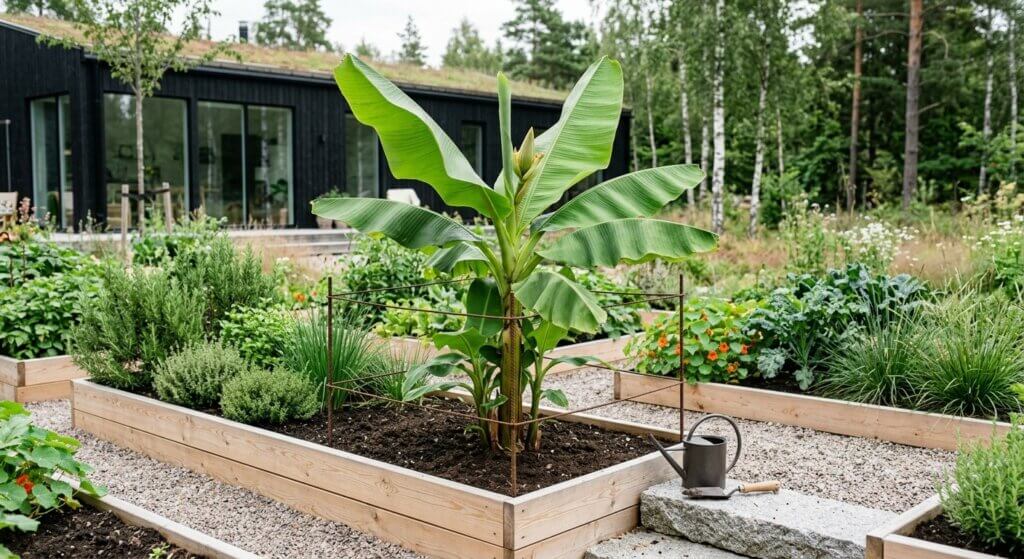
Although bananas are tropical plants that normally thrive in warm, humid climates, it is actually possible to grow banana plants in Denmark — though primarily as houseplants or in greenhouses.
The banana plant is technically not a tree, but the world’s largest herbaceous plant. What looks like a trunk is actually a pseudostem formed by tightly rolled leaf sheaths. In its natural habitat, the plant can grow up to 2–9 meters tall, depending on the variety.
For indoor cultivation in Denmark, dwarf varieties such as Musa acuminata ‘Dwarf Cavendish’ are recommended, or the ornamental Musa basjoo (Japanese banana), which is the hardiest banana variety and can actually survive Danish winters outdoors with good winter protection.
To grow a banana plant indoors, you’ll need a large pot with well-drained, nutrient-rich soil. The plant needs plenty of light — ideally direct sunlight for several hours a day. The temperature should be kept above 15°C, and the plant thrives best at 25–30°C. Watering should be generous during the growing season, but be careful not to let the roots sit in water. It is extremely rare for an indoor banana plant in Denmark to bear fruit, but as a decorative plant with its large, striking leaves, it’s a fantastic addition to any home.
How to prepare banana in the air fryer
The air fryer brings out the banana’s natural sweetness and gives it a lightly caramelized surface. Caramelized bananas make a quick dessert that can be served with ice cream, yogurt, or oatmeal.
Total time: 12 minutes
- Prepare the bananas
Choose ripe but firm bananas. Peel them and halve lengthwise, or cut into thick slices.
- Season
Brush the bananas with a little melted butter or oil, and sprinkle with brown sugar and a pinch of cinnamon for extra caramelization.
- Air fry
Place the bananas cut-side up in the basket and cook at 180°C for 6–8 minutes, until golden and soft.
- Serve
Serve the bananas warm with a scoop of ice cream, a dollop of yogurt, or a sprinkle of chopped nuts.
Storage
Proper storage of bananas can make a big difference in how long they stay fresh and delicious.
At room temperature
Unripe, green bananas should be stored at room temperature (about 20°C), where they’ll ripen naturally over 3–5 days. Hang them in a banana holder if you can, so air can circulate freely around them — this prevents bruising and uneven ripening.
Controlling the ripening
- Slow down ripening: Separate the bananas and wrap the stem end in plastic wrap, where the ethylene gas is released. Ripe bananas can also be stored in the refrigerator — the peel will turn brown, but the flesh stays fresh.
- Speed up ripening: Put the bananas in a paper bag together with an apple, which releases ethylene gas.
- Freezing: Peel overripe bananas, slice them if you like, and freeze them airtight. Frozen bananas keep for up to 6 months and are perfect for smoothies, nice cream, and baking.
Try this recipe
Bananas and baking are a fantastic combination, and one of the best ways to use up ripe bananas is in a moist banana cake. When you bake it in your air fryer, you get an incredibly moist cake with a lightly caramelized surface. Try our Banana Cake in the Air Fryer — it’s easy to make, requires few ingredients, and turns out perfect every time.
Equipment and products
Cinnamon and banana are a true classic flavor combination that enhances the banana’s natural sweetness and adds a warm, aromatic depth. Whether you sprinkle cinnamon over your morning banana slices or use it in a banana cake, genuine Ceylon cinnamon makes a world of difference. Try Whole Ceylon Cinnamon Organic – 50 grams – Biogan and discover the fine, mild flavor of genuine Ceylon cinnamon.
Frequently Asked Questions
Yes, bananas are a very healthy fruit. They are an excellent source of potassium, vitamin B6, and vitamin C, and also contain dietary fiber and natural antioxidants. A medium-sized banana contains only around 105 calories and provides long-lasting energy.
A medium-sized banana (about 118 g) contains around 105 calories. Per 100 grams, a banana contains around 89–93 calories, primarily from natural sugars and starch.
Yes, bananas freeze very well and keep for up to 6 months in the freezer. Peel them first, slice them if you like, and place them in an airtight container. Frozen bananas are ideal for smoothies, nice cream, and baking.
A banana is ripe when the peel is uniformly yellow, possibly with a few small brown spots. Green bananas are unripe and starchy, while bananas with many brown spots are overripe and extra sweet — perfect for baking.
Yes, botanically speaking, a banana is actually a berry. It develops from a single flower with one ovary and contains the seeds embedded in the flesh — though in cultivated bananas, they are nearly invisible.
Facts about bananas
| Field | Value |
|---|---|
| English name | Banana |
| Latin name | Musa acuminata |
| Family | Banana family (Musaceae) |
| Plant type | Perennial herbaceous plant (the world’s largest herb) |
| Height | 2–9 meters (depending on variety) |
| Hardiness | Tropical (USDA zone 9–11); Musa basjoo to zone 5 |
| Light | Full sun to light partial shade |
| Soil | Nutrient-rich, well-drained, moist |
| Calories per 100g | Approx. 89–93 kcal |
| Flowering/Harvest | 9–12 months from flowering to harvest (tropical climate) |
| Flavor | Sweet, creamy, with notes of honey and vanilla |
| Culinary use | Raw, smoothies, baking, desserts, fried, grilled |
| Storage | Room temperature 3–7 days; frozen up to 6 months |
