

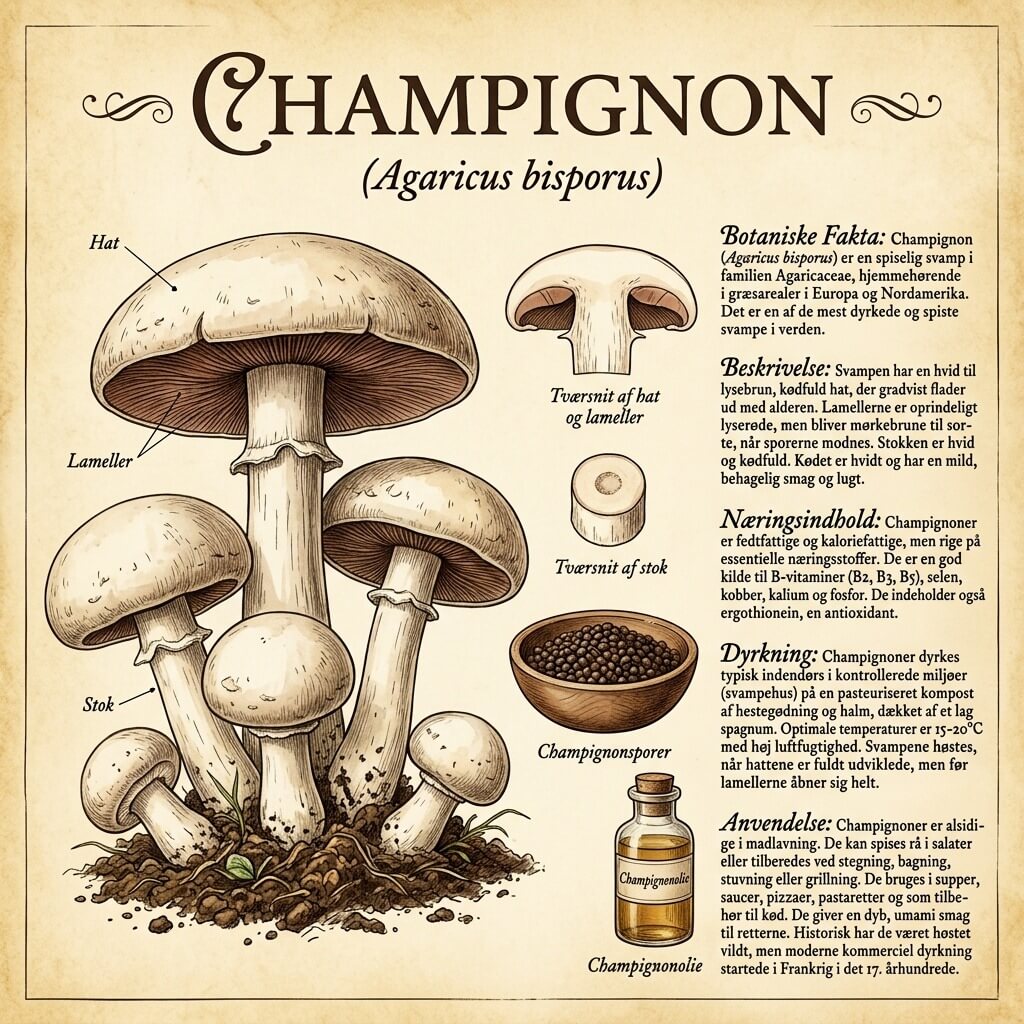
The button mushroom, also called the white mushroom or common mushroom, is the fruiting body of the species Agaricus bisporus in the family Agaricaceae. The button mushroom is therefore a fungus – not a plant – and is among the world’s most widely cultivated mushrooms, found in supermarkets year-round.

Advertisement: The page displays ads and contains advertising links (affiliate links). See our advertisers here.
The white button mushroom is a mutation of the originally brown mushroom, which was discovered at Keystone Mushroom Farm in Pennsylvania in 1925 and has since been propagated because the white colour was considered more attractive. White and brown mushrooms are therefore the same species – just different varieties.
Today, A. bisporus is cultivated in more than 70 countries. Young mushrooms have closed caps and a mild, slightly earthy flavour; as the mushroom matures, the cap grows larger and darker (cremini) and eventually develops into the more robust portobello, which is simply a fully grown brown mushroom. This makes the button mushroom a versatile ingredient that can be used raw or cooked in countless dishes.
Estimated reading time: 8 minutes
History and Origin
The button mushroom originates from the Mediterranean region and was first described as a species in the 1920s. The white variants were discovered in Pennsylvania in 1925 and spread through clonal propagation. In Denmark, mushroom cultivation became popular in the post-war years, when small mushroom farms were built in cellars and barns.
Mushrooms have also been part of European cuisine for centuries; they were prized by the Romans and later the French for their umami flavour and ability to replace meat during periods of fasting. Today, button mushrooms feature in everything from French coq au vin and Italian risotto to Asian stir-fries and modern plant-based dishes.
Flavour and Aroma
Raw button mushrooms have a mild, slightly nutty flavour with a firm, juicy texture. The flavour becomes deeper and more umami-rich when cooked, especially when the mushrooms are browned in fat. Both the cap and the stem can be eaten, and the whole mushroom has a light, spongy texture that absorbs flavour from marinades and sauces. Older mushrooms with open gills have a more intense, meaty flavour, while very small mushrooms with a closed veil are milder.
Culinary Uses
The button mushroom is a versatile kitchen ingredient that can be used both raw and cooked. Its mild umami flavour makes it a good match for many other ingredients.
In Danish Cuisine
- Raw in salads: Cut thin slices and toss them in lemon juice and oil with parmesan and nuts.
- Fried or sautéed: Sauté slices in butter or oil with garlic and thyme as a side for meat or pasta.
- Soups and sauces: Use button mushrooms as a base in creamy mushroom soups, stroganoff or cream sauce.
- Fillings and burgers: Blend mushrooms and use them in meat fillings or as a filling in plant-based patties.
- Pizza and tarts: Scatter slices on pizza or in quiche and tarts with cheese and spinach.
Internationally
Button mushrooms feature in many classic dishes worldwide. In French cuisine they’re used in sauces like duxelles and sauce chasseur, in Italian cooking in risotto, pasta and pizza, in Spanish cuisine in tapas such as mushrooms fried with garlic and parsley, and in Asian cuisines in soups, stir-fries and as dumpling fillings. Modern cooking uses mushrooms in vegetarian burgers, fillings, carpaccio, pickles and as a meat substitute thanks to their umami flavour.
Preparation Methods
- Cleaning: Brush or wipe the mushrooms with a damp cloth or paper towel to remove dirt. Don’t soak them, as they’ll absorb water and become soggy. For button or cremini mushrooms, you can rinse them quickly in cold water and dry them thoroughly.
- Slicing: Trim off the stem end if it’s dry, and cut the rest into slices or quarters. Small mushrooms can be cooked whole.
- Browning and marinating: Grilled mushrooms are brushed with oil and seasoned before cooking. Mushrooms absorb flavour, so feel free to marinate them in oil, soy sauce or herbs for extra taste.
- Good pairings: Thyme, rosemary, parsley, sage, garlic, lemon, butter, cream, parmesan, plus chicken, beef, bacon, eggs and tofu.
Nutrition and Health Aspects
Vitamins and Minerals
The button mushroom is a nutrient-dense, low-calorie food. One cup (96 g) of whole raw white mushrooms contains approximately 21 kcal, 3 g carbohydrate, 1 g fibre, 3 g protein and 0 g fat, along with significant amounts of nutrients. When mushrooms are exposed to UV light, their vitamin D2 content increases markedly, and they’re one of the few plant-based sources with a higher protein content than most vegetables.
- Vitamin D: approx. 33% of daily value per cup
- Selenium: approx. 16% of daily value
- Phosphorus: approx. 12% of daily value
- Folate: approx. 4% of daily value
- B vitamins: riboflavin (B2), niacin (B3) and pantothenic acid
Bioactive Compounds and Digestion
Mushrooms are rich in bioactive compounds such as polyphenols, polysaccharides, beta-glucans, ergothioneine, glutathione and selenium. These antioxidants help fight oxidative stress. Beta-glucan, a soluble fibre, can help lower cholesterol levels, while polysaccharides act as prebiotics and can support gut flora.
Due to their low calorie content and high fibre and protein content, mushrooms are well suited to weight control and plant-based diets. They also contain chitin, an indigestible fibre that can cause bloating in some people. Button mushrooms also contain the natural compound agaritine; cooking reduces its content significantly, so if you eat large amounts of mushrooms regularly, it’s a good idea to vary with cooked mushrooms. People with mushroom allergies may experience reactions, and immunocompromised individuals should avoid raw mushrooms.
Look-Alikes and Quality
Button mushrooms can be confused with other white mushrooms, but they typically have smooth, clean caps and a well-defined ring (veil) around the stem when young. Choose mushrooms that are firm, plump and dry, but not dried out, and avoid mushrooms with dark spots or sliminess. A closed veil under the cap indicates a mild, delicate flavour, while an open veil and visible gills give a richer flavour. Cremini and portobello are simply more mature stages of the same species; cremini has a brown cap and a more intense flavour, while portobello is large and meaty. Foraged mushrooms should only be eaten if correctly identified, as many wild mushrooms are poisonous.
Production and Cultivation
The button mushroom is one of the few edible crops that can be produced indoors year-round. Unlike a plant, the mushroom isn’t grown in ordinary soil but on a nutrient-rich, pasteurised substrate in dark, temperature-controlled climate halls.
Growing Conditions
- Light: Button mushrooms grow in low light or darkness; direct sunlight isn’t necessary.
- Temperature: The ideal temperature for fruiting bodies is 13–16 °C. Mycelium growth thrives at 21–24 °C.
- Humidity: Requires high humidity (85–95%) to prevent drying out.
- Ventilation: Good air circulation is necessary to prevent CO2 build-up.
- Substrate: Pasteurised compost based on straw, manure and gypsum.
How to Grow Button Mushrooms at Home
Total time: 3-6 months to first harvest
- Prepare the substrate
Button mushrooms grow best on pasteurised compost based on horse manure and straw. You can buy ready-made mushroom compost or a growing kit with spawn (mycelium) and substrate. The substrate should be moist but not waterlogged.
- Add the mycelium
Buy spore syringes, grain spawn or a kit. Mix the spawn into the top layer of substrate so the mycelium can spread.
- Create optimal conditions
Place the container in a dark room at around 21 °C to promote mycelium growth, and cover it with a layer of moist potting soil or peat moss (casing). When the mycelium forms a white network (after 2-3 weeks), lower the temperature to 13-16 °C and keep the humidity at 85-95%.
- Water and care
Keep the substrate evenly moist by misting water over the surface. Avoid direct light, and don’t add fertiliser during fruiting.
- Harvest
The first mushrooms appear 1-2 weeks after the temperature is lowered. Harvest the mushrooms when the cap is fully closed by gently twisting them off the stem. A culture can produce mushrooms for 3-6 months.
- Aftercare
When the yield declines, the used substrate can be composted in the garden. Start over with fresh substrate and spawn for a new harvest.
Storage
Fresh button mushrooms are delicate and are best stored cool and dry, so they don’t become slimy.
- In the fridge: Store the mushrooms in their original packaging or a porous paper bag in the refrigerator; they’ll keep for 5-7 days.
- Avoid plastic: Sealed plastic bags encourage condensation and make the mushrooms soggy.
- Freezing: Only freeze the mushrooms after cooking; sautéed mushrooms can be frozen for up to a month.
Sustainability and Biodiversity
Mushrooms are often grown on waste products such as straw and manure, converting organic material into edible protein. They require relatively little water and space and produce less CO2 per kg than most animal-based foods. After cultivation, the used substrate can be used as a soil improver in the garden. Mushrooms are also part of forest ecosystems, where they break down dead plant material and enable important nutrient cycles.
Try This Recipe
The button mushroom’s umami and creamy texture truly shine as a filling. Sautéed with garlic and cream, they become a rich mushroom filling wrapped in crispy puff pastry. Try our recipe for Puff Pastry Chicken in the Airfryer – Crispy Pastry with Creamy Mushroom Filling.
Equipment and Products
If you want to enhance the mushroom’s natural umami, a good mushroom cream is the shortcut. It adds a deep, earthy kick to sauces, fillings and creamy dishes with button mushrooms. See Hr.Skov Truffle Cream with Wild Mushrooms in our shop.
Frequently Asked Questions
Yes. White button mushrooms, brown cremini and portobello are all fruiting bodies of Agaricus bisporus. The difference lies in age: white button mushrooms are harvested early with closed caps; cremini are slightly more mature with brown caps; portobello are fully mature with large, open caps.
Yes, button mushrooms can be eaten raw in small amounts, but they contain the natural compound agaritine, which can be undesirable in large amounts. Cooking significantly reduces agaritine. People with digestive issues or mushroom allergies should avoid raw mushrooms.
Store fresh mushrooms in the refrigerator in their original packaging or a paper bag; they’ll keep for up to a week. Only freeze mushrooms after they’ve been sautéed. Avoid sealed plastic bags, as they can encourage condensation and make the mushrooms slimy.
Gently brush the surface with a soft brush or damp cloth. For button and cremini mushrooms, you can also rinse them quickly in cold water and dry thoroughly. Never soak them, as they absorb water and become soggy.
There’s no difference in species – the white button mushroom is a mutation of the brown one, propagated for its colour. Brown ones (cremini) have a slightly more intense, earthier flavour, while white ones are mild. Both are prepared the same way.
Facts About the Button Mushroom
| Field | Value |
|---|---|
| English name | Button mushroom, white mushroom |
| Latin name | Agaricus bisporus |
| Family | Agaricaceae |
| Type | Basidiomycete fungus (fruiting body), not a plant |
| Origin | Mediterranean region; white variant from Pennsylvania (1925) |
| Production method | Indoors on pasteurised compost in dark climate-controlled halls |
| Season in Denmark | Available year-round (grown indoors) |
| Size | Caps 3–10 cm in diameter, stem 3–8 cm |
| Calories per 100g | Approx. 22 kcal |
| Key nutrients | Vitamin D, selenium, phosphorus, folate, B vitamins, protein |
| Flavour | Mild, slightly earthy, umami |
| Culinary uses | Raw in salads, sautéed, in soups, sauces, pizza and fillings |
| Cleaning | Brush or wipe clean – do not soak in water |
| Cooking time | 3–10 minutes depending on method |
| Storage | In a paper bag in the fridge for 5–7 days; freeze only cooked mushrooms |
