

Ginger has a warm, spicy scent and flavor that instantly brings to mind Asian soups, cookies, and steaming cups of tea. In Denmark, the brownish root is nowhere near as exotic as it was a couple of decades ago. Supermarket produce sections are bursting with fresh rhizomes, and many people now grow their own ginger in pots. The plant does, however, have a long and fascinating history, and requires specific growing conditions to thrive in the Danish climate.

Advertisement: The page displays ads and contains advertising links (affiliate links). See our advertisers here.
Ginger (Zingiber officinale) is the fresh or dried rhizome of a perennial tropical plant. Its sharp, citrusy heat comes from the compound gingerol, making ginger essential in everything from stir-fries and curries to teriyaki, chai, mulled wine, and Danish Christmas baking. Freshly grated ginger and dried powder differ in strength, so they can’t simply be swapped 1:1.
Estimated reading time: 9 minutes
What is ginger?
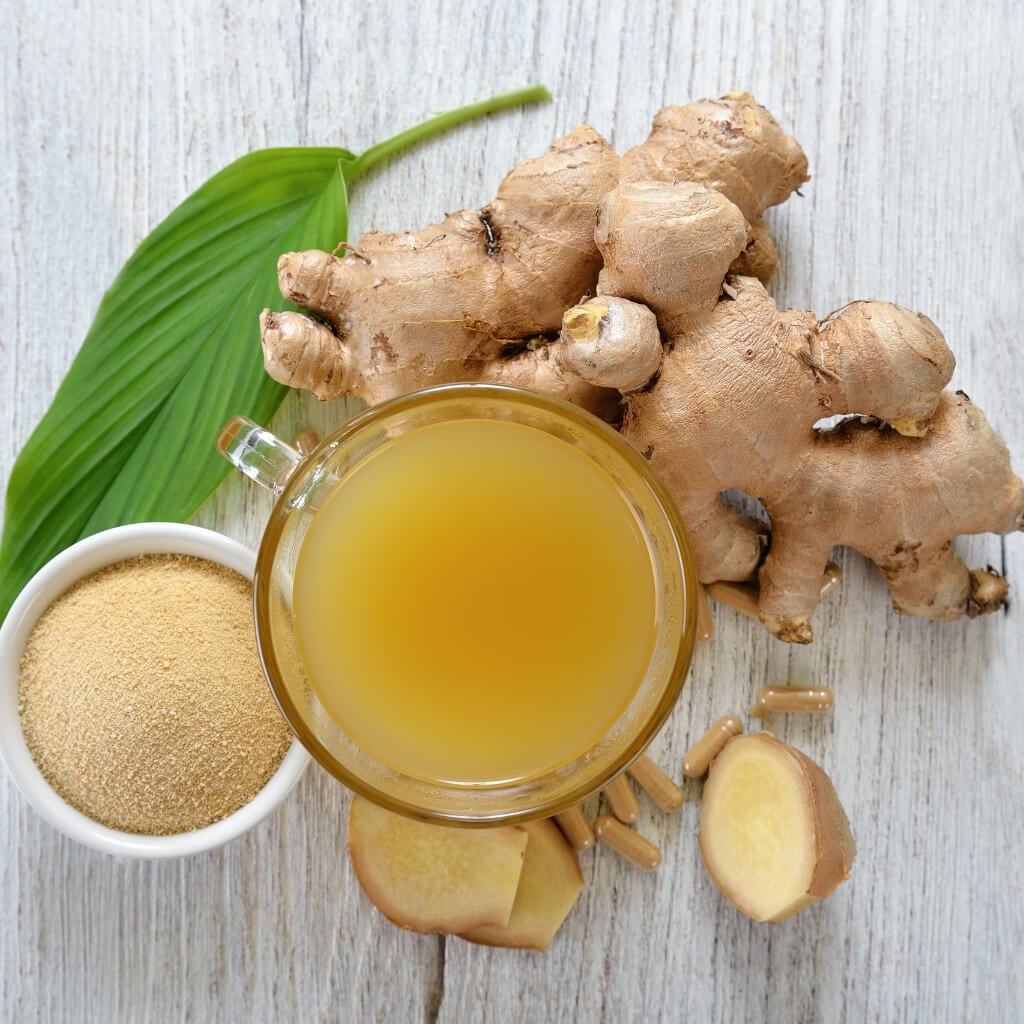
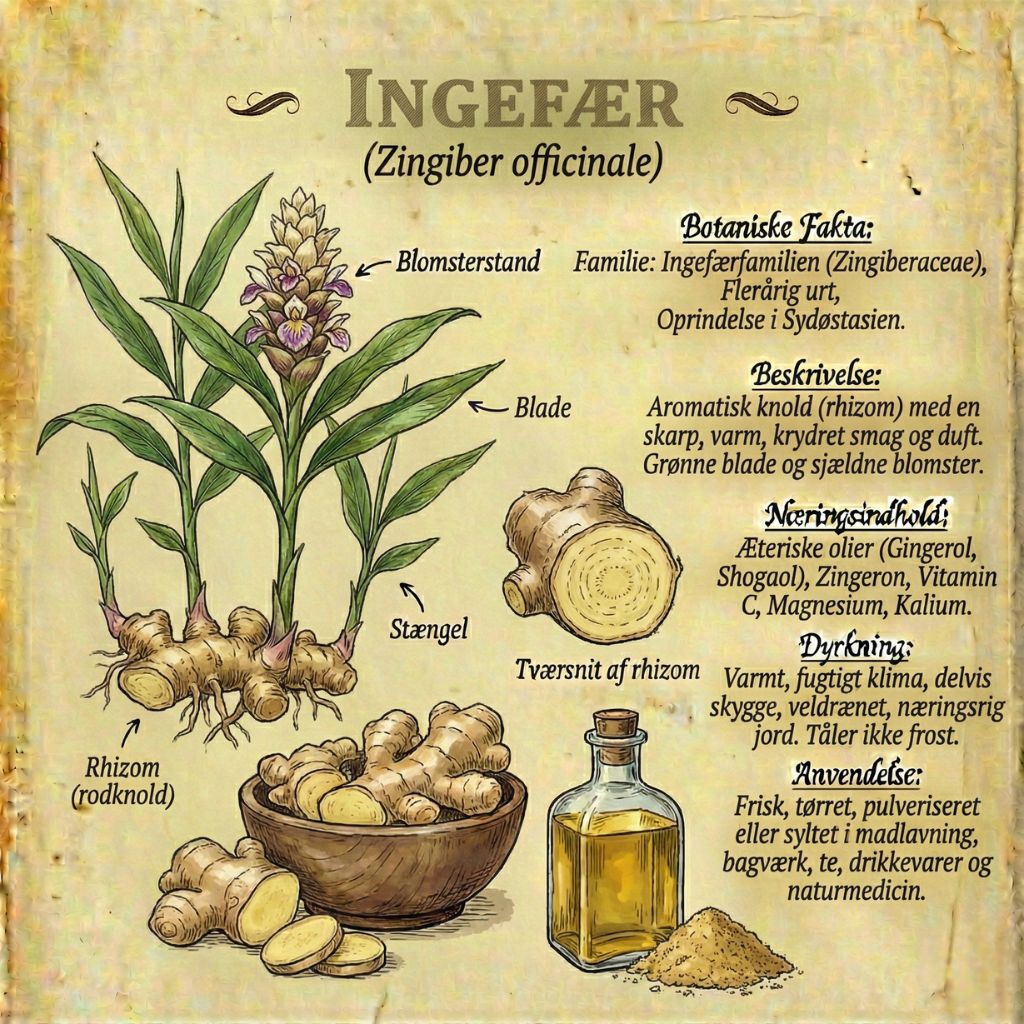
Ginger is a perennial, herbaceous plant in the ginger family (Zingiberaceae). Its botanical name is Zingiber officinale. The plant is thought to originate from Southeast Asia, where both the climate and soil suit its needs. It’s the underground stem – the rhizome – that we use in the kitchen and in medicine. The rhizome is thick and branching, with a light brown skin and yellow or cream-colored flesh. The taste is sharp, warm, and slightly citrusy, and the aroma comes partly from volatile oils such as gingerols and shogaols.
In the wild, ginger can grow up to a meter tall. The leaves are 15-30 cm long and grow in pairs along the bamboo-like shoots. Each stem sprouts from a hidden rhizome in the soil. The flowers sit in dense, cone-shaped spikes with green bracts; tucked between the bracts are small yellowish-green flowers with purple stripes. In cultivation, flowering is rare, especially in cooler climates like Denmark. Ginger reproduces mainly vegetatively, since cultivated plants rarely set seed.
The edible rhizome is used as a spice, a flavoring, and a natural remedy. Its sharp taste works in both sweet and savory dishes: from spicy Asian stir-fries to Christmas cookies. Fresh ginger needs to be peeled before use, while dried powder is used straight away. The pickled pink ginger served with sushi is made from young shoots, which have a milder flavor.
History and origin
Name and early history
The name “ginger” comes from the Greek zingiberis, which in turn comes from the Sanskrit singabera, meaning “horn-shaped” – a reference to the rhizome’s knobby form. Ginger is one of the oldest spices in Asia. It has been used in India and China since antiquity, both as a culinary spice and as a medicinal plant. Around the 1st century CE, trade routes carried ginger to the Mediterranean, where the Romans prized the pungent root.
Spread to Europe
During the 11th century, ginger became known in England. Spaniards and Portuguese later brought ginger to the Caribbean and Central America; from Santiago in the Caribbean, it was exported to Spain in the mid-16th century. In medieval Europe, ginger was, along with pepper and cinnamon, one of the most sought-after and expensive spices. It was used for everything from honey cakes to beer (ginger ale) and as a preservative to keep meat fresh on long sea voyages. In Denmark, ginger was once a luxury item, but today it’s an everyday staple. It features in gløgg (mulled wine), peppernuts, and modern dishes like green smoothies and Asian soups.
Taste and aroma
Ginger tastes warm, sharp, and slightly sweet, giving a pleasant heat in the mouth and throat. Young rhizomes are milder, while older roots have a more intense heat. The flavor develops with cooking: fresh ginger is bright and sharp, while dried powder is more aromatic and rounded. That’s exactly why you can’t simply swap one for the other – dried powder has a more concentrated, warm character, while fresh ginger contributes juice and freshness.
Ginger pairs well with many ingredients. Good matches include:
- Garlic, chili, lemongrass and lime in Asian dishes
- Soy sauce and honey in marinades and glazes
- Carrots and pumpkin in soups and baked dishes
- Fish and shellfish, where ginger tones down fishy flavors
Culinary uses
Ginger has a sharp heat that’s balanced by fresh citrus and sweet notes. In cooking, it’s used in both sweet and savory dishes and works equally well in the pot, in the pan, and in baking.
In Danish cuisine
In Danish cuisine, ginger is best known from Christmas baking. Dried ginger powder adds warmth to brunkager (spiced brown Christmas cookies), peppernuts, and honey cakes, and a piece of fresh ginger belongs in a pot of homemade gløgg (mulled wine). Freshly grated ginger has also become an everyday staple in soups, smoothies, and shots with lemon and turmeric.
Internationally
Internationally, ginger is indispensable in Asian cooking. It features in Chinese stir-fries, Indian curries, Thai soups, and Japanese teriyaki. In Japan, pickled ginger (gari) is served with sushi to cleanse the palate between bites. Ginger is also used as a flavoring in pickles, chutney, and fermented drinks like kombucha, and in cocktails it lends a spicy edge to Moscow mules and ginger beer.
Preparation methods
- Grate fresh ginger and use it in marinades for chicken, pork, or tofu.
- Add slices of ginger to stir-fries with vegetables and soy sauce for extra depth.
- Let slices of ginger steep in boiling water for a quick ginger tea.
- Mix ginger powder into cookie dough such as peppernuts or gingersnaps.
- Simmer ginger in sugar syrup to make candied ginger pieces or syrup.
A good tip: avoid simmering ginger for hours on end, as the heat can kill off the aroma. It’s better to add ginger toward the end of cooking, or use whole slices that can be removed before serving. When you grate ginger, you can press out the juice with your fingers to control the intensity.
Health benefits
Potential health aspects
Ginger has traditionally been used to relieve digestive upset, nausea, and colic. Research suggests that active compounds such as gingerols and shogaols may have anti-inflammatory and antioxidant effects. Many people use ginger for motion sickness, morning sickness, and nausea, and some studies show a degree of effect on nausea and vomiting. In alternative medicine, ginger is used for joint and muscle pain, but the evidence is limited. Please note that this article is not medical advice; consult a doctor before taking larger doses or supplements, especially during pregnancy, illness, or if you’re using blood-thinning medication.
Traditional use
In India, ginger has been part of Ayurveda for thousands of years as a remedy for digestive problems, colds, and coughs. In China, it features in classic herbal formulas against colds, nausea, and inflammation. In Arabic and North African folk medicine, ginger is mixed with honey to make cough syrup. In Europe, ginger was a popular remedy for stomach cramps, flatulence, and colic, and dried ginger was ground into powder and stirred into wine or beer as a winter drink. Many old Danish home remedies still recommend ginger tea with lemon and honey for colds.
Modern uses
Today, ginger is a global favorite. It appears in everything from energy shots to craft beer and kombucha, and is used in fermented drinks, smoothies, and juices. In cosmetics, ginger extract is used in perfumes and creams for its warm scent and potential antioxidant properties. Ginger is also sold as a dietary supplement in capsules, powders, and tinctures – but here you should be careful with dosage and keep in mind that the evidence is limited.
Growing and harvesting in Denmark
Ginger needs warmth and moisture to thrive. In Denmark, it grows best indoors in pots or a greenhouse, where the temperature can be controlled.
How to grow ginger in a pot
Total time: 8-10 months
- Pre-sprouting
Buy a fresh ginger rhizome with clearly visible eyes. Cut it into 3-5 cm pieces with at least one eye each, and let the cut surfaces dry for a day so they don’t rot.
- Planting
Plant the pieces in a wide pot with nutrient-rich, well-drained soil. The eyes should face upward, with only 2-3 cm of soil covering them. Use pots with drainage holes and a layer of expanded clay pebbles.
- Light and watering
Place the pot somewhere warm, at 20-25 degrees, and avoid direct sun. Keep the soil consistently lightly moist but not waterlogged, and mist the leaves occasionally to increase humidity.
- Feeding and care
Once the shoots are 15-20 cm tall, feed with liquid organic fertilizer or compost tea every third week. Remove withered leaves and watch out for aphids and spider mites.
- Harvest
After 8-10 months, the leaves turn yellow and the rhizome is ripe. Carefully dig up the tuber, trim off the stems, and save a few healthy pieces for replanting next season.
Growing conditions
To get vigorous ginger in a northern climate, you need to simulate tropical conditions. Ideally, the plant needs:
- Light: Partial shade or filtered sun. Direct sun can scorch the leaves.
- Soil: Loose, well-drained soil with a high organic content and a pH of 5.5-6.5. Compost and coconut coir improve the structure.
- Temperature: 20-28 degrees, and never below 15 degrees. In Denmark, ginger is best grown in a greenhouse, orangery, or indoors.
- Water: Evenly moist soil, ideally with high humidity. Use rainwater or decalcified water.
- Fertilizer: Organic NPK with a focus on phosphorus and potassium supports rhizome development. Too much nitrogen leads to excessive leaf growth and a small root.
Ginger has few pests when grown in pots, but can be attacked by aphids or spider mites if the air is dry. Regular misting with water or a mild soap solution helps prevent infestations, and good drainage keeps root rot at bay.
Storage
Harvest and freshness
The harvest time depends on the purpose. Young “baby ginger” can be harvested after as little as 4-5 months and has thin skin and a mild flavor. Traditionally, mature ginger is harvested after 8-10 months, once the stems wither and the leaves turn yellow. Dig up the rhizome by hand or with a fork so you don’t damage the tuber, shake off the soil, rinse gently, and let it dry.
Refrigeration, freezing, and drying
- Fresh ginger keeps in the refrigerator for 2-3 weeks – put the rhizome in an airtight bag with a piece of paper towel to absorb moisture.
- Ginger can be frozen, either whole or sliced/grated. Frozen ginger grates easily straight from the freezer.
- Dried ginger is made by slicing the rhizome thinly and drying the slices in a dehydrator or oven at 45-50 degrees until crisp. Stored dry and dark, it keeps its flavor for up to a year.
You can also make pickled ginger by simmering slices in regular vinegar or strawberry vinegar and sugar – or candied pieces by simmering them in syrup.
Look-alikes and quality
Possible mix-ups
Ginger can be confused with other rhizomes in the ginger family, such as galangal (Alpinia galanga) and turmeric (Curcuma longa). Galangal has a harder, paler rhizome and a stronger, more peppery aroma. Turmeric is smaller and bright orange inside, and is used mainly as a coloring and flavoring in curries. The difference is clear when you cut a slice: ginger is yellow and fibrous, turmeric is orange, and galangal has a more uniform cream color. The smell test works well too – ginger smells citrusy, while galangal smells more medicinal.
Buying and quality
When buying ginger in Denmark, choose rhizomes that are firm, heavy, and unwrinkled. The skin should be smooth and thin – you should be able to scrape it with your fingernail. Avoid ginger with mold, discoloration, or dry ends. Organic ginger is grown without synthetic pesticides and can have a higher flavor quality, but is often more expensive. The best quality is often found at Asian grocers and at markets in summer. Imported ginger is available year-round, while freshly harvested Danish ginger can be found in autumn if you grow your own.
Sustainability and biodiversity
Since ginger is a tropical plant, most of the ginger we buy is imported from China, India, Nigeria, and Peru. Transport over long distances generates CO2 emissions. Growing ginger at home in a pot can slightly reduce the climate impact, and organic or fairtrade-certified products support more sustainable farming methods. Ginger requires moderate watering and can be grown in reusable containers; in a greenhouse, it makes sense to collect rainwater for watering. The plant’s flowers attract pollinators, but flowering is rare in Denmark. Kitchen scraps such as peels can be composted to improve soil structure in the garden.
Try this recipe
Ginger’s sharp heat feels tailor-made for Asian cooking, where it balances soy, garlic, and sweetness. Freshly grated ginger lifts both the meat mixture and the glaze, giving the dish its unmistakable sweet-and-spicy aroma. Try our Chinese glazed chicken meatballs in the air fryer – a sweet-and-spicy Asian everyday dish, where ginger plays the lead role alongside soy and garlic.
Ginger also works well in sweet baking. When you grate fresh ginger into cookie dough, you get a fresher and more aromatic flavor than with powder alone.
Equipment and products
If you don’t have fresh ginger on hand, dried ginger is a practical, long-lasting alternative for baking, mulled wine, and spice blends. Our Ginger Organic – 24 g – Urtekram is organic and ready to sprinkle straight into the dough or the pot, so you always have ginger’s warmth right at hand.
Frequently asked questions
Ginger can’t tolerate frost. In Denmark, it must either be grown indoors year-round or harvested before autumn. The rhizome can be stored indoors and replanted in spring.
It thrives best in partial shade to filtered sun. Too much shade results in weak growth and a small harvest.
Culinary amounts are generally safe for most people. Large doses, however, can cause heartburn or interact with medication. Consult a healthcare professional if you’re pregnant, breastfeeding, or taking blood-thinning medication.
Choose fresh rhizomes with juicy flesh, ideally grow your own in nutrient-rich soil, harvest them late, and add them toward the end of cooking to preserve the aromatic compounds.
Fresh ginger is juicy, sharp, and citrusy, while dried powder is more concentrated, warm, and aromatic. They can’t simply be swapped 1:1 – use fresh in stir-fries and marinades, and dried in baking and spice blends.
Facts about ginger
| Field | Value |
|---|---|
| English name | Ginger |
| Latin name | Zingiber officinale |
| Family | Ginger family (Zingiberaceae) |
| Plant type | Perennial herbaceous plant; often grown as an annual in pots |
| Height | 50-100 cm |
| Hardiness | Not frost-hardy; requires a frost-free winter |
| Light | Partial shade to filtered sun |
| Soil | Rich, well-drained, slightly acidic (pH 5.5-6.5) |
| Sowing/planting | Indoor pre-sprouting February-April; planted out once temperatures are stably above 20 degrees |
| Flowering | Rare in Denmark; yellow/green flowers in cone-shaped spikes |
| Harvest | After 8-10 months; young “baby ginger” can be harvested after 4-5 months |
| Flavor | Warm, sharp, slightly sweet and citrusy |
| Culinary use | Stir-fries, tea, marinades, baking, fermented drinks |
| Storage | Refrigerator (2-3 weeks), freezing, pickling, drying |
