

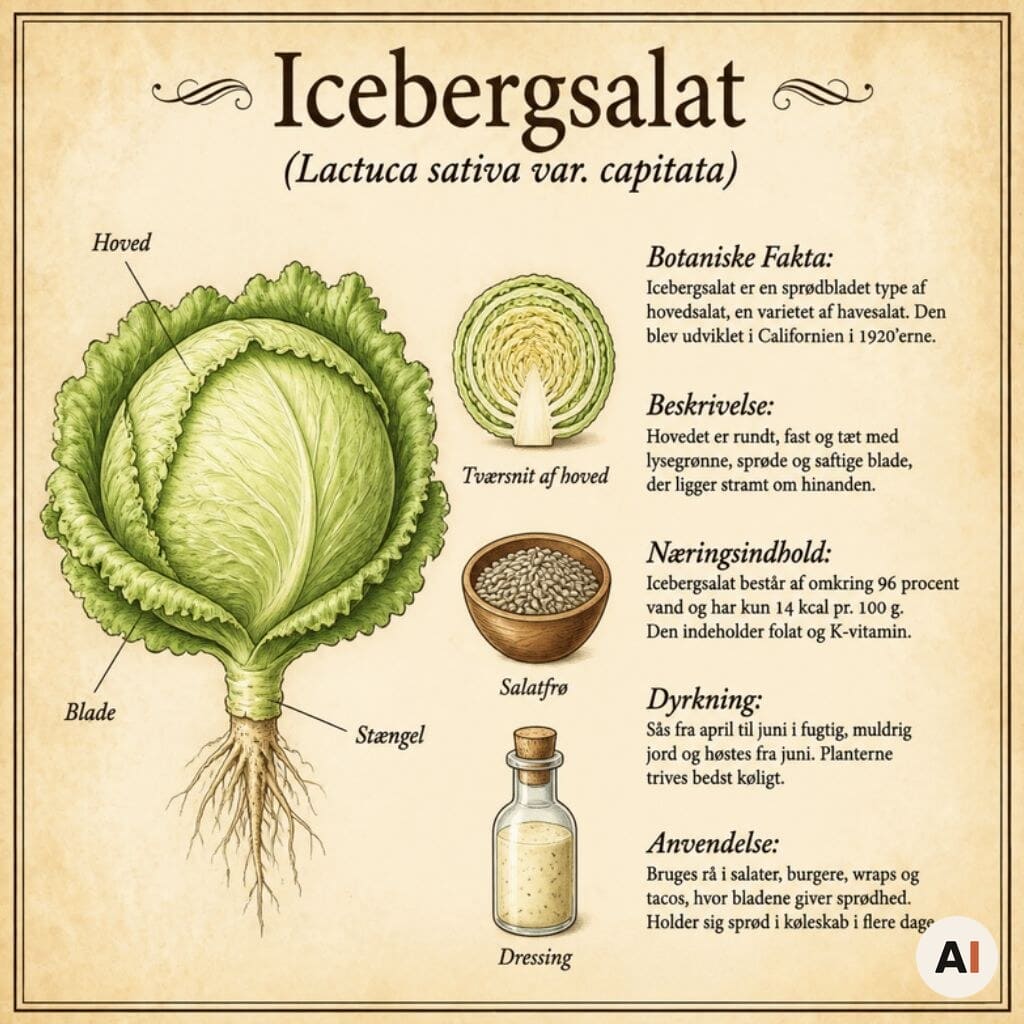
Iceberg lettuce is the crisp, pale green head lettuce most of us know from burgers, pita bread and the classic shrimp cocktail. It is also called crisphead lettuce, and botanically it is a crisp-leaved type of head lettuce, Lactuca sativa var. capitata. The head is dense and heavy, and the leaves crunch when you bite into them.
I love iceberg lettuce as a counterpoint to food from the air fryer. When the chicken or fish comes out of the basket hot and crispy, those cool, juicy strips are what lifts the whole dish. The lettuce, on the other hand, can’t take heat, so it should always be used raw.
Here you’ll get the story behind the lettuce, its taste, the classic dishes and my best tips on growing and storing it.
Estimated reading time: 6 minutes
History and origin
From California to the whole world
Iceberg lettuce is a relatively young type of lettuce. It was developed in California in the 1920s and first came onto the market under the name Imperial. Since the 1940s it has been called iceberg, and it has taken that name with it out into the world.
The success was due not least to the yield: the lettuce is very high-yielding and well suited to large-scale farming – both when it is grown and when it is packed. At the same time, the firm heads stay crisp longer than soft lettuce types, which suits a lettuce that has to be transported a long way.

From salad bar to burger bun
In Denmark, iceberg lettuce really became widespread from the late 1970s, when American salad bars and burgers made their entrance. Suddenly the crisp lettuce was in the salad bar, on the burger bun and in the bowl next to dinner – and it has been there ever since.
Named after the iceberg
The name simply refers to the iceberg, and the Danish name issalat, literally “ice salad”, follows the same track. Botanically, the lettuce belongs to the daisy family, Asteraceae, like the other lettuce types of the species Lactuca sativa.
Taste and aroma
Mild and fresh
Iceberg lettuce has a mild, fresh and almost neutral taste with a hint of sweetness. It is neither bitter like frisée nor peppery like arugula, which is why it suits most people’s taste.
The crunch is everything
It’s the texture that is iceberg lettuce’s great strength. The leaves are thick, juicy and crunchy, and the lettuce is more than 95 percent water. The innermost leaves are pale and tightly packed, while the outer ones are greener and a bit looser. I like to use the big outer leaves as bowls or wraps and shred the rest.
What goes with iceberg lettuce
The mild taste leaves room for bold dressings and fillings: shrimp with creamy dressing, blue cheese dressing with crispy bacon, or a quick salad with cucumber and tomato. With hot, crispy food from the air fryer, that cool crunch is almost indispensable.
Culinary uses
In everyday cooking
Most people know iceberg lettuce from the classic shrimp cocktail, where the shrimp are served on a bed of shredded lettuce. It is also a fixture in burgers, at the salad bar and in the everyday salad with cucumber and tomato, and for taco night a bowl of shredded iceberg lettuce is almost mandatory.
Around the world
In the US, wedge salad is a classic, where a head is cut into wedges and topped with blue cheese dressing and bacon. Tex-Mex cooking uses shredded iceberg in tacos, and in Chinese cooking the leaves become lettuce cups, for example in san choy bow.
Cooking methods
Iceberg lettuce does not belong in the air fryer. It can’t take the heat, and the leaves collapse quickly. Use it raw – in fine shreds, in wedges or as whole leaves that you can fill. My best tip: add the lettuce at the very last moment, once the hot food is out of the basket, so it keeps its crunch all the way to the table.
If you need whole leaves for wraps or lettuce cups, cut out the core and let cold water run into the hole – that way the leaves come loose more easily without tearing. Here are the classic dishes where iceberg lettuce makes a difference:
- Shrimp cocktail: shrimp and dressing on shredded iceberg lettuce.
- Burgers: crunchy leaves under the patty or the chicken.
- Tacos: shredded iceberg as a fresh topping.
- Pita bread and wraps: shreds with cucumber and tomato.
- Wedge salad: wedges with blue cheese dressing and bacon.
- Lettuce cups: whole leaves with a spiced filling, e.g. san choy bow.
Health benefits
Mostly water and few calories
Iceberg lettuce is first and foremost a water-rich vegetable. With 95.7 g of water and only 16 kcal per 100 g, it gives you volume and crunch without adding much to your calorie count – plus a little dietary fiber on top.
Nutrients in iceberg lettuce
Even though the lettuce is light, it contains vitamin K, folate and vitamin C, among other things. Here is the content per 100 g of raw iceberg lettuce:
- Energy: 16 kcal
- Water: 95.7 g
- Carbohydrates: 3.2 g
- Dietary fiber: 1.1 g
- Protein: 1 g
- Fat: 0.1 g
- Vitamin K: 112 µg
- Folate: 89 µg
- Vitamin C: 8.1 mg
- Beta-carotene: 150 µg
Good to know
Iceberg lettuce is not among the allergens that must be declared under EU law, but allergy to lettuce does occur in rare cases. Because the lettuce is eaten raw, it should always be rinsed thoroughly before use. If you take blood-thinning medication of the warfarin type, it is worth knowing that the lettuce contains vitamin K – talk to your doctor if you are in doubt.
Growing
Growing conditions
Iceberg lettuce is an annual plant that thrives best in cool weather. In heat and drought it easily bolts, and then the plant stretches upward instead of forming a firm head. Even watering and a spot in sun to light shade give the best heads.
- Light: sun to light shade.
- Soil: improved with well-rotted compost and dolomite lime.
- Climate: cool – heat and drought cause bolting.
- Water: even watering, especially in dry spells.
- Harvest: when the head is firm and compact.
How to grow iceberg lettuce
You can either start the lettuce indoors or sow it directly in the bed. Here’s how to do it, step by step:
Total time: 3-4 months
- Prepare the soil
Spread a couple of cm of well-rotted compost over the bed well before sowing, and sprinkle a handful of dolomite lime per m².
- Sow the seeds
Sow the lettuce in trays or pots in late March for transplanting later, or sow it directly outdoors from April.
- Plant out
Plant the seedlings out in late April, when they have 4–5 true leaves. Choose a spot in sun to light shade.
- Water and care
Water regularly, especially in hot and dry spells, so the lettuce doesn’t bolt.
- Harvest
Harvest the iceberg lettuce when the head is firm and compact. Cut it off at ground level.
Storage
In the fridge
Iceberg lettuce stays crisp longer than the soft lettuce types. Store it in the fridge in a bag or tightly wrapped so the leaves don’t dry out.
Avoid brown spots
Apples and bananas give off ethylene, which causes brown spots on the lettuce. So keep the iceberg lettuce in a different spot in the fridge than the fruit. I only cut the lettuce into shreds when I’m about to use it, because a whole head keeps better than pre-cut lettuce.
- Whole head: in the fridge, in a bag or tightly wrapped.
- Away from fruit: no apples or bananas nearby.
- Rinse before use: rinse thoroughly and pat the leaves dry.
- Not in the freezer: the watery leaves turn soft when they thaw.
Try this recipe
Crispy taco shells and cool, shredded iceberg lettuce are a pair I never get tired of. Try our recipe for Taco shells in the air fryer – crispy Friday tacos ready in 35 minutes, and top them with a good handful of finely shredded iceberg lettuce. I shred the lettuce while the shells are in the air fryer and keep it cold until the very last moment. The filling goes into the shell first, and the lettuce goes on right before serving, so it stays crunchy to the very last bite.
Frequently asked questions
Iceberg lettuce is used raw in burgers, wraps, tacos, pita bread and salads. It is also a classic in shrimp cocktail, and it turns up in wedge salad and as lettuce cups, among other dishes.
No, iceberg lettuce can’t take the heat. The leaves collapse and lose their crunch, so the lettuce should be used raw. Instead, let it be the cool, crunchy counterpoint to dishes from the air fryer, and add it only right before serving.
There are 16 kcal per 100 g of raw iceberg lettuce. The lettuce contains 95.7 g of water and only 0.1 g of fat per 100 g, so it gives you plenty of volume and crunch for very few calories.
Store it in the fridge in a bag or tightly wrapped, and keep it away from apples and bananas, which give off ethylene and cause brown spots. Only cut the lettuce into shreds right before you use it.
The name simply refers to the iceberg. The lettuce was developed in California in the 1920s and launched under the name Imperial, and since the 1940s it has been called iceberg. In Danish it is also called issalat, which means “ice salad”.
Facts about iceberg lettuce
| Field | Value |
|---|---|
| English name | Iceberg lettuce (also called crisphead lettuce) |
| Latin name | Lactuca sativa var. capitata |
| Family | Daisy family (Asteraceae) |
| Plant type | Crisp-leaved head lettuce |
| Hardiness | Annual; thrives best in cool weather |
| Light | Sun to light shade |
| Soil | A couple of cm of well-rotted compost and a handful of dolomite lime per m² |
| Sowing/planting | Sown in late March for transplanting, or directly outdoors from April; planted out in late April |
| Harvest | When the head is firm and compact |
| Origin | Developed in California in the 1920s |
| Calories per 100 g | 16 kcal (raw) |
| Taste | Mild, fresh and slightly sweet with a crisp, juicy texture |
| Culinary use | Raw in burgers, tacos, wraps, pita bread, shrimp cocktail and salads |
| Storage | In the fridge in a bag or tightly wrapped, away from apples and bananas |
