

Potatoes are the ingredient I use most in my air fryer – and here on the site, the potato is actually the most-used ingredient of them all. Whether it’s crispy potato wedges, golden French fries or baked potatoes with a fluffy inside, the potato turns up in a great many of our recipes.
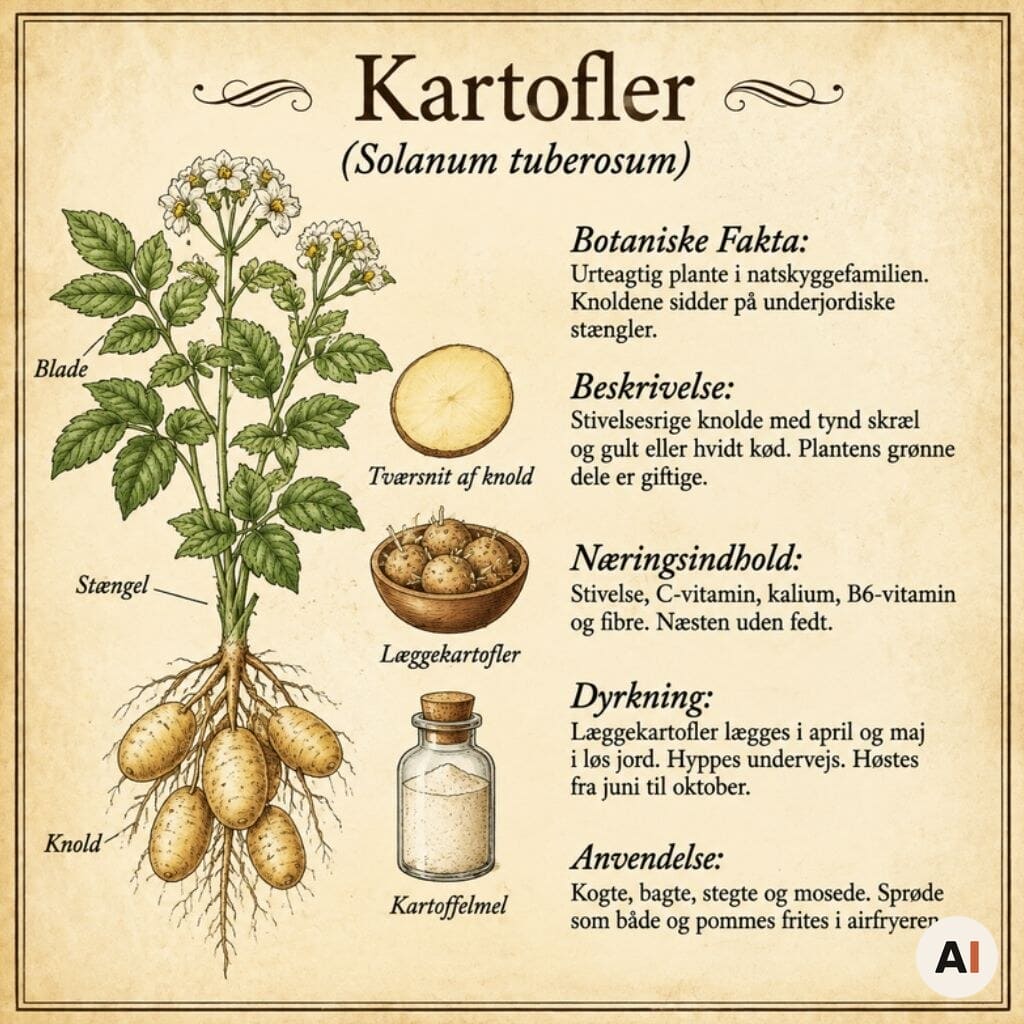
The potato, Solanum tuberosum, belongs to the nightshade family and is, botanically speaking, a stem tuber – a thickened, underground part of the stem. It is cheap, filling and incredibly versatile: it can be boiled, mashed, fried, baked and deep-fried, and in the air fryer it gets a crispy surface with very little fat.
Here you’ll get the story behind the potato, the difference between floury and waxy varieties, and my best advice on cooking potatoes in the air fryer, growing them and storing them.
Estimated reading time: 6 minutes
History and origins
From the Andes to Europe
The cradle of the potato lies in the Andes in South America, in a belt stretching from Venezuela to Argentina, as well as on the island of Chiloé in Chile. It is on Chiloé that the oldest traces of wild potatoes have been found, and they are about 13,000 years old. In the Andes, the potato was cultivated for thousands of years, long before Europeans had heard of it.
The Spaniards brought the potato across the Atlantic in the 16th century, and by 1567 it had reached the Canary Islands. From there it slowly spread to the rest of Europe, where it was initially met with a good deal of scepticism and was mostly grown as a curiosity.
The potato comes to Denmark
The potato came to Denmark with the Huguenots – French Protestants who settled in Fredericia in the 1720s. It got an important boost when the so-called ‘potato Germans’ (kartoffeltyskere) arrived on the Jutland heath in the 1760s. The German colonists were to cultivate the poor heathland soil, and the potatoes they grew earned them their nickname.
The potato thrived in the sandy soil, and over time it became so Danish that it is hard to imagine a traditional Danish dinner table without it.
Flavour and aroma
Mild and slightly earthy
The potato has a mild, slightly earthy flavour that makes it the perfect canvas for butter, salt, herbs and gravy. New potatoes taste fresh and a touch sweet, and the thin skin is perfectly fine to eat. Maincrop (storage) potatoes have a fuller flavour and a thicker skin.
Floury and waxy potatoes
The biggest difference between varieties lies in the texture. Floury potatoes contain a lot of starch and fall apart easily when boiled. In return, they turn light and fluffy inside, which makes them ideal for mashed potatoes, baked potatoes and French fries.
Waxy potatoes have less starch and hold their shape, even after boiling and frying. They are perfect for potato salad, Danish caramelised potatoes and dishes where the pieces need to stay whole. Between the two extremes you’ll find all-purpose varieties that handle most things. Many bags are labelled floury or waxy, and that is a good rule of thumb.
How the air fryer changes the flavour
Something special happens in the air fryer. The hot, circulating air dries the surface quickly, so the potato develops a golden, crispy crust and a nutty, toasted flavour while the inside stays soft. It is the same browning you know from deep-frying and the oven – just with far less fat than in the deep fryer.
Culinary uses
In everyday cooking
For generations, the potato has been a constant companion at everyday dinners. Boiled potatoes with gravy are the cornerstone of the classic home-cooked dinner, and new potatoes with butter and fresh dill or parsley are one of the highlights of summer.
Nothing goes to waste: cold boiled potatoes become kartoffelmad, a Danish open sandwich of sliced potatoes on rye bread, or biksemad, a Danish hash of fried diced potatoes, meat and onion. And at Christmas dinner, caramelised potatoes (brunede kartofler) are a must for many Danes.
Around the world
The potato is a true citizen of the world. French fries are eaten all over the globe, rösti is the Swiss crispy cake of grated potatoes, and Hasselback potatoes come from Sweden. Here are some classic potato dishes from Denmark and abroad:
- Caramelised potatoes (brunede kartofler): small, waxy potatoes tossed in caramel.
- Kartoffelmad: sliced cold boiled potatoes on rye bread.
- Biksemad: diced potatoes, meat and onion fried together.
- French fries: crispy sticks of floury potatoes.
- Rösti: Swiss potato cake made from grated potatoes.
- Hasselback potatoes: Swedish classic, sliced like a fan.
- Potato wedges and baked potatoes: the air fryer’s everyday favourites.
In the air fryer
Potatoes are probably the ingredient that suits the air fryer best of all, and here are my go-to techniques. Cut the potatoes into even pieces so they finish cooking at the same time. Rinse French fries and wedges in cold water to remove the surface starch, and pat them completely dry afterwards – moisture is the worst enemy of crispiness.
Toss them in a little oil and salt, and don’t overfill the basket, so the hot air can circulate around every piece. Shake the basket a couple of times along the way. Floury potatoes give the fluffiest French fries and baked potatoes, while an all-purpose potato is a good choice for wedges. Cook them until they are golden – not dark brown.
Health benefits
Nutrition in the potato
Potatoes have a reputation for being fattening, but it is rarely the potato itself that is to blame. Raw potatoes contain about 82 kcal per 100 g and are almost fat-free. It is the extras – butter, cream and frying fat – that make the calories climb, and that is exactly why the air fryer is such a good tool.
The energy comes mainly from starch, and the potato also contributes vitamin C, potassium, vitamin B6 and dietary fibre. Vitamin C is sensitive to heat, so some of it is lost during cooking. If you eat the skin too, you get a little more fibre.
- Starch: the potato’s most important source of energy.
- Vitamin C: about 26 mg per 100 g raw potatoes.
- Potassium: about 414 mg per 100 g raw potatoes.
- Dietary fibre: some of it sits in the skin.
- Vitamin B6: one of the B vitamins the potato contributes.
- Almost fat-free: the fat comes from the cooking, not from the potato.
What to watch out for
The above-ground parts of the potato plant are poisonous, and green tubers and sprouts contain solanine. Always cut away green patches and sprouts, and discard potatoes that are green far into the flesh.
When potatoes are fried or baked at high heat – including in the air fryer – acrylamide forms. So cook them until they are golden, not dark brown. Good to know: potatoes are not among the 14 allergens that must be declared under EU rules.
Growing
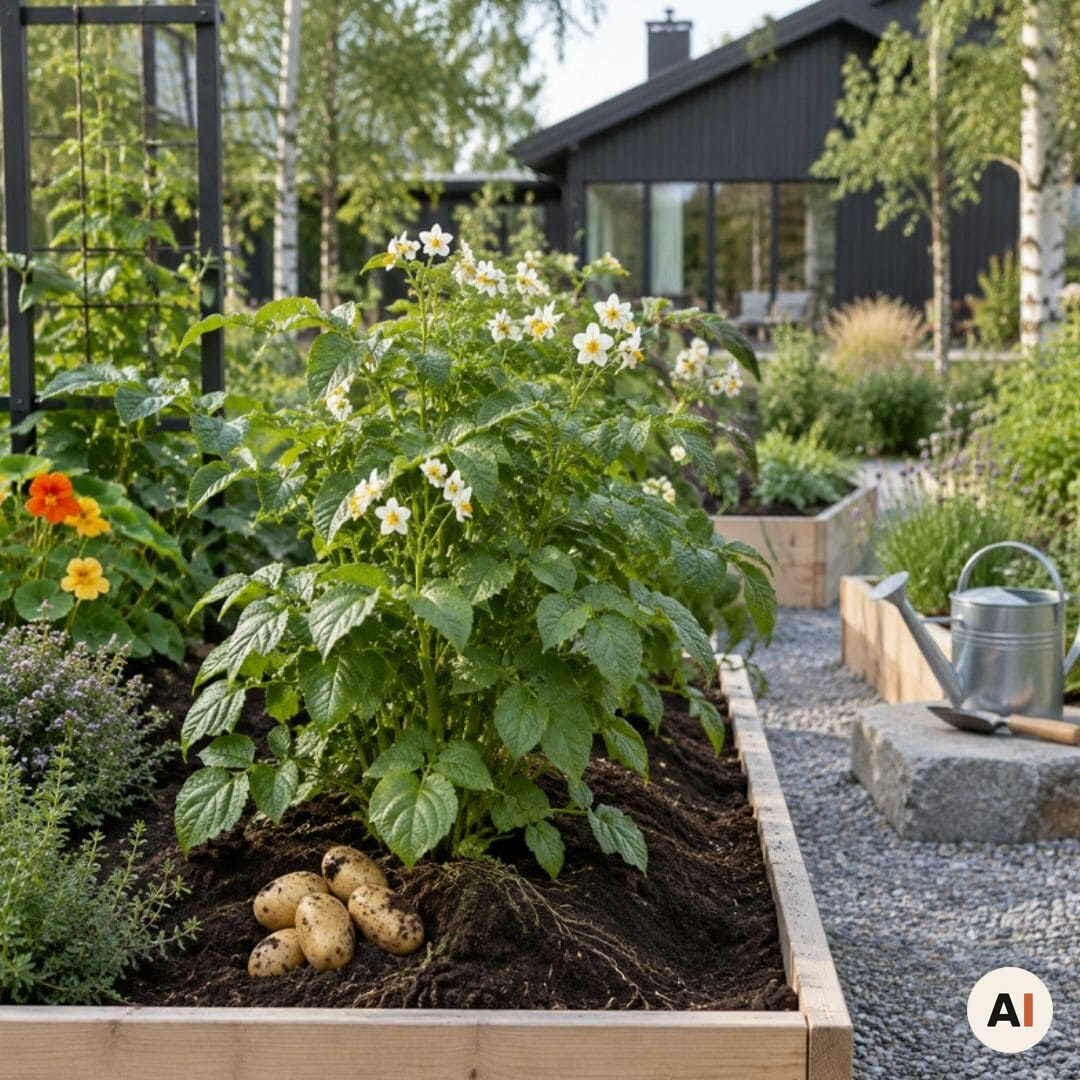
Potatoes are one of the most rewarding crops in the vegetable garden, and there is something truly special about digging up your own new potatoes on a summer’s day. Here are the most important growing conditions:
- Light: full sun.
- Soil: loose and well-drained – fine, sandy soil without stones is ideal.
- Soil temperature at planting: at least about 8 °C.
- Hardiness: not frost hardy – grown as an annual.
- Height: 25–100 cm.
- Harvest: early potatoes in June–July, maincrop potatoes in August–October.
Pre-sprouting and planting
Potatoes are not normally grown from seed, but from seed potatoes. Pre-sprout (or ‘chit’) them indoors from late February or early March, so they have short, sturdy sprouts when it is time to plant them. The potatoes are planted in April–May, when the soil is at least about 8 °C.
Soil, light and care
The potato thrives in full sun and in loose, well-drained soil – preferably fine and sandy, without stones. The foliage cannot tolerate frost, and the plant is grown as an annual. Pile soil up around the plants as they grow – this is called earthing up – so the tubers don’t turn green from the light.
Harvest
Early potatoes can be harvested in June–July, about 80–100 days after planting. Maincrop potatoes are dug up in August–October, once the foliage has died back. By then the skins have set, and the potatoes are ready to go into storage.
How to grow potatoes step by step
Total time: 4-7 months
- Pre-sprout the seed potatoes
Place the seed potatoes in a tray indoors from late February or early March, so they develop short, sturdy sprouts.
- Plant the potatoes
Plant the potatoes in loose, well-drained soil in full sun in April–May, when the soil is at least about 8 °C.
- Earth up and water
Pile soil up around the plants as they grow, so the tubers don’t turn green, and water in dry spells.
- Harvest the potatoes
Dig up early potatoes in June–July, about 80–100 days after planting, and maincrop potatoes in August–October, once the foliage has died back.
Storage
Maincrop potatoes
Maincrop potatoes keep best in the dark, well ventilated and frost-free at 5–10 °C and a humidity of about 90%. A cool cellar or a frost-free shed can be a good spot.
- Dark: light turns the tubers green.
- Cool and frost-free: 5–10 °C is ideal.
- Airy: use a paper bag, a basket or a crate rather than a sealed plastic bag.
- Unwashed: only wash the potatoes right before you use them.
- Check them regularly: cut away green patches and sprouts before cooking.
New potatoes
New potatoes have a thin, delicate skin and only keep for a few days. So buy them shortly before you plan to use them – and enjoy them while they are at their very best.
Leftover boiled and baked potatoes
If you have boiled or baked potatoes left over, cool them down quickly and keep them in the fridge. They are perfect for a potato hash (biksemad) or sliced onto rye bread (kartoffelmad) the next day – or for a trip in the air fryer, where they turn crispy again.
Try this recipe
Baked potatoes are one of the dishes I make most often in the air fryer, because the hot air gives a crispy skin and a soft, fluffy inside. Try our recipe for Turkish baked potato in the air fryer – creamy kumpir like in Istanbul’s street food stalls, where the potato becomes a whole meal. I always choose a large, floury potato, because it gives the fluffiest inside when it is mashed with butter and cheese. And then I prick the skin a couple of times with a fork before the potato goes into the basket.
Frequently asked questions
Floury potatoes have more starch and turn light, fluffy and slightly crumbly when cooked. They are great for mashed potatoes, baked potatoes and French fries. Waxy potatoes have less starch and hold their shape, so they are perfect for potato salad and caramelised potatoes. All-purpose varieties sit somewhere in between.
Green tubers and sprouts contain solanine, and the above-ground parts of the potato plant are poisonous. So cut away green patches and sprouts before you cook the potatoes, and discard potatoes that are green far into the flesh.
Raw potatoes contain about 82 kcal per 100 g and are almost fat-free. The calories only climb once butter, cream or frying fat comes into the picture. In the air fryer, a little oil is all you need.
In the Nordic countries, new potatoes start to appear from about June, and early potatoes are harvested in June–July. Maincrop potatoes are harvested in August–October and can be bought all year round.
Store potatoes in the dark, well ventilated and frost-free at 5–10 °C and about 90% humidity. Light turns the tubers green. New potatoes only keep for a few days, so eat them quickly.
Potato facts
| Field | Value |
|---|---|
| English name | Potato |
| Latin name | Solanum tuberosum |
| Family | Nightshade family (Solanaceae) |
| Plant type | Tuberous plant, grown as an annual |
| Height | 25–100 cm |
| Hardiness | Not frost hardy |
| Light | Full sun |
| Soil | Loose and well-drained, preferably fine and sandy without stones |
| Sowing/planting | Pre-sprouted from late February/early March, planted in April–May when the soil is at least about 8 °C |
| Harvest | Early potatoes June–July, maincrop potatoes August–October |
| Calories per 100 g | About 82 kcal (raw) |
| Flavour | Mild and slightly earthy, new potatoes fresh and slightly sweet |
| Culinary use | French fries, potato wedges, baked potatoes, caramelised potatoes, biksemad and rösti |
| Storage | Dark, ventilated and frost-free at 5–10 °C and about 90% humidity |
