

Radishes (Raphanus sativus var. sativus) are the first vegetable I harvest in my kitchen garden every year. In peak season, it only takes two weeks from the seed going into the ground to pulling up the bright red roots — and that fresh, peppery crunch is, to me, the very signal that the season has begun.

Advertisement: The page displays ads and contains advertising links (affiliate links). See our advertisers here.
The radish belongs to the cabbage family (Brassicaceae) and is thus closely related to cabbage, mustard, and horseradish. You can taste the kinship: the characteristic sharpness comes from mustard oils — glucosinolates — the very same compounds that give mustard and horseradish their bite.
In this entry, you’ll find the radish’s history, its flavor, its place in the kitchen — both Danish and international — plus a rundown on growing and storage, so your radishes turn out small, mild, and crisp instead of large, woody, and sharp.
Estimated reading time: 6 minutes
History and Origin
From China, Westward
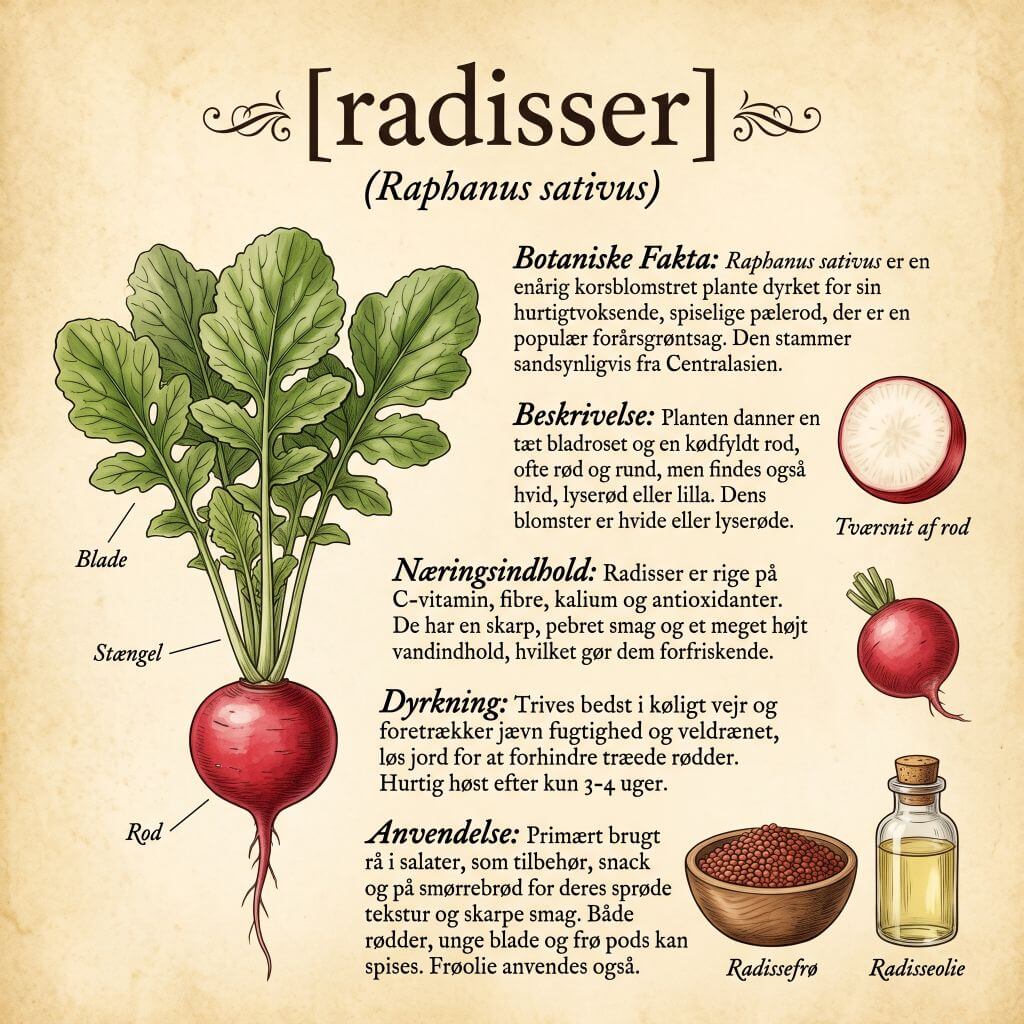
The radish is thought to originate in China, where it has been cultivated as a food crop for a very long time. From there it moved westward, and along the way it was bred into the many forms we know today — from the small, round, red spring radish to the large, pale varieties used in Asian cuisines.
A large part of the radish’s success comes down to speed. It’s one of the fastest crops there is, and at a time when the larder was empty by late winter, a vegetable that could be harvested two weeks after sowing was close to a miracle. That trait is still why the radish is the classic beginner’s plant in the kitchen garden.
The Radish in Denmark
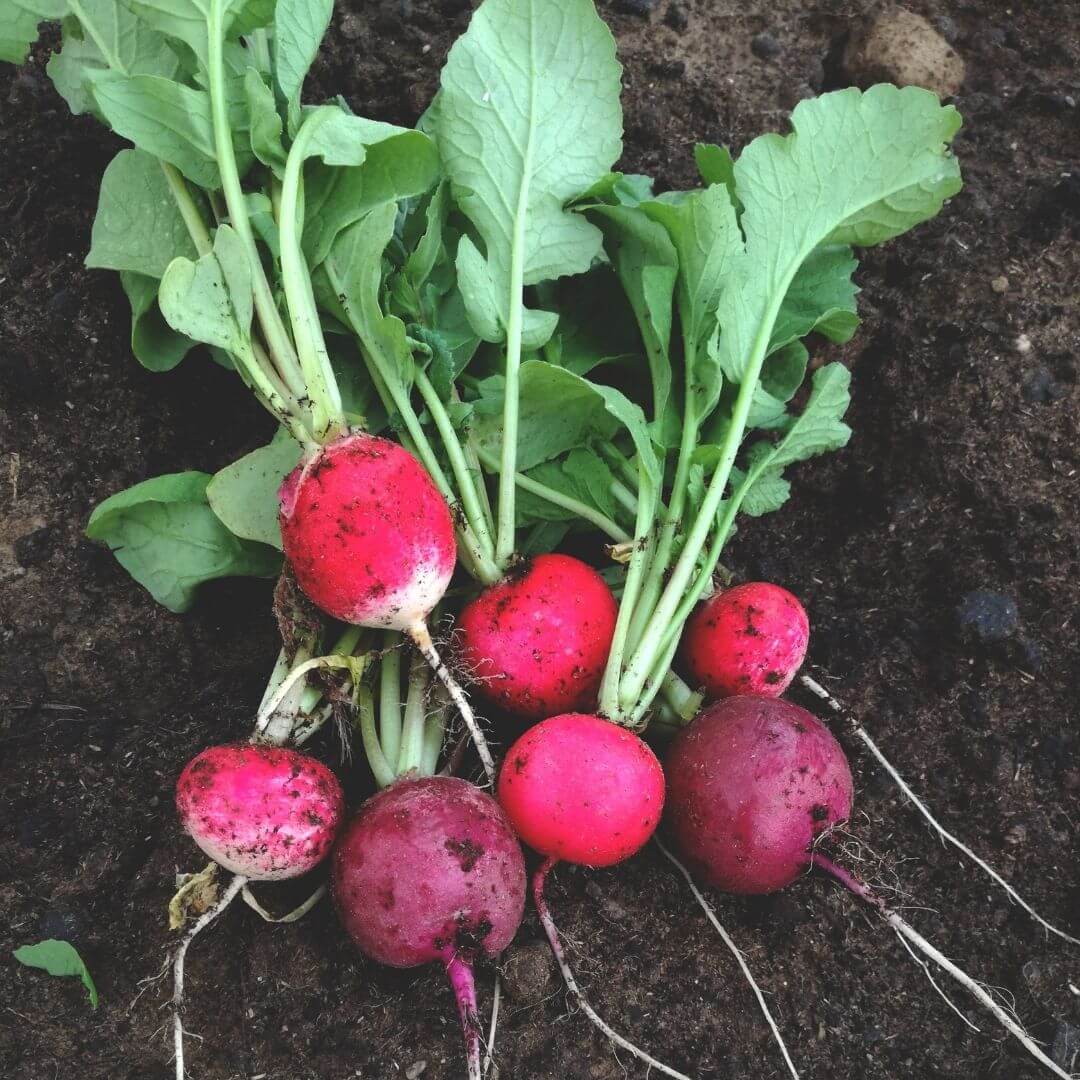
The radish arrived in Denmark in the 1600s, but it wasn’t truly widespread until the 1800s. It’s therefore a relatively young vegetable in a Danish context — and yet today it’s such a fixture of the spring table that most Danes associate it with smørrebrød and the cold table without even thinking about it.
Today, radishes are grown both outdoors and in greenhouses, and with greenhouse cultivation and successive sowing, the Danish season stretches from early spring well into autumn. In my own garden, I sow a new little batch every other week — it’s the only way to avoid everything being ready at once.
Flavor and Aroma
The Peppery Bite
The radish’s flavor is fresh, lightly sweet, and has a distinct peppery sharpness in the aftertaste. The sharpness comes from mustard oils, glucosinolates, which are only released in earnest when the cells are broken — that’s why a radish you bite into tastes more pronounced than one sliced thin in a salad.
Texture matters at least as much as flavor. A good radish is firm and crisp all the way through, and it’s precisely that crunch that makes it so useful as a contrast to soft and rich foods — butter, salmon, avocado, creamy dressing.
Size Determines the Strength
Here’s the most important thing I’ve learned about radishes: the first, small radishes have the mildest flavor. Harvest them at 1-2 cm in diameter. If you let them grow bigger, they lose flavor quality, and the sharpness takes over at the expense of the sweetness. If your radishes have become too strong, the culprit is rarely the variety — it’s the harvest timing.
Culinary Uses
In the Danish Kitchen
In Denmark, the radish is used almost exclusively raw, and it has a permanent place on the cold table. It works both as a flavor and as a garnish — the red slices with the white core bring an otherwise pale open sandwich to life.
- Smørrebrød: on rye bread open sandwiches, classically with butter and salt.
- Salad: in thin slices in a green salad.
- Side dish: as a fresh, crisp accompaniment and garnish for the cold table.
Internationally
Outside Denmark, the radish is treated with more confidence — not as a garnish, but as an ingredient with a job to do. Three classics are worth stealing:
- France: radis au beurre — whole radishes served with butter and sea salt.
- Mexico: thin slices as a crisp topping on tacos and pozole.
- Japan: daikon, a large, mild type of radish, grated or pickled as a side.
In the Air Fryer
Radishes don’t have to stay on the cold table. Heat mellows the volatile mustard oils, so a radish that’s been warmed becomes milder and softer than the raw one — the sweetness comes forward, and the sharp bite retreats. Halve them so the cut side faces down into the basket, and keep an eye on them as they cook: they’re small and go from crisp to soft fast.
My recommendation, though, is to use them both ways in the same dish — some warm and mild, the rest raw and sharp, scattered on top at the end. The contrast is the whole point.
Health Benefits
Nutritional Content per 100 g
The radish is a light vegetable. At 12 kcal per 100 g, it’s among the least energy-dense things you can put on your plate, and yet it contributes a decent amount of vitamin C.
- Vitamin C: 33 mg per 100 g.
- Folate: 24 µg per 100 g.
- Dietary fiber: 1.3 g per 100 g.
- Carbohydrate: 1.2 g per 100 g.
- Protein: 0.8 g per 100 g.
- Fat: 0.1 g per 100 g.
Good to Know
Radishes don’t contain any common allergens. As mentioned, the sharp flavor comes from mustard oils, and in larger amounts they can irritate the stomach in sensitive individuals — but eaten in normal amounts as a side, it’s nothing you need to worry about.
Growing
Season and Sowing
Radishes are sown directly where they’ll grow — they don’t need to be pre-cultivated or pricked out. Outdoors, sow them from April, once the frost has left the ground, and in a greenhouse or cold frame you can get started as early as the beginning of March. The outdoor season runs roughly from May to September.
The key to a long season is successive sowing: a new batch every other week until August. Sow a whole row at once, and you’ll end up with a hundred radishes the same weekend — half of which grow too big before you manage to eat them.
Growing Conditions
- Soil: light, porous, and moist soil that isn’t too rich in nutrients.
- Light: a bright spot, but ideally with shade at midday — radishes don’t thrive in direct sun all day.
- Hardiness: annual and cool-tolerant; the seeds germinate at as low as approx. 3 °C.
- Height: approx. 10-20 cm of leaf top.
- Time to harvest: 2 weeks in peak season, up to 6 weeks in colder weather.
Total time: 2-6 weeks
- Choose the spot
Find a bright spot, ideally with shade at midday. Radishes don’t thrive in direct sun all day.
- Prepare the soil
Loosen the soil so it’s light, porous, and moist. Skip heavy fertilizing — radishes want soil that isn’t too rich in nutrients.
- Sow the seeds
Sow directly where they’ll grow from April outdoors, or as early as the beginning of March in a greenhouse or cold frame. Sow a new batch every other week until August.
- Water evenly
Keep the soil evenly moist while the radishes grow.
- Harvest on time
Harvest at 1-2 cm in diameter — after about 2 weeks in peak season and up to 6 weeks in colder weather. Larger radishes lose flavor quality.
Storage
Trim the Tops Right Away
The most important step is also the one most people skip: trim off the leafy tops as soon as the radishes come inside. With the tops trimmed, radishes keep in the fridge’s crisper drawer for about a week.
How to Revive Limp Radishes
If they’ve gone soft, they’re not necessarily a lost cause. A bath in cold water will freshen them up again, and most will regain their firmness. Good radishes are always recognized by the same thing: they’re firm and crisp.
- Trim the tops before storing.
- Crisper drawer: keeps for about 1 week in the fridge.
- Cold water: limp radishes can be freshened up.
- Quality check: good radishes are firm and crisp.
Try This Recipe
The radish’s peppery bite is made to meet spicy, rich fish — that’s exactly why Mexicans put raw radish slices on their tacos. I use the same trick in my recipe for Mexican Salmon in the Air Fryer – Juicy and Spicy in 20 Minutes, where a scattering of thin radish slices at the end adds cold crunch as a counterweight to the chili and warm salmon. Slice them only once the salmon is ready — that way they keep their crispness.
Equipment and Products
Radishes and salmon are a Danish classic on rye bread, and here the quality of the fish is crucial. Cured salmon from a local smokehouse with a layer of thin radish slices and a little dill hits the same contrast as on the cold table: sweet, salty, and crisp in the same bite. Choose firm radishes for this kind of open sandwich — limp radishes simply disappear into the rich fish.
Frequently Asked Questions
In peak season, it only takes 2 weeks from sowing to harvest. In colder weather, it can take up to 6 weeks.
The sharpness comes from mustard oils, and it takes over once the radishes get too big. Harvest them at 1-2 cm in diameter — the first small radishes have the mildest flavor.
Yes. The heat mellows the volatile mustard oils, so the radishes become milder and softer while the sweetness comes forward. Halve them and keep an eye on them as they cook — they’re small and go from crisp to soft fast.
Trim off the tops and store them in the fridge’s crisper drawer, where they’ll keep for about a week. Limp radishes can be freshened up in cold water.
Outdoors, roughly from May to September. From a greenhouse or cold frame, they can be sown as early as March-April, and successive sowing every other week until August gives a long season.
Facts About Radishes
| Field | Value |
|---|---|
| English name | Radishes |
| Latin name | Raphanus sativus var. sativus |
| Family | Cabbage family (Brassicaceae) |
| Plant type | Annual herb |
| Height | Approx. 10-20 cm (leaf top) |
| Hardiness | Cool-tolerant; seeds germinate at approx. 3 °C |
| Light | Bright spot, ideally with shade at midday |
| Soil | Light, porous, and moist; not too rich in nutrients |
| Sow/plant | March-April in greenhouse or cold frame; April-August outdoors |
| Harvest | May-September outdoors; 2-6 weeks after sowing |
| Calories per 100 g | 12 kcal |
| Flavor | Fresh and peppery; mildest when the radishes are small |
| Culinary use | Raw on smørrebrød, in salads, and as a crisp side |
| Storage | Fridge crisper drawer with tops trimmed, approx. 1 week |
