

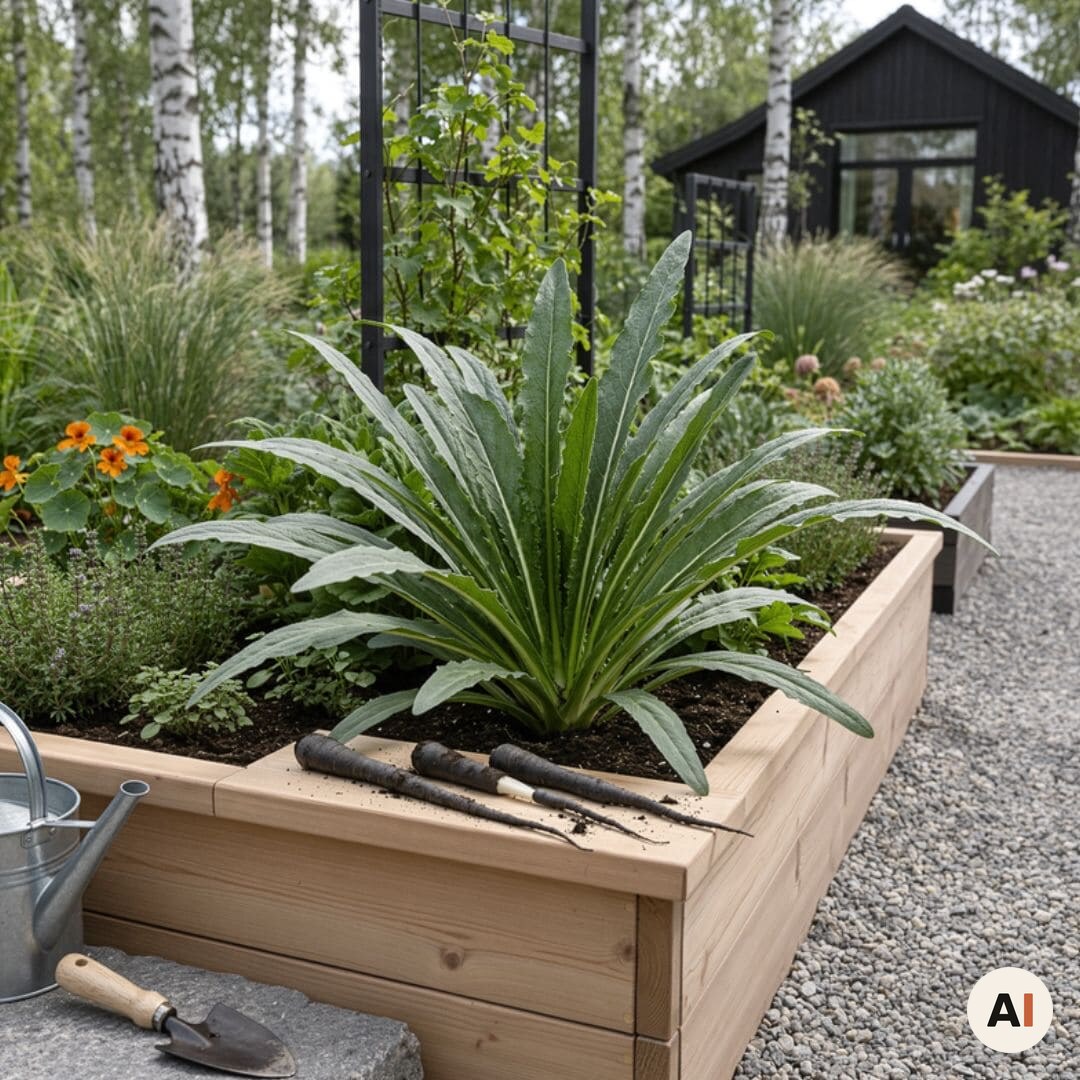
Black salsify is one of the most unappealing-looking vegetables in the produce aisle: long, black roots with soil in every crevice, which many people walk straight past. But beneath the black skin hides white, firm flesh with a fine, asparagus-like flavor – and that is exactly why I have grown so fond of it during the winter months.
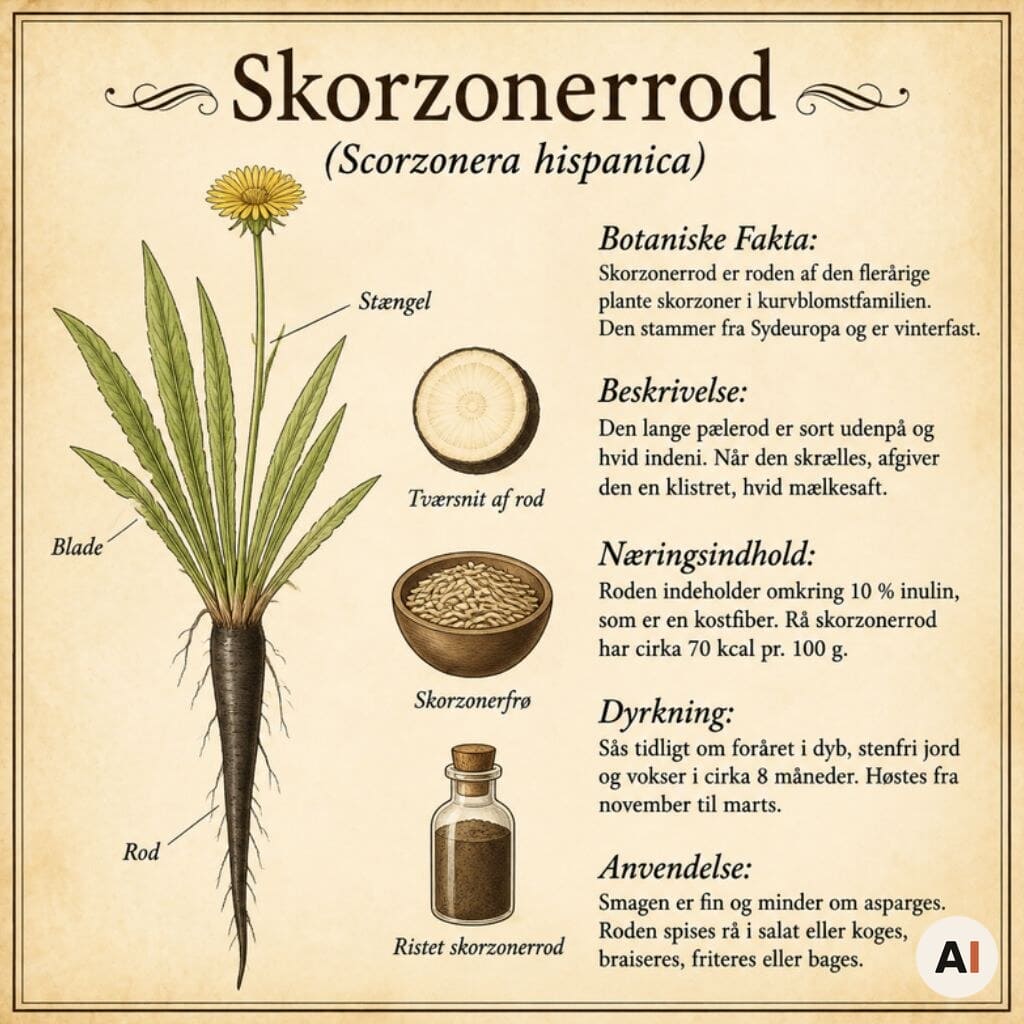
Black salsify is the long taproot of the scorzonera plant (Scorzonera hispanica), which belongs to the daisy family. It is normally harvested from November to March, so it is a true winter vegetable that you can dig up fresh while the rest of the vegetable garden rests.
In this entry I tell you where black salsify comes from, what it tastes like, how to peel it without brown fingers, and how to grow it yourself. And then you get my best tip for baking it golden and crisp in the air fryer.
Estimated reading time: 6 minutes
History and Origin
From Southern Europe to Northern Vegetable Gardens
Black salsify originates in Southern Europe, and the Latin name gives that away too: the species name hispanica means Spanish. Here in northern Europe it is a newcomer, then, but one that has had plenty of time to settle in.
As a vegetable, black salsify has in fact been known in Western and Northern Europe since the 1600s. In other words, it is not a new trend but an old vegetable-garden classic that has been grown for several hundred years.
A Fashionable Vegetable in France
In France, black salsify became a fashionable vegetable that Louis XIV prized. So the black root has had its place at the finest tables too – a fun contrast to the earthy reputation many root vegetables otherwise have.
Family and Relatives
Scorzonera belongs to the daisy family (Asteraceae) – the same large family as dandelion, sunflower and Jerusalem artichoke. Like the dandelion, it has a white milky sap, which you notice the moment you cut into the root.
The plant is biennial to perennial, but in the vegetable garden it is normally grown as an annual, so the root is harvested as early as the first winter after sowing.
Flavor and Aroma
Delicate and Asparagus-Like
The taste is what surprises most people. Black salsify has a fine, asparagus-like flavor with a mild sweetness – it contains 6.6 g of sugars per 100 g – and it is far more elegant than the black, earthy skin suggests.
I usually say it tastes like something between asparagus and a mild root vegetable. That is why it works really well in dishes where you would otherwise use asparagus.
Texture – Raw and Cooked
Raw, the white flesh is firm and crisp, so it can be cut into thin slices or fine sticks for a salad. Boiled, the root becomes tender and soft, while in the air fryer it gets golden, lightly caramelized edges and a tender, juicy center.
Culinary Uses
In the Kitchen
Traditionally, black salsify is boiled as a vegetable, but it can also be eaten raw in a salad, or braised and deep-fried. You can boil it with the skin on and peel it afterward, which is the easiest route to clean fingers.
Because the flavor is so mild, the root is very versatile. It goes well with fish, poultry and white meat. Here are the ways I use it most often:
- Boiled black salsify: tossed in butter, lemon and fresh parsley as a side dish for fish or chicken.
- Raw in salad: cut into thin slices or fine sticks and tossed in lemon juice so they keep their white color.
- Braised black salsify: simmered until tender in butter and a little stock.
- Deep-fried sticks: crisp on the outside and tender inside – here the air fryer is a good alternative to the deep fryer.
- Black salsify in bacon: wrapped up like asparagus and baked until the bacon is crisp.
How to Avoid Brown Fingers
When you peel or cut a raw black salsify root, a white, sticky milky sap seeps out that stains your fingers brown. So peel the roots under running water – or boil them first and remove the skin afterward. A pair of disposable gloves doesn’t hurt either.
Peeled roots turn brown quickly, so put them straight into a bowl of water with lemon or vinegar while you peel the rest.
In the Air Fryer
Black salsify baked in the air fryer is my clear favorite. I peel the roots, cut them into sticks of the same length and thickness, and put them in lemon water. Right before they go into the basket, I pat them thoroughly dry and toss them in a little oil and salt.
Spread the sticks out in a single layer so the hot air can circulate around them, and shake the basket halfway through. They are done when the edges are golden and a knife slides through easily. At the end, I like to toss them in grated Parmesan or a knob of butter with grated lemon zest.
Health Benefits
Nutritional Content
Black salsify provides 73 kcal per 100 g and consists for the most part of water. It contributes dietary fiber and potassium, and the fat content is very low. Here is the nutritional content per 100 g of raw black salsify:
- Energy: 73 kcal
- Water: 79 g
- Protein: 3.3 g
- Fat: 0.4 g
- Carbohydrates: 10.5 g, of which 6.6 g sugars and 3.9 g starch
- Dietary fiber: 7 g
- Potassium: 387 mg
- Phosphorus: 94 mg
Inulin – the Root’s Special Carbohydrate
Black salsify contains about 10% inulin, a carbohydrate that the body can’t break down on its own. Instead, it reaches the large intestine, where it becomes food for the gut bacteria.
Inulin is mildly laxative, and a large portion can cause gas if you aren’t used to it – a bit like with Jerusalem artichokes. If you are sensitive, start with a smaller portion as a side dish.
Growing
Soil and Sowing
Scorzonera takes a little patience: it is about 6 months from sowing to harvest. The root grows 30–50 cm long, so the soil must be loose and stone-free to a depth of two spade blades, otherwise the roots will have trouble growing straight down.
Both sandy and clay soil can be used as long as it is loose, and the pH should be 6.5–7. I give the bed a good helping of well-rotted compost before I sow in late April or early May.
- Soil: loose and stone-free to a depth of two spade blades – sandy or clay soil.
- pH: 6.5–7.
- Fertilizer: well-rotted compost.
- Sowing time: late April to early May.
- Sowing depth: 1.5 cm – deeper than 2 cm gives poor germination.
- Row spacing: 40 cm.
- Development time: about 6 months.
- Harvest: November to May.
- Hardiness: fully winter-hardy.
Hardiness and Varieties
Scorzonera is fully winter-hardy, and the roots can stay in the ground all winter. If you let the plant stand until the following year, it can grow a meter tall with yellow flowers. Well-known varieties are Russian Giant and Hoffmanns Schwarzer Pfahl.
How to Grow Black Salsify
Here is my approach from sowing to harvest:
Total time: about 6 months
- Prepare the soil
Dig the soil loose to a depth of two spade blades, remove all stones, and mix in well-rotted compost.
- Sow the seeds
Sow the seeds in late April to early May in 1.5 cm deep furrows with 40 cm between the rows. Don’t go deeper than 2 cm, as that gives poor germination.
- Tend the plants
Keep the rows free of weeds, and water during dry spells so the roots can grow long and straight through the summer and fall.
- Harvest the roots
Harvest from November to May. Loosen the soil on both sides of the row with a digging fork, take a good hold of the top of the root, and pull it straight up in one long, steady pull.
Storage
Best in the Ground
The best storage is actually no storage at all: leave the roots in the ground and dig them up as needed. That way they are always fresh, and you can harvest all the way until May.
After Harvest or Purchase
Harvested roots can be stored in sand or in a plastic bag in the refrigerator for about a week. If you buy black salsify, choose firm roots without breaks or soft spots.
- In the ground: let the roots stay in over the winter, and dig them up as needed.
- In sand: put harvested roots in a box of sand in a cool place.
- In the refrigerator: in a plastic bag for about a week.
- Peeled roots: straight into water with lemon or vinegar so they don’t turn brown.
Try This Recipe
The fine, asparagus-like flavor of black salsify makes it an obvious stand-in for asparagus when the season for those is over. Try our recipe for Asparagus with Bacon in the Air Fryer – Crispy Bacon and Tender Spears in 27 Minutes, and swap the asparagus for peeled black salsify cut into sticks. I parboil the sticks myself until they are almost tender, so they finish at the same time as the bacon turns crisp. The salty bacon and the mild, slightly sweet root are a pairing I return to every winter.
Frequently Asked Questions
Black salsify has a fine, asparagus-like flavor with a mild sweetness. Raw, it is firm and crisp, boiled it becomes tender, and in the air fryer it gets golden, lightly caramelized edges.
The root releases a white, sticky milky sap that stains your fingers brown. Peel it under running water, or boil the roots first and remove the skin afterward. Disposable gloves help too.
Yes. Raw black salsify can be used in salads, cut into thin slices or fine sticks. Toss it straight away in a little lemon juice so it doesn’t turn brown.
Black salsify is normally harvested from November to March. Because the root can stay in the ground over winter, it can be harvested all the way until May.
Yes, and it is one of my favorites. Peel the roots, cut them into sticks of equal length, pat them dry, and toss them in a little oil and salt. Bake them in a single layer and shake the basket halfway through, until they are golden at the edges and tender inside.
Facts About Black Salsify
| Field | Value |
|---|---|
| English name | Black salsify |
| Latin name | Scorzonera hispanica L. |
| Family | Daisy family (Asteraceae) |
| Plant type | Biennial to perennial plant, normally grown as an annual; long, black taproot with white flesh |
| Origin | Southern Europe |
| Height | A meter tall when in flower; the root grows 30–50 cm long |
| Hardiness | Fully winter-hardy |
| Soil | Loose and stone-free to a depth of two spade blades, pH 6.5–7 |
| Sow/plant | Late April to early May, 1.5 cm deep |
| Flowering/harvest | Yellow flowers; normally harvested November–March and can be harvested all the way until May |
| Varieties | Russian Giant, Hoffmanns Schwarzer Pfahl |
| Calories per 100 g | 73 kcal (raw) |
| Flavor | Fine and asparagus-like with a mild sweetness |
| Culinary use | Boiled, raw in salad, braised, deep-fried and baked in the air fryer |
| Storage | In the ground over winter; harvested roots in sand or in a plastic bag in the refrigerator for about a week |
