

White cabbage is a classic kitchen-garden crop and one of the most versatile vegetables in Nordic cooking. The round cabbage with pale green leaves belongs to the so-called head cabbages in the brassica family and has been a staple food for centuries, able to keep all winter long. The cultivar Brassica oleracea var. capitata f. alba forms a dense, firm head in its first growing season, though the plant is actually biennial.

Advertisement: The page displays ads and contains advertising links (affiliate links). See our advertisers here.
With its mild flavor, good crunch and high nutritional value, white cabbage works equally well raw, in hot dishes and for pickling. It’s cheap, long-lasting and available in every Danish greengrocer year-round – a true workhorse of the kitchen.
Estimated reading time: 8 minutes
What Is White Cabbage?
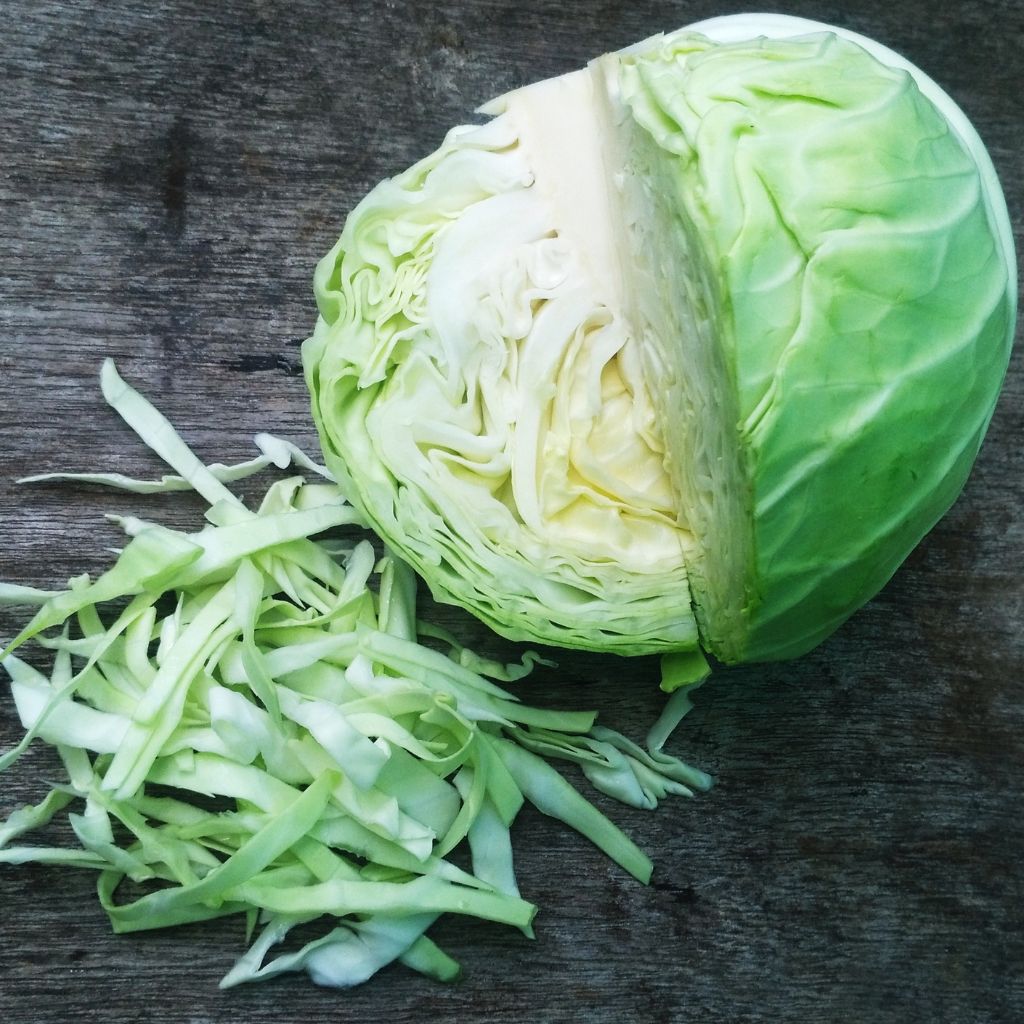
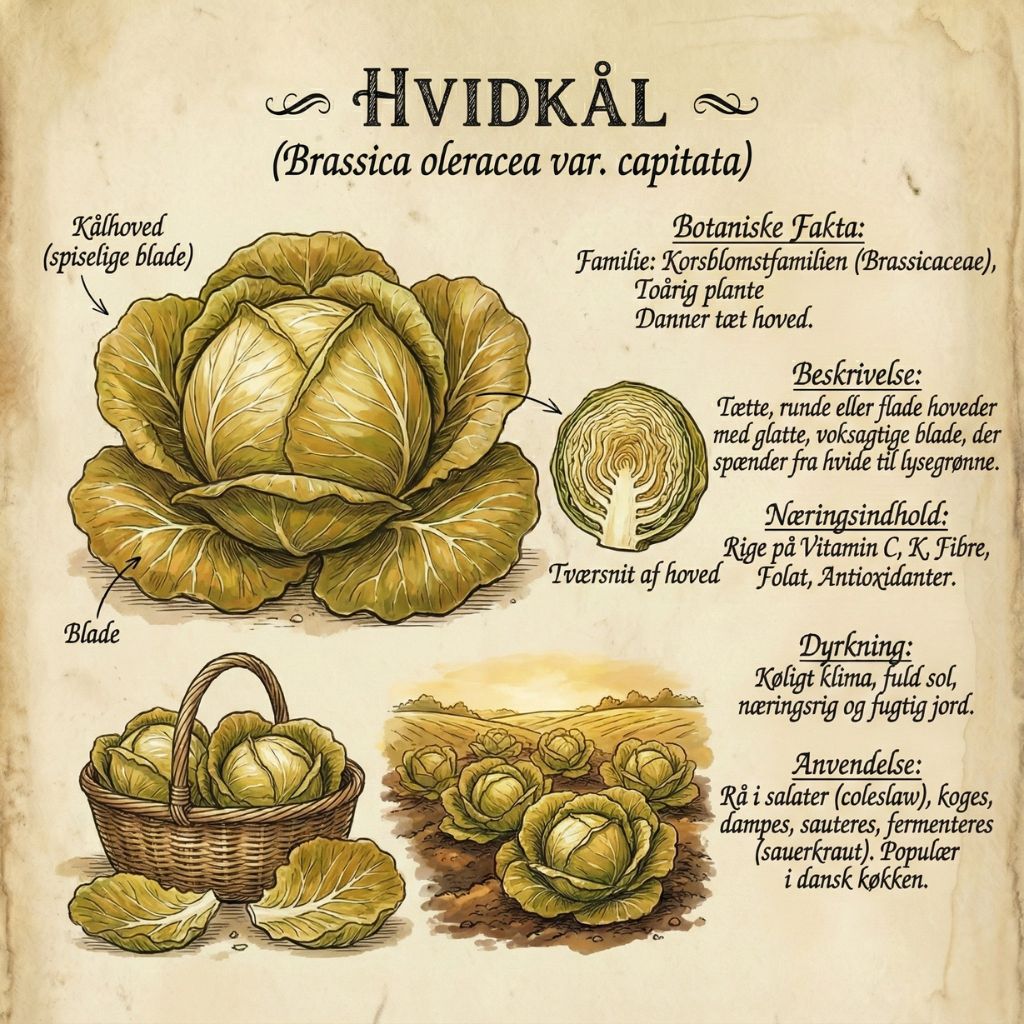
White cabbage is a cultivar of wild cabbage (Brassica oleracea) and is closely related to red cabbage, pointed cabbage and savoy cabbage. The plant forms a rosette of large leaves that curl inward to create a dense, ball-shaped head. The head typically weighs 500–1000 g, but during the long Nordic summer days it can grow considerably larger.
White cabbage has smooth, pale green leaves with a thick midrib; the leaves sit layer upon layer, protecting each other from sun and frost. The stem is short, and the root system consists of many fine fibrous roots that lie mainly in the top 20–30 cm of soil. Since the plant is biennial, it would flower and set seed in its second year, but in the kitchen garden the head is harvested in the first season.
History and Origin
White cabbage was likely developed somewhere in Europe before 1000 BC and has been cultivated in the Nordic region for several hundred years. In the Middle Ages, head cabbage became an important part of European food culture and was grown in monastery gardens and farmers’ fields.
Over time, cabbage has been bred into a wealth of shapes and colors; white cabbage stands out for its firm head and pale color. The cabbage features in many traditional dishes: as creamed cabbage with spices, in soups and stews, for sauerkraut and pickling, and in small, stuffed cabbage rolls. Many European languages use words derived from the Latin caulis (stalk), a testament to the plant’s long cultural significance.
Flavor and Aroma
White cabbage has a mild, slightly sweet flavor that pairs well with tangy, salty and spicy components. Raw, it’s fresh and crisp with a faint peppery undertone, while long cooking brings out a round, almost caramel-like sweetness. The characteristic sulfur compounds give the cabbage its slightly sharp aroma, which mellows significantly with heat.
Try combining it with apples, pears, carrots, cranberries or citrus fruit in salads. In hot dishes it pairs well with pork, bacon, potatoes, onions, mushrooms and spices such as cumin, coriander, Juneper, fennel and curry. Sauerkraut is often seasoned with bay leaf and Juneper, while kimchi is spiced with chili, garlic and ginger. White cabbage also works well in Nordic dishes with mustard, dill and parsley.
Culinary Uses
The mild, slightly sweet flavor makes white cabbage highly versatile in the kitchen. The cabbage can be boiled, steamed, sautéed, braised, fermented or roasted – and it works equally well raw or cooked.
In Danish Cuisine
Raw white cabbage can be cut into fine strips for coleslaw, raw salads or salads with apple, carrots, onion and a tangy dressing. The leaves stay crisp even with dressing, and whole leaves can be used as an edible bowl or to wrap meat filling, rice or vegetables for stuffed cabbage rolls. Creamed white cabbage served with pork and white cabbage salad are among the classic Danish dishes.
Internationally
White cabbage is used all over the world: for fermentation as German sauerkraut and Korean kimchi, in Eastern European cabbage rolls (gołąbki), in Irish colcannon, and in Asian wok and noodle dishes. The cabbage’s neutral flavor makes it an ideal carrier for strong spices and marinades.
In the Airfryer
White cabbage is excellent in the airfryer. Cut the head into wedges, brush with oil and season with salt, pepper and optionally smoked paprika. At 190 °C for 12–15 minutes, the edges turn crispy and lightly charred while the center stays tender and sweet. Finely shredded cabbage can also be roasted into crispy cabbage chips in just a few minutes.
Health Benefits
White cabbage consists of around 92 % water and contains only about 25 kcal per 100 g. It’s rich in dietary fiber and contains roughly 5.8 g carbohydrate, 2.5 g fiber, 1.3 g protein and almost no fat per 100 g. The high fiber content contributes to a good sense of fullness and healthy digestion.
Vitamins and Minerals
White cabbage is an excellent source of vitamin C and vitamin K, and also contributes folate, vitamin B6 and several minerals:
- Vitamin C: approx. 36 mg per 100 g
- Vitamin K: approx. 76 μg per 100 g
- Folate: approx. 43 μg per 100 g
- Potassium: approx. 170 mg per 100 g
- Smaller amounts of calcium and iron
Glucosinolates and Digestion
The characteristic sulfur compounds (glucosinolates) give the cabbage its slightly sharp aroma and are being studied for their potential beneficial effects on immune function and cell health. Fermented white cabbage such as sauerkraut also adds lactic acid bacteria, which can support a healthy gut flora.
Growing
White cabbage thrives best in nutrient-rich, loamy soil with a pH of 6.5–7.5. It’s a good idea to prepare the soil with compost and a light dusting of lime before sowing or planting, and avoid fresh manure, which can attract pests. Cabbage has a high need for water and nutrients; a lack of fertilizer or water, especially in July when the head is forming, results in smaller heads and lower yields.
Sowing and Care
White cabbage can be sown directly outdoors, but the very early and very late varieties should be started indoors in a greenhouse from late March to early April. After germination, thin out to the strongest plant. To avoid attacks from flea beetles and cabbage worms, it’s recommended to lay a layer of row cover or netting over the rows. Transplanting of pre-grown plants happens after 3–4 true leaves; water the planting hole thoroughly and plant preferably in overcast weather to spare the plants.
Plant spacing affects the size of the head. Normal spacing is 35–60 cm within the row and 45–70 cm between rows, while red cabbage and winter white cabbage require the widest spacing. During growth, the soil should be kept moist and covered with organic material to retain moisture and supply nutrients. White cabbage is prone to pests such as cabbage root fly and cabbage worms, as well as the disease clubroot; good crop rotation, netting and covering reduce the risk.
How to Grow White Cabbage
Total time: 3-5 months
- Prepare the soil
Prepare nutrient-rich, loamy soil with pH 6.5-7.5, add compost and a light dusting of lime.
- Sow or start indoors
Sow directly outdoors from mid-April, or start early and late varieties indoors in a greenhouse from late March.
- Transplant and protect
Transplant after 3-4 true leaves with 35-60 cm spacing in the row and cover with netting against cabbage root fly and cabbage worms.
- Water and tend
Water evenly, keep the soil moist and covered, and fertilize as needed throughout summer.
- Harvest
Harvest when the head feels firm and heavy, 3-5 months after sowing.
Storage
White cabbage is ready for harvest 3–5 months after sowing, depending on variety and growing conditions. The head is ready when it feels firm and heavy; cut the head off with a sharp knife and leave the bottom leaves and stalk standing, so the plant can sprout small side shoots for mini cabbages later in the season.
Shelf Life and Cold Storage
Fresh heads can be stored for a long time. For long-term storage, the cabbage should be kept cool (around 0–2 °C) and humid (90–100 % humidity). Under optimal conditions, white cabbage can keep for up to six months, but in the refrigerator or pantry it lasts a few weeks.
- Store whole heads in a perforated plastic bag or newspaper
- Remove the outer leaves as they dry out
- Shredded cabbage can be frozen after brief blanching
- Fermenting into sauerkraut gives months of shelf life
Look-Alikes and Quality Tips
White cabbage is often confused with pointed cabbage, which has a more conical, open head, and savoy cabbage, which has crinkled, darker leaves. Red cabbage is the same species, but the leaves are purple due to anthocyanins. When buying white cabbage, the heads should feel heavy for their size, and the leaves should sit tightly and be crisp.
Avoid heads with cracks, brown spots or limp leaves. The cabbage’s stalk and leaves should be firm and free of discoloration. Choose organically grown cabbage when possible, and use the whole head – the outer leaves can be used in stock or vegetable juice.
Sustainability and Biodiversity
White cabbage can be grown almost anywhere and is well-suited to a cool climate. Its long shelf life means it can be stored through the winter, reducing the need for transport during the winter months. However, cabbage requires a fair amount of nutrients and water, so it’s a good idea to use compost, green manure and soil cover to preserve soil fertility while reducing the need for artificial fertilizer.
By growing several types of cabbage and rotating with other vegetables such as beans, peas and celery, biodiversity in the garden is promoted. Surplus heads or cabbage stalks can be composted or fed to livestock, so nothing goes to waste.
Try This Recipe
White cabbage’s mild sweetness and crunch make it perfect as a fresh salad component alongside hot dishes from the airfryer. Finely shredded and tossed in a tangy dressing, it balances the rich, savory flavor of seared protein. Serve it as a fresh contrast to Airfryer Tofu – Crispy Asian Salad with Marinated Tofu, where the cabbage’s crunch pairs perfectly with the marinated tofu.
Equipment and Products
When white cabbage is roasted in wedges or served with classic roast pork, the right seasoning lifts the flavor significantly. A good roast pork salt highlights the cabbage’s natural sweetness and gives the crispy edges extra character. We recommend Flæskestegssalt Vestjyske Delikatesser for both cabbage and roast.
Frequently Asked Questions
To extend shelf life, white cabbage should be stored in a cool, humid environment. In an unheated cellar or a cool pantry, whole heads can keep for many weeks. For even longer storage, place the heads in a perforated plastic bag in the vegetable drawer of the refrigerator or in a cold cellar at 0-2 °C and high humidity.
Yes. Its mild flavor makes white cabbage ideal for salads, coleslaw and raw dishes. Grate or shred it finely and add a tangy dressing to lift the flavor. Raw cabbage is rich in vitamin C and dietary fiber.
Both are head cabbages of the same species, but red cabbage has purple leaves and contains anthocyanins, which give it its color. Red cabbage has a stronger flavor and is often used for pickling, while white cabbage is milder and more versatile.
Splitting occurs when the cabbage grows very quickly or after rainy periods, when the plants absorb large amounts of water. This can be remedied by sowing and transplanting at 3-4 week intervals, watering evenly and avoiding large swings in moisture.
Yes. Cut white cabbage into wedges, brush with oil and season. At around 190 °C for 12-15 minutes, the edges turn crispy and caramelized while the center stays tender and sweet. Finely shredded cabbage can also be roasted into crispy cabbage chips.
Facts About White Cabbage
| Field | Value |
|---|---|
| English Name | White Cabbage |
| Other Names | Head Cabbage, Common Cabbage |
| Latin Name | Brassica oleracea var. capitata f. alba |
| Family | Brassicaceae (mustard/cabbage family) |
| Plant Type | Biennial leaf vegetable (grown as an annual) |
| Height | 40–60 cm in the first year |
| Soil and Location | Nutrient-rich, loamy soil with pH 6.5–7.5; sunny location |
| Sowing/Planting | Start indoors from late March to early April, or sow directly from mid-April; spacing 35–60 cm in rows, 45–70 cm between rows |
| Harvest | After 3–5 months, from early summer to late autumn depending on variety |
| Calories per 100g | Approx. 25 kcal |
| Key Nutrients | Vitamin C, vitamin K, folate, potassium, dietary fiber |
| Flavor | Mild and slightly sweet with a crisp texture |
| Uses | Raw dishes, salads, coleslaw, soups, stews, braised, sauerkraut, kimchi, stuffed cabbage leaves |
| Storage | Cool (0–2 °C) and humid; weeks to months in a perforated plastic bag or cold cellar |
