

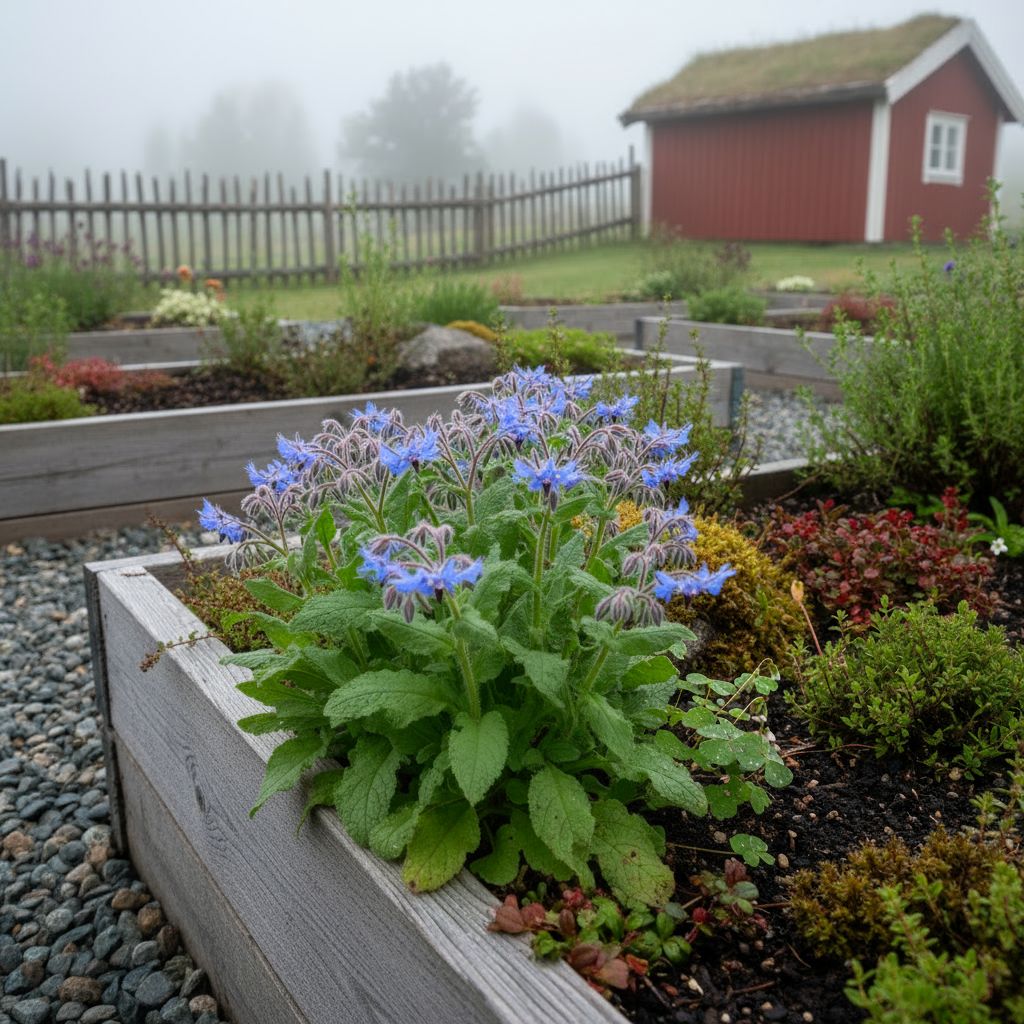
Borage is an annual herb in the borage family, with star-shaped, sky-blue flowers. It’s a feast for the eyes in the kitchen garden, and its cucumber-scented leaves and decorative flowers make it popular in drinks and salads. The plant is also called cucumber herb or starflower, and its Latin name is Borago officinalis.

Advertisement: The page displays ads and contains advertising links (affiliate links). See our advertisers here.
But the plant’s vigorous growth and content of pyrrolizidine alkaloids call for caution: it self-seeds readily, and large amounts can burden the liver. In this article you’ll get an in-depth portrait of borage, its history, uses and cultivation in Denmark – along with a clear caveat about how to enjoy it safely.
Estimated reading time: 9 minutes
History and origin
From antiquity to monastery gardens
Borage originally hails from Palestine, Syria and southeastern Turkey, but has naturalized across large parts of Europe and the Middle East. It has been cultivated as a medicinal and culinary herb since antiquity and was known by the Greeks and Romans for its ability to “gladden the heart”; it was added to wine blends meant to lift the spirits. Danish sources from the 1800s mention borage as part of monastery and kitchen gardens, where it was used in herb salt, soups and medicinal extracts.
Spread and folklore
The plant came to Northern Europe via the Mediterranean and spread quickly as a garden plant, because it’s easy to grow and self-seeds. In folklore, the flowers were placed in bouquets in some regions to ward off evil spirits, and a wine infusion was drunk as a “courage tonic,” meant to give warriors courage. Today, borage is grown in both kitchen gardens and flower beds for its beautiful flowers and as a plant for pollinators.
Flavor and aroma
Borage has a fresh, slightly salty flavor with a distinct cucumber note – hence the name cucumber herb. The leaves are covered in fine, stiff bristles, so they’re best used finely chopped when eaten raw. The star-shaped blue flowers are mild and slightly sweet, with the same cucumber-like freshness. An important kitchen principle is that heat destroys both color and flavor: both leaves and flowers should therefore be used raw or added right at the end.
Borage is especially good in dishes that need a fresh kick:
- Mix finely chopped leaves into cold potato soup or cucumber soup for extra freshness.
- Scatter blue flowers over a fresh spinach salad with feta and radishes.
- Make an herb mayonnaise by blending leaves with oil, lemon and egg yolk.
- Use the flowers as a garnish in cocktails, lemonade and gin.
- Season a yogurt or quark dip with finely chopped leaves and lemon zest.
Because of the bristles, it helps to mix borage with other herbs like parsley, dill or basil, which soften the sensation in the mouth.
Culinary use
It’s mainly the young leaves and the blue flowers that are used in the kitchen – and always in moderate amounts. The seeds contain around 30% oil, of which about 20% is gamma-linolenic acid (GLA), and this borage oil is extracted commercially for dietary supplements and skincare.
In Danish cuisine
In Denmark, the fresh leaves are used finely chopped in cold soups, salads and dips, while the raw flowers are a classic edible garnish on salads, summer fruit and desserts. The flowers can be frozen in ice cubes to make decorative ice cubes for summer drinks, and they can release an edible blue dye that colors vinegar or drinks.
Internationally
In English drinking tradition, whole leaves and flowers are a classic flavoring in Pimm’s and other wine-based summer drinks. In microbreweries and distilleries, the flowers are added to gin and liqueurs for a distinctive, spicy note. Traditionally, blue dye from the flowers was also used to color liqueurs and vinegar.
Preparation
Borage doesn’t tolerate heat well. Add the leaves at the very end of the dish or use them in cold dishes, and add the flowers just before serving. Dried leaves lose both color and flavor, so the plant should be used fresh – only the dried stems can be kept as a mild flavoring for tea or schnapps.
Health benefits and precautions
Traditional properties
Borage has been part of folk medicine for centuries and was considered a strengthening herb that could relieve melancholy and lift the mood. The leaves contain mucilage and were traditionally used as a mild diaphoretic, diuretic and expectorant remedy for fever, coughs and colds, while mashed leaves were applied externally to swellings. The seed oil with gamma-linolenic acid is used today in dietary supplements and skincare.
Important caution about pyrrolizidine alkaloids
The whole plant – but not the purified seed oil – contains small amounts of pyrrolizidine alkaloids, which in large quantities can burden and damage the liver. The Danish Veterinary and Food Administration (Fødevarestyrelsen) has placed borage on its list of restricted medicinal plants and advises against large intake. In normal kitchen amounts – a few leaves or flowers as garnish – the content is low, but the plant should be enjoyed in moderate amounts and not as a daily food. Pregnant and breastfeeding women, as well as people with liver problems, should avoid eating the leaves and flowers altogether, and medicinal use should only be done in consultation with a professional.
Cultivation
Borage is one of the easiest herbs to grow. It thrives in ordinary garden soil but prefers dry, sunny conditions and well-drained soil, and does particularly well on lean, chalky sandy soils, where the flower color becomes a deeper blue. The plant is drought-tolerant thanks to a strong taproot, and although it’s an annual, it comes back every year through self-seeding. It tolerates a wide pH range of 4.8–8.3 and can be grown in pots if the pot is deep enough for the root.
How to grow borage
Total time: 1 season
- Sow directly
Borage develops a strong taproot and doesn’t transplant well. So sow the seeds directly at the growing site in April-May, 1-2 cm deep, once the soil is warm. The seeds germinate in about 10 days.
- Thin out
When the seedlings have 2-3 leaves, thin them to 25-30 cm apart so they can spread. The plant grows up to 70 cm tall.
- Light, soil and water
Choose a bright spot with full sun and dry, well-drained soil. Water only during dry spells for more abundant flowering, and avoid overwatering, as the roots can otherwise rot. Fertilizing is rarely necessary.
- Harvest leaves and flowers
Harvest the younger leaves when the plants are 15-20 cm tall, and use them right away. Pick the flowers in the morning, just after they’ve opened, for the most intense color.
- Let it self-seed
Leave a few seed heads standing over winter so the plant self-seeds and returns next spring. Seeds germinate best if the soil is lightly disturbed by hoeing or weeding.
Watch out for powdery mildew, which often occurs during dry spells late in the season; good air circulation and morning watering help prevent it. Note that borage’s enthusiastic self-seeding can also turn it into an unwanted weed, so it may be wise to limit its space in the garden.
Look-alikes and quality
Borage can be confused with other plants in the borage family, especially common bugloss (Anchusa officinalis) and comfrey (Symphytum officinale), which also have hairy leaves and blue flowers. Borage is recognized, however, by its wheel-shaped star flowers and cucumber-scented leaves. Confusion with dangerous plants is rare, but only eat plants you can identify with certainty – especially since borage itself contains liver-affecting compounds.
Borage is rarely sold as a fresh herb in supermarkets, but can be found as small plants or seed packets at nurseries and markets. Choose plants with healthy, green leaves free of yellow spots and with fresh flower buds, and avoid plants with white mildew spots.
Storage
The youngest leaves are the most delicate and are picked continuously from spring to midsummer. They should be used right away, as they quickly lose flavor and color.
- Flowers are harvested from June to August and used the same day or frozen in ice cube trays for later use.
- Dried stems can be stored in jars and used as a mild flavoring for tea or schnapps.
- Seeds ripen irregularly; harvest the seed heads, let them ripen further in a dry place, and store the seeds somewhere cool. They remain viable for two to three years.
Try this recipe
Borage’s blue star flowers are one of the most beautiful edible garnishes you can put on a dessert. Scatter a few fresh flowers over a creamy summer dessert just before serving – you’ll get both a play of color and a subtle hint of cucumber. Try them on a Strawberry Dream in the Airfryer – fluffy almond base with creamy strawberry mousse.
Equipment and products
Borage is a classic flavoring in gin- and berry-based summer drinks, where the blue flowers float on top of the glass as a garnish. A berry liqueur provides a great base for such drinks, and fresh borage flowers on top enhance both color and aroma. See Bloom – Strawberry Gin Liqueur in the shop.
Sources and further reading
- Danish Wikipedia on Almindelig hjulkrone for botanical description, origin and warnings.
- Historiske planter (herb encyclopedia) for cultivation advice and historical uses.
- Useful Temperate Plants Database for information on cultivation, edible parts, medicinal properties and seed oil.
Frequently asked questions
Borage is an annual herb that doesn’t survive frost. It ensures its continued presence through self-seeding – if you leave a few seed heads standing, new plants will appear the following year.
Leaves and flowers can be eaten in small amounts, but the plant is on the drug list and contains pyrrolizidine alkaloids, which can be harmful to the liver. Use it only sparingly, and avoid it during pregnancy, breastfeeding, or if you have liver problems.
Sow the seeds directly at the growing site in April-May and cover them lightly. Keep the soil moist until they germinate. Avoid transplanting, as the taproot is sensitive.
Yes, but the pot needs to be deep enough to hold the long taproot. Use well-drained soil, water regularly, but avoid standing water. The plant can grow tall, so provide support.
The freshly chopped leaves are added to cold soups, salads and dips, while the flowers work well as a garnish on cakes, salads and drinks. Whole leaves are also used in drinks like Pimm’s. Always use the plant raw, as heat destroys both color and flavor.
Facts about borage
| Field | Value |
|---|---|
| English name | Borage (cucumber herb, starflower) |
| Latin name | Borago officinalis |
| Family | Borage family (Boraginaceae) |
| Plant type | Annual (self-seeding) |
| Height | 60–70 cm |
| Hardiness | Annual; doesn’t survive frost, but self-seeds |
| Light | Full sun / light shade |
| Soil | Dry, well-drained, sandy or stony; pH 4.8–8.3 |
| Sow/plant | Direct sowing April–May or September |
| Flowering | May–October |
| Harvest | May–September (leaves and flowers) |
| Flavor | Fresh, salty and cucumber-like |
| Culinary use | Salads, cold soups, drinks, edible garnish |
| Caution | Contains pyrrolizidine alkaloids; enjoy in moderate amounts, avoid during pregnancy/breastfeeding |
| Storage | Use fresh; leaves quickly lose flavor when dried. Seeds are dried for next season |
