

Capers are one of the Mediterranean’s most distinctive flavorings. The small, tart and peppery buds add depth to dishes from tapenade to meat marinades, and they have been part of human food culture for thousands of years. Today you’ll find them in brine on supermarket shelves, but behind the salty taste lies a fascinating plant with its own biology, cultural history, and cultivation challenges.

Advertisement: The page displays ads and contains advertising links (affiliate links). See our advertisers here.
Capers are the unopened flower buds of the evergreen shrub Capparis spinosa. The shrub is a low, widely spreading plant with thick, succulent leaves. Many wild varieties have thorns at the leaf stalk, but thornless cultivars also exist. In summer, the shrub develops large, decorative flowers with four white to pale pink petals and long violet stamens. If the buds aren’t harvested, the flower is followed by an elongated fruit, the caper berry, while it’s the small, green buds that are prized as a delicacy.
When the buds are harvested, they’re often dried briefly and then placed in salt or brine, where enzymes convert the mustard glycoside glucocapparin into mustard-like oils and the flavonoid rutin. This process gives capers their characteristic flavor and sometimes leaves white crystals of rutin on the buds.
Estimated reading time: 10 minutes
History and Origin
The caper shrub has a history stretching back to the Bronze Age. It’s native to the Mediterranean region and parts of the Middle East and North Africa, where it has been used as food and medicine for millennia.
From Antiquity to Today
In Greek and Roman culture, capers were both eaten and credited with healing properties; Pliny the Elder mentions the plant, and Ovid refers to capers as an aphrodisiac. Seeds were used to preserve wine, and the root bark was used against coughs, asthma, and arthritis. The caper shrub has also been used for soil improvement and erosion control, as its deep roots bind the soil on slopes.
Commercial Production
Commercial production is most widespread in countries like Morocco, Turkey, Spain, and Italy, where the buds are hand-picked in the morning during the summer months. The smallest buds – called nonpareilles – fetch the highest price, while larger buds and caper berries are often used for pickles. Capers have never been a native plant in Denmark, but importing pickled buds is popular. In newer Nordic cuisines, there’s experimentation with pickling local seed pods, for example unripe seeds of wild garlic or dandelion, as an alternative to pricier capers.
Flavor and Aroma
Capers have a complex flavor made up of salt, acidity, bitterness, and a mustard-like sharpness. The combination comes from the mustard glycosides released during fermentation and storage, and the small bud’s intensity gives dishes umami and depth.
Good Flavor Pairings
Capers pair especially well with tomato, lemon, olives, anchovies, garlic, and herbs like parsley and basil. They go well with fish and shellfish, lamb, beef, and game, and they complement creamy dishes like potato salad and mayonnaise. They can also provide contrast to sweet elements, for example combined with raisins in Sicilian dishes. Two important kitchen tips: always rinse capers briefly in water to remove excess salt or brine, and add them at the very end of cooking to preserve texture and aroma.
Culinary Uses
Capers are traditionally used in many dishes from Mediterranean cuisine, where the tangy buds elevate sauces, pasta, and fish dishes alike.
In Danish Cuisine
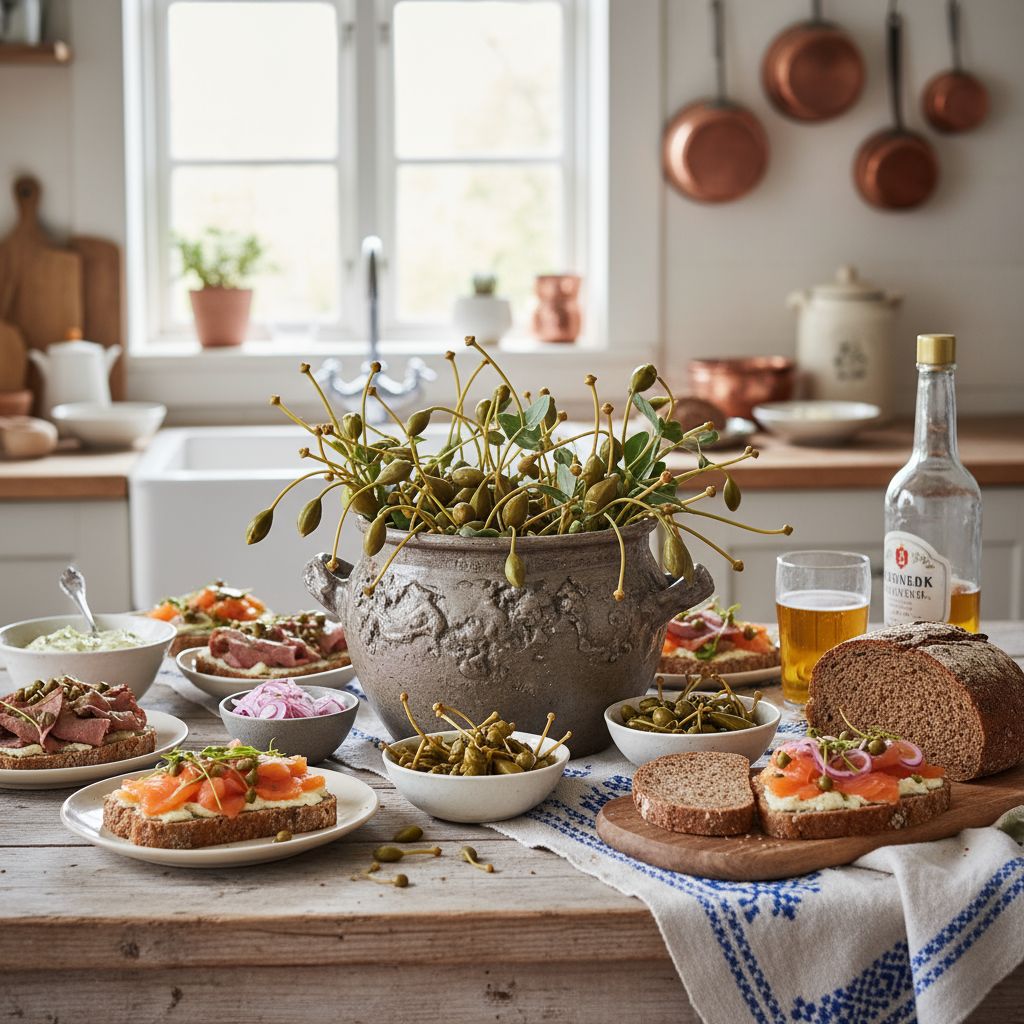
In Nordic cuisine, capers are used as a garnish on smørrebrød (open-faced sandwiches) – classically on roast beef smørrebrød with remoulade or on tartare. They’re also a staple in homemade remoulade and tartare sauce, and they’re a perfect match for smoked and cured salmon, where the acidity cuts through the richness. The buds can also be deep-fried and served as crispy snacks or a topping.
Internationally
In Mediterranean cuisine, capers add flavor depth to sauces like sauce tartare and salsa verde; they elevate classic dishes like spaghetti puttanesca and vitello tonnato; and they’re indispensable in tapenade, caponata, bagna cauda, and piccata. In modern gastronomy, they appear as tangy contrasts in dressings and in cocktails, for example a dry martini garnished with caper berries.
Preparation and Ideas
- Mix finely chopped capers into mayonnaise, Dijon mustard, and lemon zest for a quick tartare sauce.
- Add capers and chopped anchovies to an olive oil and garlic dressing for vegetable tarts.
- Sauté capers in butter, garlic, and chopped parsley, and pour over grilled fish or chicken.
- Briefly toast capers in the pan until crispy, and sprinkle over oven-roasted root vegetables.
- Make a tapenade of olives, capers, garlic, lemon, and herbs as a spread for bruschetta.
Health Benefits
Pickled capers contain relatively few calories (about 23 kcal per 100 g) and consist of around 84% water. However, they’re high in sodium (around 2350 mg/100 g) due to the brine and should therefore be used in moderation by people who need to limit their salt intake.
Vitamins, Minerals, and Antioxidants
- Vitamin K and riboflavin (B2), as well as minerals like iron and calcium.
- Rutin – the small white crystals on pickled buds are the flavonoid rutin, which acts as an antioxidant and is thought to strengthen blood vessels.
- Plant extracts have shown antioxidant, liver-protective, and lipid-lowering properties in research, but the evidence is still limited.
Traditional Use and Precautions
In traditional medicine, the caper plant has been used against digestive problems, as a diuretic, and to treat liver and skin diseases. In ancient times, the seeds were used to preserve wine and relieve toothache, while the root bark was used against coughs, asthma, arthritis, and skin conditions. Pregnant women are traditionally advised to avoid large amounts of capers or extracts, as the plant was historically used to induce menstruation. In ordinary culinary use, however, pickled capers are generally safe.
Mix-ups and Quality
Capers, Caper Berries, and False Capers
It’s important to distinguish capers from caper berries: capers are the small, unopened flower buds, while caper berries are the larger, elongated fruits that form after flowering. Caper berries have a milder flavor and are often eaten like olives. Capers can also be confused with false capers, which are pickled buds from other plants such as dandelion, wild garlic, or honeysuckle. These aren’t harmful, but the flavor is different. Never gather buds from toxic or unknown species.
Salt-Cured or Brine-Cured
Capers are sold either salt-cured (dry-salted) or brine-cured in vinegar brine. Salt-cured capers preserve flavor and firmness better and have a cleaner, more complex aroma – they just need to be rinsed or soaked before use to remove excess salt. Brine-cured capers are more widely available and have a more tangy, vinegary flavor. When buying, size is an indicator of quality: the smallest nonpareilles are considered the most delicate. Avoid jars with discoloration or limp buds, and store capers refrigerated in their original brine or salt after opening.
Growing and Harvesting in Denmark
Growing capers in Denmark requires patience, patience, and more patience. Follow these steps to give your plant the best conditions.
Growing Conditions
The caper shrub needs warmth and light and thrives in climates with warm summers and mild winters. It wants full sun, ideally reflected off a wall or on a south-facing balcony. The soil should be well-drained, stony or sandy, and ideally alkaline with a pH of 6.5-7.5. The plant doesn’t like heavy clay soil or spots where water sits still. Unlike many other herbs, capers tolerate drought, but young plants need regular watering. The plant can withstand short frost periods down to about -5°C, but longer cold spells can damage the shoots, so a greenhouse or a sunny windowsill provides the best conditions in Denmark.
How to Grow Capers
Total time: 3-4 months
- Pre-treat the seeds
Caper seeds are dormant. Soak dried seeds in lukewarm water for 24 hours, wrap them in damp paper towel in an airtight bag, and cold-stratify in the refrigerator for 2-3 months. Then soak them in warm water for 12-24 hours before sowing.
- Sow the seeds
Sow the seeds in March-April in well-drained seed compost. Cover with about 1 cm of soil, and keep the tray somewhere bright at a minimum of 10-15°C. The seeds germinate slowly – up to 2-3 months. Keep the soil lightly moist without overwatering.
- Prick out and transplant
Once the plants have a couple of leaves, prick them out into larger pots with sandy, alkaline soil. Provide plenty of light in a greenhouse or on a sunny patio at 20-25°C during the day, and use deep pots with good drainage.
- Care for, overwinter, and harvest
Water sparingly – only when the soil is completely dry. Apply a mild fertilizer in early summer, and overwinter frost-free at 5-10°C. After 2-3 years, the plant begins producing buds, which are harvested early in the morning.
Harvest
Pick the buds early in the morning, when they’re small and firm (about 5-7 mm), as the smallest capers have the finest flavor. Sort them by size, lay them on a cloth, and let them dry for a day before placing them in salt or brine. After flowering, caper berries form, which can also be harvested and marinated like olives. Young shoots and leaves can be prepared as a vegetable, but older leaves become bitter.
Storage
After drying, you can salt the buds in layers in a jar (a ratio of about 30 g salt per 100 g capers) or place them in a brine of water, vinegar, and salt. After a couple of weeks, the salt is rinsed off, and the capers are ready to use.
- Store capers refrigerated after opening – they keep for a long time in salt or brine.
- Always rinse capers briefly before use to remove excess salt.
- Fresh buds can be fully dried and stored in airtight jars, but the flavor becomes milder.
Sustainability and Biodiversity
Wild caper shrubs play an important role in coastal ecosystems in the Mediterranean region. They stabilize slopes and cliffs with their deep root systems and provide food for insects and birds. However, overharvesting of wild buds can threaten local populations. Therefore, choose capers from certified cultivation or grow your own in pots. The plant requires few resources once established and can grow without irrigation in dry climates, making it a relatively sustainable crop compared to more water-intensive herbs.
Try This Recipe
Capers and salmon are a classic pairing – the tangy, salty bud cuts through the rich fish and enhances both flavor and freshness. Serve a dollop of remoulade or tartare sauce with finely chopped capers alongside it for the perfect balance. Try our Salmon Patties in the Airfryer – Crispy Without Oil in 12 Minutes and serve them with a homemade caper remoulade for a tangy, fresh meeting between the Mediterranean and Danish cuisine.
Equipment and Products
Finely chopped capers are the secret behind a good tartare or remoulade sauce, adding acidity and sharpness to the creamy base. For a quick head start, you can begin with a fish-friendly mayonnaise like Kystfiskens Garlic, Lemon & Smoke Mayonnaise and stir in chopped capers and a little lemon zest – giving you a super-fast caper sauce for fish, tartare, and smørrebrød.
Frequently Asked Questions
Capers are the small, unopened flower buds from the caper shrub, while caper berries are the larger, elongated fruits that form after flowering. Caper berries have a milder flavor and are often eaten like olives or used as a garnish in cocktails.
Yes. Both salt-cured and brine-cured capers should be rinsed briefly in cold water before use to remove excess salt or vinegar brine. Salt-cured capers can benefit from soaking a bit longer. Always add capers at the very end of cooking to preserve texture and aroma.
In most areas, the caper shrub needs protection during winter. It can stay outside on a warm, south-facing patio in summer, but should be brought indoors or covered against frost in winter. A frost-free conservatory or a greenhouse is ideal.
Salt-cured capers are dry-salted and preserve flavor and firmness best, with a cleaner aroma, but need to be rinsed before use. Brine-cured capers sit in vinegar brine, are more widely available, and have a more tangy, vinegary flavor.
Pickled capers in normal culinary amounts are generally considered safe, but large amounts or extracts from the caper plant should be avoided during pregnancy, as the plant has traditionally been used as a menstruation-inducing agent. Talk to your doctor if in doubt.
Facts About Capers
| Field | Value |
|---|---|
| English name | Capers |
| Latin name | Capparis spinosa |
| Family | Caper family (Capparaceae) |
| Plant type | Evergreen shrub / perennial |
| Height | 0.5-1.5 m |
| Hardiness | Tolerates light frost, but requires frost-free winter shelter in Denmark |
| Light | Full sun |
| Soil | Sandy, stony, well-drained, alkaline (pH 6.5-7.5) |
| Sow/plant | Seeds stratified for 2-3 months; sown March-April in pots; transplanted into large containers or a greenhouse |
| Flowering/Harvest | Flowering June-September; buds July-August; berries August-September |
| Flavor | Sharp, tangy, mustard-like, bitter |
| Culinary use | Sauces, marinades, dressings, pizza, pasta, fish, meat, tapenade, remoulade |
| Storage | Cure in salt or vinegar brine; refrigerate after opening; can be dried |
