

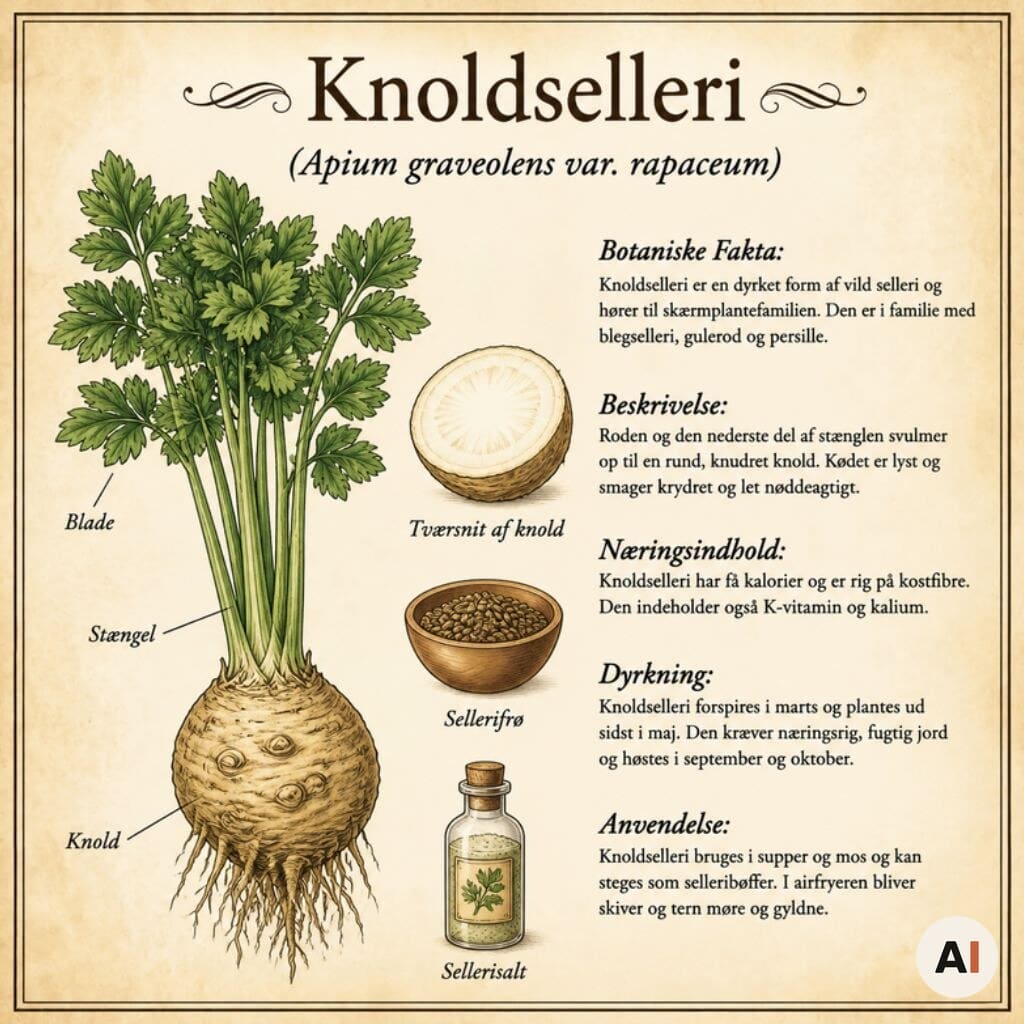
Celeriac (also called celery root) is one of the most overlooked vegetables in the winter produce section – and one of my absolute favorites when the days get short. The gnarled, slightly unsightly root hides a peppery, slightly nutty flavor that turns mellow and almost sweet when roasted. Botanically it is called Apium graveolens var. rapaceum, and it is a cultivated form of celery from the carrot family.
What we eat is the root and the lowest part of the stem, which together have swollen into a firm bulb with creamy white flesh. Celeriac is in season in fall and winter: it is harvested in November, before the hard frost sets in, and can then be stored for several months.
I use it for everything from soup and mashed celeriac to crispy fries and thick celeriac steaks in the air fryer. Here you get the history, the flavor, the classic dishes, the nutritional content, how to grow it, and my best tips for storage.
Estimated reading time: 6 minutes
History and origins
From leaf celery to bulb
Celeriac is a cultivated form of celery, whose wild form is native to Europe and the Mediterranean region. Celery was already known in ancient Egypt, Greece and Rome, but back then the plant was grown as leaf celery, for its leaves and stalks.
Celeriac as a cultivated form in its own right first appears in the 1700s. By selecting plants with thick, fleshy roots, growers gradually bred the large, round bulb we know today.

Family and relatives
Celeriac belongs to the carrot family (Apiaceae), along with carrots, parsnips, parsley and dill, among others. Stalk celery (blanched celery) is the same species, but grown for its long, juicy leaf stalks instead of the root – it has its own entry here in the Food Encyclopedia.
Flavor and aroma
Raw celeriac
Raw celeriac is crisp and juicy, with a fresh, strong celery flavor and a peppery edge. Grated or cut into thin strips, it adds freshness to salads, and it stands up well to a bold dressing with mustard, lemon or mayonnaise.
Roasted, fried and boiled
When celeriac is heated, it changes noticeably. The sharp celery note recedes into the background, and a mild, nutty, almost sweet flavor comes forward. In the air fryer, the surface caramelizes, so the edges turn golden and lightly toasted while the center becomes soft and creamy.
The flavor pairs well with butter, thyme, rosemary, garlic, apple, walnuts, mustard and aged cheese – and celeriac is a natural side dish for game, pork and fish.
Culinary uses
Celeriac is a workhorse in the kitchen. It can be grated raw, simmered into soup, mashed, baked whole, or cut into slices, sticks and cubes. Here are the classics I keep coming back to:
- Chicken soup: celeriac among the soup vegetables adds depth to soup and stock.
- Celeriac Waldorf salad: grated celeriac with apple and walnuts.
- Mashed celeriac: creamy mash to go with game and hearty fall stews.
- Celeriac steaks: thick, breaded slices with a crispy crust.
- Céleri rémoulade: raw strips in mustard mayonnaise, from France.
- Celeriac schnitzel: the German version of a breaded celeriac slice.
In the home kitchen
At home, celeriac is first and foremost one of the soup vegetables in classic soups and stocks, for example chicken soup. Raw and grated, it adds crunch to a celeriac Waldorf salad, and in winter it turns into creamy mashed celeriac or breaded celeriac steaks.
Around the world
In France, céleri rémoulade is a classic: raw strips of celeriac tossed in mustard mayonnaise. In Germany, the slices are breaded for Sellerieschnitzel (celeriac schnitzel), and the root is a staple of Suppengrün – the German soup vegetable bundle of celeriac, carrot, leek and parsley.
In the air fryer
The air fryer is made for celeriac, because the dry, circulating heat gives golden, crispy surfaces without deep-frying. I mainly make thick celeriac steaks, which I brush with butter and thyme, crispy cubes as a side dish, fries as an alternative to potatoes, and a smaller root baked whole, so it turns soft and creamy inside.
My most important tip is to cut the pieces to an even size, toss them in a little oil and spread them out in a single layer. Shake the basket a couple of times along the way. Celeriac contains a lot of water, and the steam needs to be able to escape – otherwise the pieces turn soft instead of crispy.
How to peel celeriac
Cut off the top and the root end so the celeriac stands steady, and cut the peel off from top to bottom with a sharp knife. The gnarled base with its many small roots needs to be cut away generously, because soil often hides in the folds. Rinse the celeriac, and brush the cut surfaces with lemon juice if it has to wait – it turns brown quickly.
Health benefits
A light vegetable with fiber
Raw celeriac provides only 22 kcal (91 kJ) per 100 g, and 93 g of every 100 g is water. So it fills the plate without adding much to your energy intake, and the dietary fiber makes it a good contribution to your daily greens.
Nutritional content per 100 g
Here is the nutritional content of 100 g of raw celeriac:
- Energy: 91 kJ (22 kcal)
- Water: 93 g
- Protein: 1.3 g
- Fat: 0 g
- Carbohydrate: 2.5 g
- Dietary fiber: 3 g
- Potassium: 485 mg
- Phosphorus: 65 mg
- Calcium: 36 mg
- Magnesium: 14 mg
The potassium content is worth noting: potassium contributes to normal muscle function and to the maintenance of normal blood pressure. Celeriac is no miracle cure, though – it does the most good as part of a varied diet with plenty of vegetables.
Celery is an allergen
Celery, including celeriac, is one of the allergens that must be labeled in the EU. Celery allergy can cross-react with birch and mugwort pollen. If you notice an itchy mouth after eating raw celery, talk to your doctor. Always check the ingredient list on stock cubes, spice blends and prepared meals if you are allergic.
Growing
Growing conditions
Celeriac requires patience. It has a long growing season and needs a head start indoors before it can go out in the garden. In return, you get roots that can be stored for several months.
- Light: a good, sunny spot.
- Soil: deep, compost-rich soil with even moisture.
- Nutrients: celery needs sodium, magnesium, manganese and boron.
- Starting indoors: bright and mildly warm, ideally around 17 °C (63 °F) and not below 13 °C (55 °F).
- Frost: the plant does not tolerate frost and must be protected or lifted before a hard frost.
Varieties
There are many varieties of celeriac. Well-known varieties include Mentor, Monarch, Prager Riesen, Alabaster, Balder, Snehvide, Roem van Zwijndrecht and Cesar.
How to grow celeriac
Total time: 8-9 months
- Start indoors
Sow the seeds indoors no later than March 1, preferably in February, and keep them bright and mildly warm – ideally around 17 °C (63 °F) and not below 13 °C (55 °F).
- Prick out and harden off
Prick the small seedlings out into pots, and gradually get them used to outdoor conditions before planting them out.
- Plant out
Plant out from mid-May to early June in a sunny spot with deep, compost-rich soil.
- Water and care
Keep the soil evenly moist all summer, and make sure the plants get enough nutrients.
- Harvest and store
Lift the roots in November, before the hard frost, and store them frost-free in boxes of sand.
Storage
In the kitchen
Celeriac should be stored cool. A whole root keeps best loosely wrapped in the vegetable drawer of the refrigerator, so it doesn’t dry out. Once it has been cut, the cut surface quickly turns brown, so cover it or brush it with lemon juice, and use the rest within a few days.
Winter storage and freezer
If you have grown celeriac yourself, you can lay the roots in boxes of sand in a frost-free place, where they will keep for several months. For the freezer, I cut the root into cubes, blanch them briefly and freeze them in portion bags.
- Whole root: cool, for example in the vegetable drawer.
- Cut root: cover the cut surface and use within a few days.
- Winter storage: in boxes of sand in a frost-free place.
- Freezer: blanched cubes for soup, stews and mash – not for salad.
Try this recipe
Celeriac becomes naturally creamy when cooked, which makes it a perfect base for a plant-based pâté. Try our recipe for Celeriac Pâté in the Air Fryer – Creamy Vegetarian Pâté in 65 Minutes, where the root is the main ingredient in a pâté that is baked directly in the air fryer. I always choose a heavy, firm root without soft spots, because it gives the fullest and nuttiest flavor. I serve the pâté warm on dense rye bread with pickled beets, just like a classic Danish liver pâté.
Frequently asked questions
Yes. Raw celeriac is crisp and has a fresh, strong celery flavor. Grate it coarsely or cut it into thin strips for salads such as Waldorf salad and céleri rémoulade, and toss it in dressing or lemon juice right away so it doesn’t turn brown.
Cut the peeled root into slices, sticks or cubes of an even size, and toss them in a little oil, salt and seasoning. Cook them in a single layer at high heat, and shake the basket a couple of times along the way, until the pieces are golden on the outside and tender inside.
Yes. Peel the root, cut it into cubes, blanch them briefly, and freeze them in portion bags. Frozen celeriac loses its crispness, so it is best in soup, stews and mash – not in salads.
Yes. Celery, including celeriac, is one of the allergens that must be labeled in the EU. Celery allergy can cross-react with birch and mugwort pollen, so people with pollen allergies should be aware of it.
They are the same species, but grown for different parts of the plant. Celeriac is grown for its bulb, made up of the root and the lowest part of the stem, while stalk celery is grown for its juicy leaf stalks. Celeriac has a nuttier flavor and is best suited for roasting, boiling and mashing.
Facts about celeriac
| Field | Value |
|---|---|
| English name | Celeriac (also called celery root) |
| Latin name | Apium graveolens var. rapaceum |
| Family | Carrot family (Apiaceae) |
| Plant type | Root vegetable, where the root and the lowest part of the stem form a bulb |
| Hardiness | Does not tolerate frost |
| Light | A good, sunny spot |
| Soil | Deep, compost-rich soil with even moisture |
| Sow/plant | Start indoors by March 1 at the latest; plant out from mid-May to early June |
| Harvest | November, before hard frost |
| Season | Fall and winter |
| Calories per 100 g | 22 kcal (raw) |
| Flavor | Peppery and slightly nutty; mild and sweet when roasted |
| Culinary use | Soup vegetables, Waldorf salad, mashed celeriac, celeriac steaks, céleri rémoulade and fries |
| Storage | Cool; winter storage in boxes of sand in a frost-free place |
| Allergen | Yes, celery must be labeled as an allergen in the EU |
