

Swiss chard is two vegetables in one: large, tender leaves that you can use just like spinach, and thick, juicy stalks that can be boiled, steamed or roasted. You may know it better as chard, and the types with wide, white stalks are also called silverbeet. Botanically, Swiss chard is a variety of beet, Beta vulgaris var. cicla, which makes it a close relative of the beetroot.
I love Swiss chard because nothing goes to waste. The leaves work well in a creamed dish or a tart, and the stalks get a lovely roasted edge in the air fryer. It is also one of the easiest vegetables to grow yourself – a single sowing can give you a harvest from summer well into the autumn.
Estimated reading time: 6 minutes
History and origin
From wild sea beet to kitchen garden
Swiss chard descends from sea beet, Beta vulgaris subsp. maritima, which grows wild along coasts – in Denmark, for example, along the Great Belt. Sea beet is the wild ancestor of all our cultivated beets: in beetroot, breeding has refined the root; in Swiss chard, it is the leaves and stalks. Swiss chard itself came to us from the Mediterranean region.
The Swedish botanist Carl Linnaeus described it in 1753 as Beta vulgaris var. cicla. It used to be classed in the goosefoot family (Chenopodiaceae), but today it belongs to the amaranth family (Amaranthaceae), like spinach and quinoa.
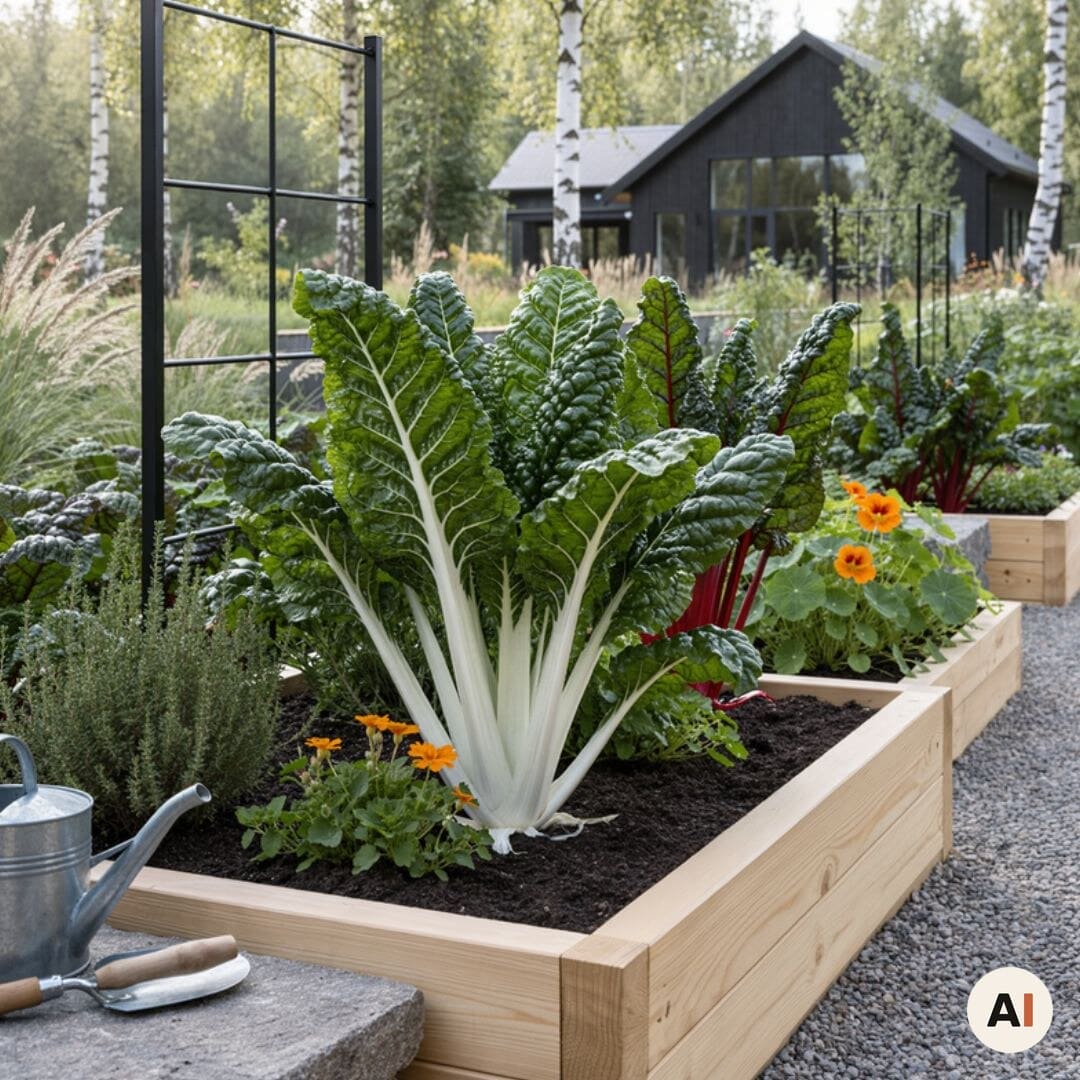
Swiss chard in Denmark
The earliest records of Swiss chard in Denmark date from the middle of the 15th century, and by the 19th century it had a firm place in every kitchen garden. Today there are varieties with stalks in white, yellow, orange and red, so Swiss chard is just as pretty in the garden bed as on the plate.
Many names for the same plant
Swiss chard goes by many names. In Danish it is called bladbede or mangold, and in English you will also see it called simply chard. The types with wide, white stalks are called silverbeet. Perpetual spinach is also a Swiss chard – a type with soft, thin leaves that is more like spinach.
Flavour and aroma
The leaves
The leaves taste like a stronger version of spinach: slightly earthy and mineral, with a faint bitterness reminiscent of beet greens. Raw, Swiss chard tastes rather bitter, but the bitterness disappears when it is cooked. The small, young leaves are the mildest and can happily be eaten raw in salads.
The stalks
The stalks are crisp and juicy with a mild, fresh flavour, a little like celery. The white stalks of silverbeet are the mildest, while the coloured stalks can have a more earthy note.
When the stalks are exposed to dry heat, the edges caramelise, and the flavour becomes sweeter and more nutty. That is why they are so good in the air fryer.
Culinary uses
The most important trick with Swiss chard is to treat the leaves and stalks as two different vegetables. The stalks need longer than the leaves, so I separate them and give the stalks a head start before the leaves join in.
In everyday cooking
The leaves are typically used like spinach – creamed, or only very briefly fried or blanched. The stalks can be boiled like asparagus or used in stews, and they are also good in these classics:
- Creamed Swiss chard: the leaves in a lightly thickened sauce – like creamed spinach.
- Stalks like asparagus: boiled until tender and served with melted butter.
- Stalks au gratin: in a dish with cheese and breadcrumbs on top.
- Pickled stalks: a crisp, tangy side dish.
- Breaded stalks: coated in breadcrumbs and fried until crisp.
Around the world
In Croatia, Swiss chard is called “the queen of the Dalmatian garden”, and it is used in, among other things, soparnik, a Dalmatian pie. In Nice, tourte de blettes is a classic – a sweet tart with Swiss chard, raisins and pine nuts. In many places, leaves and stalks are used together in tarts and lasagne, the leaves go into stir-fries, soups and omelettes, and a large, raw leaf can even replace the tortilla in a wrap.
In the air fryer
In the air fryer, the stalks are the star. I cut them into sticks, toss them in a little oil and salt – garlic and grated Parmesan are good too – and roast them at medium heat until the edges are golden. Shake the basket a couple of times along the way so they cook evenly.
The leaves can become crisp chips, just like kale. Dry them thoroughly, massage a thin layer of oil into them and lay them in a single layer in the basket, preferably with a small rack on top so the light leaves do not fly around. They go quickly from crisp to burnt, so keep an eye on them.
Health benefits
Nutrients in Swiss chard
Swiss chard is a light vegetable at about 21 kcal per 100 g, but it is high in, among other things, vitamin K, beta-carotene and magnesium. Here are the key figures per 100 g:
- Vitamin K: 327.3 µg (cooked)
- Beta-carotene: 3,647 µg (raw), which the body can convert into vitamin A
- Vitamin C: 30 mg (raw)
- Vitamin E: 1.9 mg alpha-TE (raw)
- Potassium: 379 mg (raw)
- Magnesium: 81 mg (raw)
- Calcium: 51 mg (raw)
- Sodium: 213 mg (raw)
The sodium content is high for a vegetable, so I am always a little careful with the salt when I cook Swiss chard.
Oxalic acid and vitamin K
Like spinach and rhubarb, Swiss chard contains oxalic acid, which binds calcium and hinders its absorption. Fresh leaves have about 480 mg of oxalate per 100 g – among the highest levels in edible vegetables. Small amounts have not been shown to do any harm, but if you are prone to kidney stones, it is a good idea to hold back. Boiling in plenty of water, which you pour off, lowers the content.
Swiss chard is also rich in vitamin K. If you take blood-thinning medication of the vitamin K antagonist type, talk to your doctor about how much vitamin K-rich greens you eat.
Growing
Growing conditions
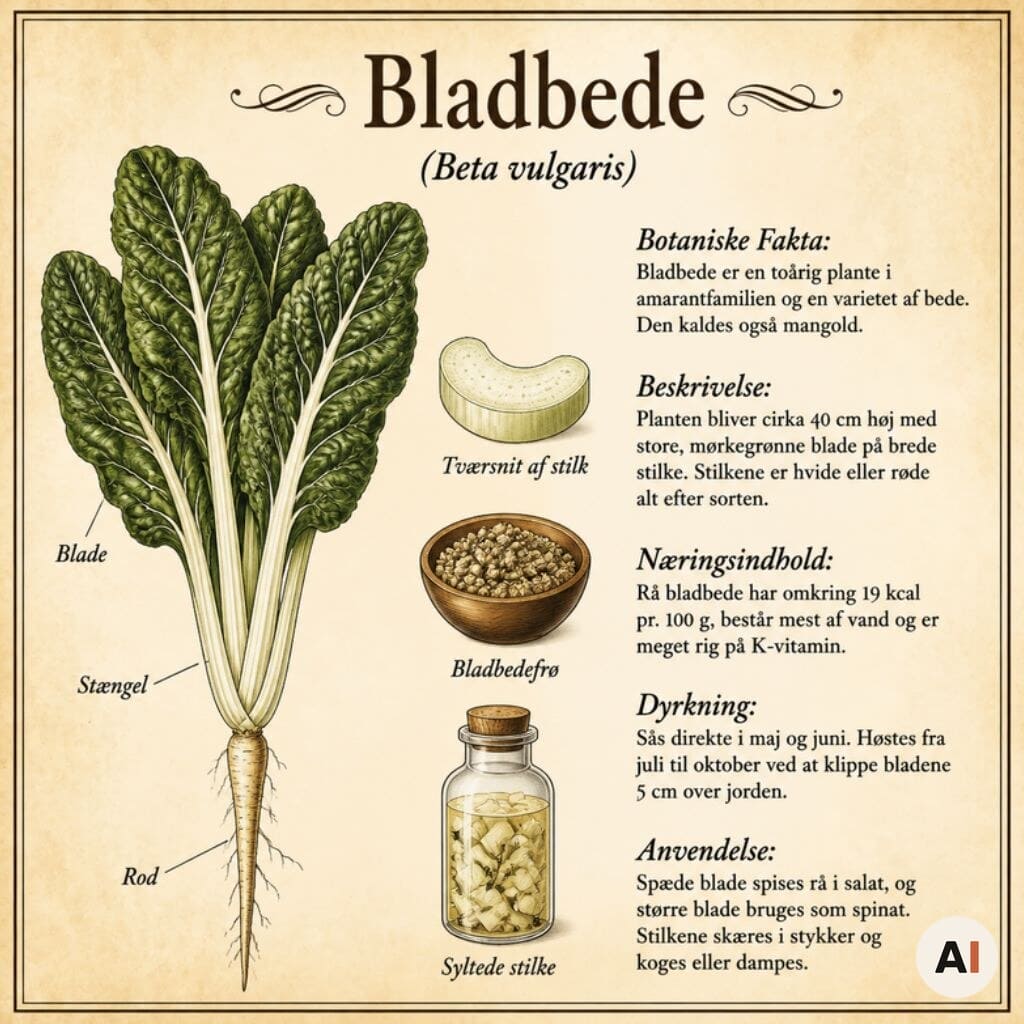
Swiss chard is one of the most rewarding vegetables in the kitchen garden. It is a biennial, but is most often grown as an annual, and it thrives in almost any kind of soil.
- Soil: rich in humus and well drained, preferably not too heavy, with a pH around neutral.
- Sowing time: directly outdoors from late April to June in the Nordic countries, once the temperature has reached 8–10°C.
- Germination temperature: ideally around 20°C and at least 8°C.
- Feeding: compost during the first two months. It is better to under-feed than to over-feed – the nitrate content of the leaves rises with heavy fertilising.
- Height: about 40 cm for a variety like ‘Bright Light’.
- Hardiness: hard frost takes the tops and the outermost leaves, but the plant usually overwinters and sprouts again.
Varieties
The classic white-stalked silverbeets include ‘Blonde à Carde Blanche’, ‘Glatter Silber’ and ‘White Silver’, while ‘Bright Yellow’ and ‘Golden Chard’ have yellow stalks. If you would rather have tender leaves than thick stalks, choose perpetual spinach.
How to grow Swiss chard
Total time: about 10 weeks
- Prepare the soil
Choose a bed with rich, well-drained soil that is not too heavy, and aim for a pH around neutral.
- Sow the seeds
Sow directly outdoors from late April to June in the Nordic countries, once the temperature has reached 8–10°C. Each ‘seed’ is really a small cluster of seeds that can produce several plants.
- Thin out and care for the plants
Thin out once the small plants have come up, so each plant has plenty of room. Water in dry periods, and give compost during the first two months.
- Harvest as you go
About 10 weeks after sowing you can start harvesting. Snap off the oldest, largest leaves at the base so the plant keeps producing new ones, or cut the stalks about 5 cm above the ground.
Storage
Eat it fresh
Swiss chard quickly loses its juiciness and vigour after harvest, so I prefer to harvest it the same day I am going to use it. If you buy it, choose bunches with springy leaves and firm stalks.
- In the fridge: wrap the Swiss chard loosely in a damp tea towel or put it in a bag, and place it in the vegetable drawer.
- Wash just before use: wet leaves go limp faster.
- Limp leaves: stand the stalks in a glass of cold water, and the leaves will often perk up again.
- Freeze: Swiss chard can be frozen – even slightly wilted leaves.
How to freeze Swiss chard
I blanch the leaves and stalks separately, because the brief cooking preserves the colour. Then I cool them quickly in cold water, squeeze the water out and freeze them in portions. I use the frozen leaves straight from the freezer in casseroles, soups and lasagne – just like frozen spinach.
Try this recipe
The leaves of Swiss chard can be used exactly like spinach, and in a dish where everything is baked together, both leaves and stalks come into their own. Try our recipe for Spinach lasagne in the air fryer – creamy, green and ready in under an hour – I like to swap part of the spinach for Swiss chard when it is in season. I chop the stalks finely and sauté them first, and at the end I let the leaves wilt in the pan before everything goes into the layers. That way I use the whole plant, and the lasagne gets a little extra bite.
Frequently asked questions
Yes, chard is simply another name for Swiss chard (in Danish it is called both bladbede and mangold). The types with wide, white stalks are also called silverbeet.
Yes, but raw Swiss chard tastes rather bitter. The small, young leaves are the mildest and work well in salads, while larger leaves and stalks are best cooked, as that makes the bitterness disappear.
Cut the stalks into sticks, toss them in a little oil and salt, and roast them at medium heat until the edges are golden. The leaves can become crisp chips if you dry them well, give them a thin layer of oil and keep an eye on them as they cook.
Outdoor-grown Swiss chard is harvested from July to October in the Nordic countries. Plants sown in April are ready from July or August, and the harvest can continue well into the autumn.
Yes, even slightly wilted leaves. Blanch the leaves and stalks separately, cool them quickly, squeeze out the water and freeze them in portions. Blanching preserves the colour.
Facts about Swiss chard
| Fact | Details |
|---|---|
| English name | Swiss chard (also chard; white-stalked types are called silverbeet; in Danish bladbede or mangold) |
| Latin name | Beta vulgaris var. cicla |
| Family | Amaranth family (Amaranthaceae) |
| Origin | The Mediterranean region; descended from wild sea beet |
| Plant type | Biennial leaf vegetable, most often grown as an annual |
| Height | About 40 cm (‘Bright Light’) |
| Hardiness | Usually overwinters and sprouts again; hard frost takes the tops and the outermost leaves |
| Soil | Rich in humus, well drained and not too heavy, pH around neutral |
| Sowing/planting | Directly outdoors from late April to June in the Nordic countries, when the temperature is 8–10°C |
| Harvest | July–October in the Nordic countries, first harvest about 10 weeks after sowing |
| Calories per 100 g | About 21 kcal |
| Flavour | Leaves earthy like a robust spinach, stalks mild and juicy |
| Culinary use | Leaves used like spinach; stalks boiled, baked au gratin, pickled or roasted in the air fryer |
| Storage | Best fresh; blanch and freeze for later |
