

Parsley root is one of those root vegetables I always keep in the vegetable drawer from September and right through winter. It looks like a pale carrot, but the flavour is something else entirely: nutty, sweet, and with a distinct parsley scent that gives away exactly which family it belongs to. Botanically, it’s called Petroselinum crispum var. tuberosum — quite simply a root form of the common parsley we otherwise snip leaves from.

Advertisement: The page displays ads and contains advertising links (affiliate links). See our advertisers here.
In many Danish kitchens, parsley root lives a quiet life as a soup vegetable — an anonymous stick in the soup bundle alongside leek, carrot, and celery. I think that’s a shame. The root can do far more than flavour a broth, and especially in the airfryer, it reveals a sweetness and crispness that boiling never brings out.
Here’s the whole story about parsley root: where it comes from, what it tastes like, what it can do in the kitchen, how to grow it in your own garden, and how to store it so it lasts through the winter.
Estimated reading time: 7 minutes
History and origin
A root of the parsley plant
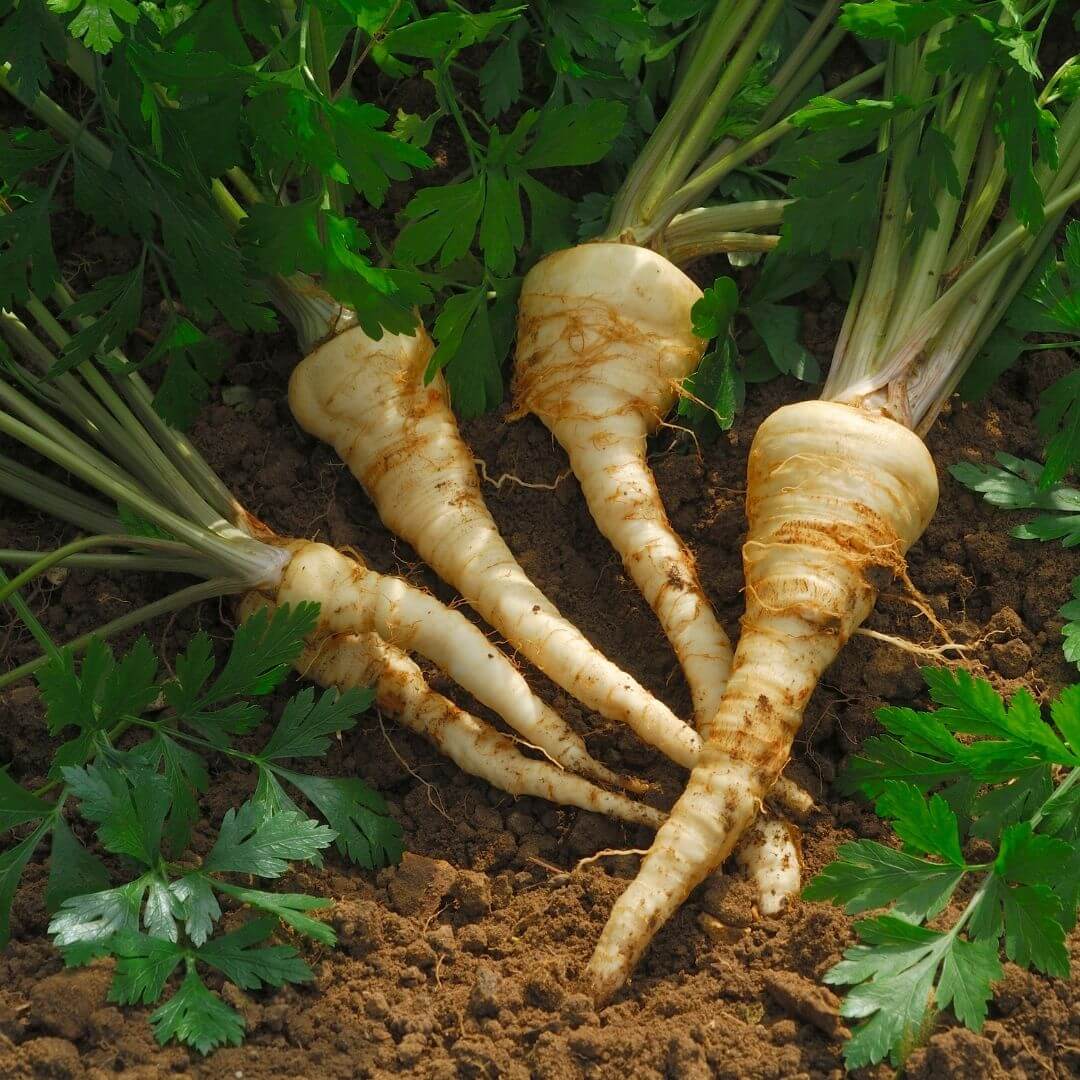
Parsley root isn’t a separate species, but a variety of common parsley where breeding has focused on the root instead of the leaves. Hence the name Petroselinum crispum var. tuberosum. It belongs to the carrot family, Apiaceae, which makes carrot, parsnip, celery, dill, and chervil close relatives — a kinship you can clearly taste your way to.
Its cultivation belongs to Northern Europe, where for generations parsley root has been exactly what the Nordic kitchen garden needed: a robust root that could stay in the ground or in storage well into winter, adding flavour to soups and stews when little else green remained.
Varieties tracing back to 1727
Parsley root is no newfangled vegetable. Documented varieties exist as far back as 1727 and 1873, which says something about how solidly the root has been rooted in Northern European kitchen gardens for centuries.
Hamburg parsley and Wurzelpetersilie
Internationally, parsley root goes by names that point directly to its dual nature. In English, it’s called Hamburg parsley; in German, Wurzelpetersilie — literally root parsley. Both names are a reminder that we’re dealing with parsley, just viewed from the soil surface downward.
Flavour and aroma
Nuttiness, sweetness, and parsley
The flavour sits somewhere between parsnip and celery, with a clear parsley character on top. It’s nutty and sweet, and the sweetness becomes more pronounced once the root has spent the season’s first cold autumn nights in the ground.
Raw versus cooked
Raw and finely grated, parsley root is fresh and almost peppery at the edges, with a crispness that suits a winter salad well. Heat changes it dramatically: boiling makes it soft and mild, while frying and the airfryer concentrate its sugars, giving caramelised edges and a deeper, roasted, nutty flavour.
The tops count too
Don’t forget the leaves. The top of the parsley root can be used exactly like flat-leaf parsley — chopped over the finished dish, stirred into a pesto, or simmered in the soup along with the root. It’s one of the few vegetables where you genuinely get two ingredients for the price of one.
Culinary uses
Parsley root is one of the most versatile root vegetables of the winter half of the year, precisely because it can both carry flavour and contribute its own.
In the Danish kitchen
Here in Denmark, parsley root is best known as a soup vegetable. It’s a permanent fixture in the soup bundle alongside leek, carrot, and celery, where it gives classic Danish soup its round, herby base. But it deserves to stand alone on the plate too.
- Soup vegetable: a staple of the soup bundle in classic Danish soup.
- Mash and purée: boiled and mashed, often half and half with potato.
- Fried or oven-baked: in wedges or thick slices as a side for most meats.
- Raw in salad: finely grated or cut into paper-thin slices.
- The tops: chopped and used like flat-leaf parsley.
Internationally
In Germany, parsley root is a key part of Suppengrün, the ready-tied bundle of soup vegetables that goes into the pot when making stock. In Poland, pietruszka korzeniowa is indispensable in rosół, the clear chicken soup, and the root turns up again in many Eastern and Central European soups. Cut into small dice, it disappears discreetly into stews, lasagne, and chilli dishes, adding body without announcing itself as a vegetable in its own right.
In the airfryer
In my opinion, the airfryer is parsley root’s best friend. The dry, circulating heat draws moisture out of the surface and concentrates the sweetness, and because the root is slimmer than a parsnip, it cooks quickly. Cut it into wedges about a finger thick, toss them in oil, salt, and a little thyme, and let them get properly coloured. The skin can easily stay on if the root is scrubbed well.
Health benefits
A light winter choice
Parsley root is a filling vegetable without being heavy. It provides 55 kcal per 100 g, equivalent to 232 kJ, and the fat content is very low. It’s especially the dietary fibre that’s worth noting.
- Energy: 55 kcal (232 kJ) per 100 g.
- Dietary fibre: 4.3 g per 100 g.
- Protein: 2.3 g per 100 g.
- Carbohydrate: 8 g per 100 g.
- Fat: 0.6 g per 100 g.
Fibre and fullness
4.3 g of dietary fibre per 100 g is decent for a root vegetable, and the fibre is a big part of why a portion of oven-baked parsley root is more filling than the calorie count would suggest. At the same time, the 8 g of carbohydrate per 100 g makes the root an obvious alternative to potato in a mash.
Take care with celery allergy
Parsley root belongs to the carrot family, which is worth knowing if you have a celery allergy. Cross-reactions are possible between plants in the same family, so take precautions if you’re serving guests with a known celery allergy.
Growing
Parsley root is rewarding to grow, but it demands patience at the start. The seeds are notoriously slow to germinate, and that’s the most common reason people give up on it after their first attempt.
Sowing and germination
It’s sown directly outdoors from mid-April until around June 1st, once the soil temperature is at least 8-10 °C. After that, arm yourself with patience: germination can take up to 28 days. If you’ve pre-sprouted the seeds or soaked them overnight, you can expect around 14 days instead.
Soil and growing conditions
The root prefers sandy loam over clay soil, although clay loam can work too. Loose, deeply worked, stone-free soil gives the neatest, straightest roots, and the pH should be around 6.5-7.5.
- Sowing: direct outdoors, mid-April to around June 1st.
- Soil temperature: at least 8-10 °C at sowing.
- Germination time: up to 28 days; around 14 days for pre-sprouted or soaked seed.
- Soil: sandy loam preferred over clay soil; clay loam is possible.
- pH: around 6.5-7.5.
- Hardiness: doesn’t tolerate frost — cover the bed, or lift the roots.
Harvest and overwintering
Parsley root is ready to harvest from September and can be lifted throughout autumn and winter. It doesn’t tolerate frost, so either cover the bed or lift the roots before the frost sets in. With a thick layer of leaves over the bed, it can overwinter in the ground just fine, and that’s the easiest way to have fresh roots on hand well into winter.
Total time: 5-6 months
- Prepare the bed
Dig the bed deeply and loosen the soil. Parsley root prefers a light, stone-free sandy loam with a pH around 6.5-7.5, so the roots can grow straight down without forking.
- Sow the seeds
Sow directly outdoors from mid-April until around June 1st, once the soil temperature is at least 8-10 °C. Soak the seeds overnight if you can, to speed up germination.
- Wait for germination
Keep the soil evenly moist. Germination takes up to 28 days, or around 14 days if the seeds were pre-sprouted or soaked. Mark the row so you don’t accidentally weed out the small seedlings.
- Thin and tend
Thin the plants so each root has room to grow thick, and keep the bed weed-free throughout summer.
- Harvest and protect from frost
Harvest from September and through autumn. Parsley root doesn’t tolerate frost, so cover the bed with a thick layer of leaves if the roots are to stay in the ground over winter.
Storage
Like carrots
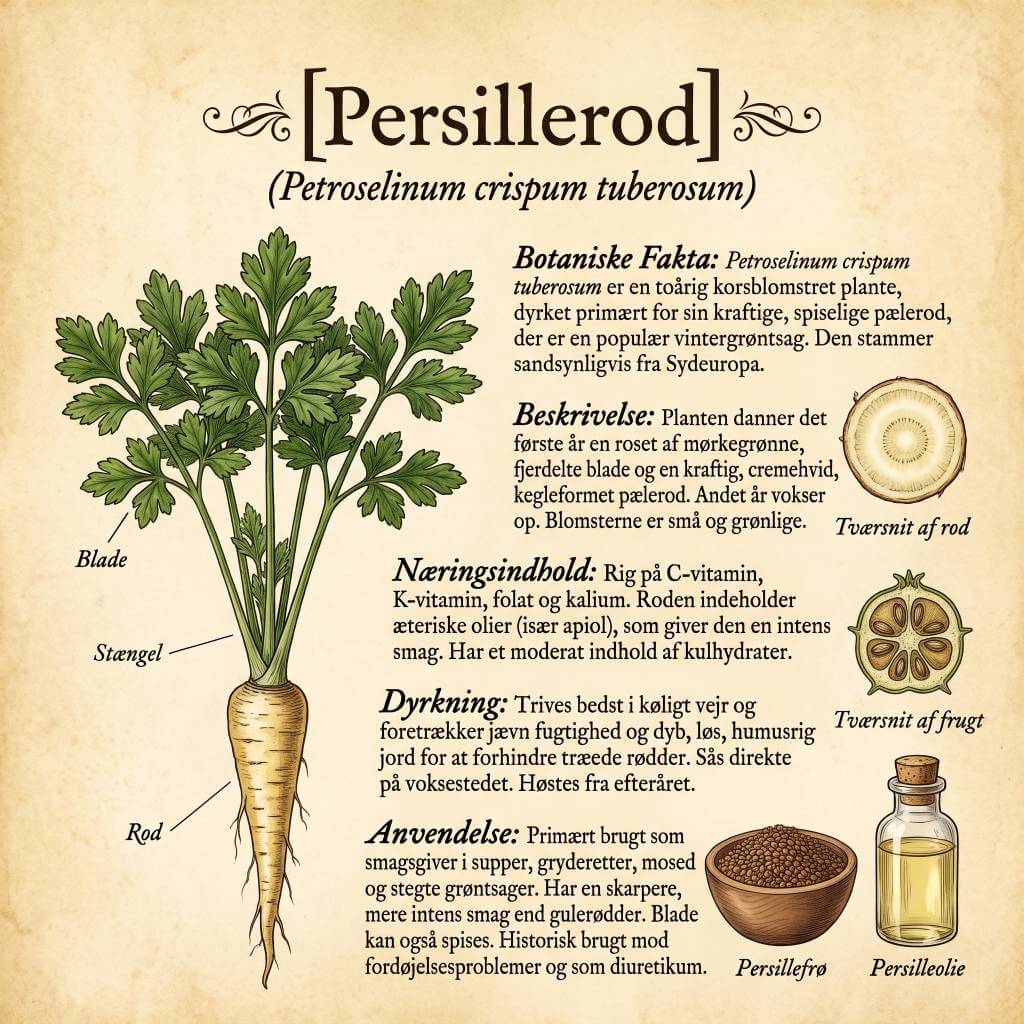
Parsley root is basically stored like carrots. The main thing is to keep it frost-free and cool, and not let it dry out. The season runs from September to March, and it’s precisely the storage that makes the long season possible.
Clamps and sand boxes
The classic method is a clamp or boxes with slightly damp sand. The roots are layered so they don’t touch each other, and the sand holds exactly the moisture the root needs without it rotting. It’s still the best way to keep a larger harvest fresh through winter.
- Frost-free: parsley root doesn’t tolerate frost, either in the bed or in storage.
- Clamp or sand box: layer the roots in slightly damp sand.
- Remove the tops: twist off the leaves before storing, so they don’t draw moisture out of the root.
- In the fridge: wrap the root so it doesn’t dry out.
- Season: September to March, when the root is a storage staple throughout winter.
Try this recipe
Parsley root’s sweetness comes through best with dry heat and a little fat — exactly what an airfryer is built for. Cut the root into fans along with carrot and parsnip, and you’ve got a plate of winter vegetables with crispy edges and a soft interior. Try our recipe for Hasselback root vegetables in the airfryer – crispy fans with butter, garlic, and fresh herbs, where parsley root works just as well as the other root vegetables in the dish.
Equipment and products
Root vegetables need salt to taste of anything. The salt draws out the sweetness and makes the difference between dull and irresistible, and I always season my parsley root wedges before they go into the basket. A coarse seasoning salt handles it in one go: Kartoffelsalt Vestjyske Delikatesser is made for exactly this kind of root vegetable and works just as well on parsley root as on potatoes.
Frequently asked questions
Parsley root is a root form of common parsley and has a distinct parsley aroma with a nutty sweetness. Parsnip is a different species, usually stronger-flavoured and more cone-shaped, and it tastes sweeter and more peppery. Parsley root is typically slimmer and paler.
Yes. The leaves can be used exactly like flat-leaf parsley — for example, chopped over the finished dish, stirred into a pesto, or simmered in the soup along with the root.
Parsley root is ready to harvest from September and stays a storage vegetable throughout winter. The Danish season runs from September to March.
It’s not necessary if the root has been scrubbed well. The skin is thin and turns crispy in the airfryer. Peel it if you want a completely pale, smooth mash or purée.
No. Parsley root doesn’t tolerate frost, so the roots must either be lifted or covered. With a thick layer of leaves over the bed, it can overwinter in the ground.
Facts about parsley root
| Field | Value |
|---|---|
| English name | Parsley root |
| Latin name | Petroselinum crispum var. tuberosum |
| Family | Apiaceae (the carrot family) |
| Plant type | Root vegetable, root form of common parsley |
| Hardiness | Doesn’t tolerate frost; can overwinter in the ground under a thick layer of leaves |
| Soil | Sandy loam over clay soil, pH around 6.5-7.5 |
| Sow/plant | Direct sowing outdoors, mid-April to around June 1st |
| Harvest | September and through autumn and winter |
| Season in Denmark | September to March |
| Calories per 100 g | 55 kcal (232 kJ) |
| Flavour | Nutty and sweet with a distinct parsley aroma |
| Culinary use | Soup vegetable, mash and purée, oven-baked or fried, raw in salad |
| Storage | Frost-free in a clamp or boxes with slightly damp sand |
