

Spinach is one of the vegetables I always keep in stock – frozen all year round and fresh when spring arrives. Mature spinach, Spinacia oleracea, has larger, sturdier leaves than baby spinach, and it is made for cooking: stewed in cream, folded into a tart or tossed into a pasta dish at the last moment.
What surprises most people the first time is how much spinach wilts down. A big heap of fresh leaves turns into a small handful in the pan, because the leaves are mostly water. That is why I always buy more than I think I will need – or I take frozen spinach, which has already wilted down.
In this entry you can read about the journey of spinach from Persia to kitchen gardens in Northern Europe, how it tastes, what it contains, and how to grow and store it. The entry is about mature spinach – baby spinach, the small, tender leaves for salads, is a different matter.
Estimated reading time: 7 minutes
History and origins
From Persia to Europe
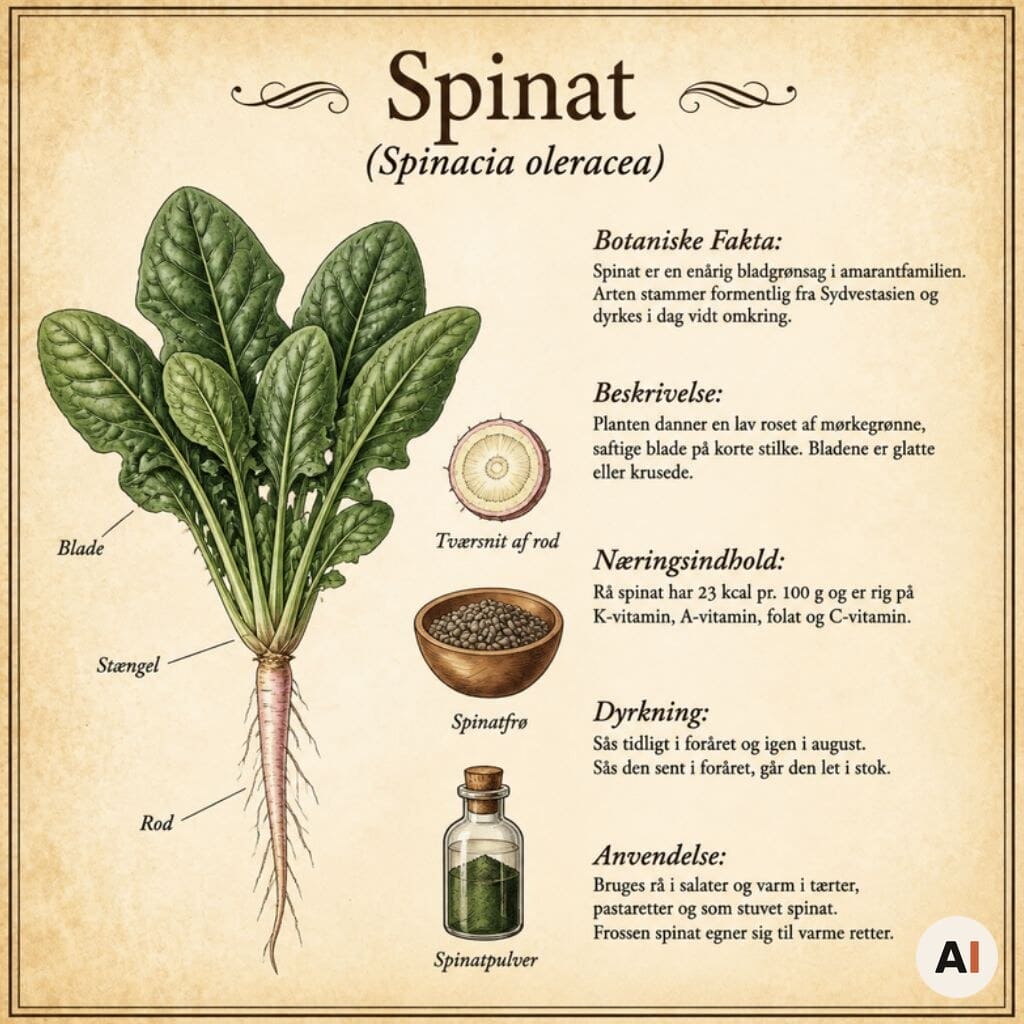
Two wild species of spinach grow in Southwest Asia, and cultivated spinach comes from Persia. It was the Arabs who brought spinach to Spain, and from there it spread in the 16th century to countries including England and France.
Botanically, spinach belongs to the amaranth family (Amaranthaceae), where it is related to beetroot and quinoa, among others. It used to be placed in the goosefoot family, and that is the classification you will find in many older gardening books.

Spinach in Denmark
Spinach only became widespread in Denmark in the 20th century. Today it is grown across large parts of the temperate zone, and in the Nordic countries it is first and foremost a spring vegetable, at its best from March to May.
I find it funny that a vegetable that has travelled so far has become so familiar. Today, creamed spinach with egg or fish feels just as Danish as new potatoes with parsley.
Flavour and aroma
Mild with a mineral edge
Fresh spinach tastes mild, green and slightly earthy, with a faint mineral edge. Mature leaves have more flavour and more bite than baby spinach, and when the spinach is perfectly fresh, the stalks add a little crispness.
Many people know the slightly rough, almost furry feeling on the teeth after a meal with spinach. It comes from the oxalic acid in the leaves and is completely harmless.
Good flavour pairings
When spinach is heated, the flavour becomes softer and rounder. It loves fat and acidity: butter, cream, olive oil, feta and Parmesan on one side and lemon on the other. Garlic and grated nutmeg are classics – to me, nutmeg is inseparable from creamed spinach.
Spinach also pairs well with eggs, salmon, chicken and potatoes, and it can carry strong spices such as cumin, garam masala and chilli. That is why it suits an Indian curry just as well as a savoury tart.
Culinary uses
Spinach is one of the most versatile leafy vegetables, because it can both play the lead role and give a green lift in the background. I use fresh spinach when the leaves need to be seen and tasted, and frozen spinach when it is going into fillings, tarts and creamed dishes.
In Danish cuisine
Creamed spinach (stuvet spinat) is the Danish classic: the spinach is stewed in cream, seasoned with salt, pepper and nutmeg, and served with fish, eggs or ham. Spinach gratin with cheese is another old favourite, and many people also simply serve the spinach boiled, steamed or puréed as a side dish.
Around the world
Out in the world, you will find spinach in everything from Greek filo pies to Indian curries. If you see à la Florentine on a menu, it typically means the dish is served with spinach – eggs Florentine is the best-known example. Here are the classics with spinach, both in Denmark and around the world:
- Creamed spinach (stuvet spinat): spinach stewed in cream with nutmeg.
- Spinach gratin: spinach with cheese, baked until golden on top.
- Spanakopita: Greek filo pie with spinach and feta.
- Palak paneer: Indian dish with spinach and the fresh cheese paneer.
- Eggs Florentine: poached eggs on a bed of spinach.
- Pasta with spinach: in lasagne, cannelloni or a creamy pasta sauce.
In the air fryer
In the air fryer, think of spinach as a filling rather than loose leaves. Light, dry leaves can be blown around by the fan, so I use spinach in tarts, filo pastry dishes, egg muffins and gratins, where it stays firmly in place.
The most important trick applies to frozen spinach: thaw it and squeeze out as much water as you can before it goes into the filling. Otherwise the water steams out during baking, and the base turns soft instead of crisp. I let fresh spinach wilt in a hot pan first and squeeze it out in the same way.
Health benefits
Spinach is a light vegetable: 100 g of raw spinach provides 26 kcal and contains 91.7 g of water. In return, you get a good helping of nutrients – especially vitamin K, folate, beta-carotene and vitamin C.
Nutritional content per 100 g
The figures apply to raw spinach:
- Energy: 26 kcal
- Water: 91.7 g
- Protein: 2.6 g
- Fat: 0.6 g
- Carbohydrate: 3.4 g
- Dietary fibre: 1.9 g
- Vitamin K: 560 µg
- Folate: 220 µg
- Beta-carotene: 4,186 µg
- Vitamin A: 349 RE
- Vitamin C: 54 mg
Good to know
Spinach contains oxalic acid, which binds calcium and can reduce how much of it the body absorbs. If you are prone to kidney stones, you are often advised to limit oxalate-rich foods – and spinach is one of them.
Spinach is also high in vitamin K. That matters if you are on blood-thinning treatment with vitamin K antagonists such as warfarin – talk to your doctor before making big changes to how much spinach you eat. Spinach, on the other hand, is not among the EU allergens that must be labelled.
Growing
Spinach is a rewarding plant in the kitchen garden, but it does not like heat. It is an annual or biennial and thrives best in the cooler months. In summer it bolts easily – it sends up a flower stalk, and that is the end of the good leaves.
Sow spinach in autumn
My best advice is to sow spinach in autumn. In the Nordic countries, you sow outdoors in late August for overwintering, and in mild autumns it can work all the way up to mid-September. Autumn-sown spinach can overwinter outdoors and gives you an early spring harvest.
If you have a greenhouse, you can sow in seed trays in the second half of August and keep growing the spinach on in the greenhouse. Use a mix of half garden soil and half almost fully rotted compost – then you can harvest from late February, typically from March.
Growing conditions
- Plant type: annual or biennial herbaceous plant.
- Soil: half garden soil and half almost fully rotted compost.
- Sowing time: late August – in mild autumns up to mid-September.
- Heat: tolerates high temperatures poorly.
- Harvest: best from March to May.
How to sow spinach for overwintering
Total time: 6-7 months
- Prepare the soil
Get a bed ready outdoors, or mix half garden soil and half almost fully rotted compost for spinach in a greenhouse.
- Sow the seeds
Sow outdoors in late August – in mild autumns up to mid-September. If the spinach is going into a greenhouse, sow in seed trays in the second half of August.
- Let the plants overwinter
The spinach can overwinter outdoors. Keep the bed free of weeds so the small plants are in good shape when spring arrives.
- Harvest in spring
Autumn-sown spinach gives an early spring harvest – in a greenhouse from late February, typically from March. Spinach is at its best from March to May, so harvest before the heat makes it bolt.
Storage
Fresh spinach is highly perishable, so it needs to be kept cold and used quickly. Frozen spinach, on the other hand, is one of the easiest shortcuts in the kitchen.
Fresh spinach
Put fresh spinach in the fridge as soon as you get home, and use it quickly. It is at its best while the leaves are still crisp and glossy.
Frozen spinach
Frozen spinach is kept in the freezer, and I use it all year round. It has already collapsed, so it is easy to portion out into tarts, pasta dishes and creamed spinach.
Storage tips
- Rinse just before use: wet leaves turn limp more quickly.
- Pick over: remove yellow or slimy leaves straight away.
- Garden surplus: blanch the spinach, squeeze out the water and freeze it in portions.
- Thawing: squeeze the water out of thawed spinach before it goes into a filling or dough.
Try this recipe
Spanakopita is the dish where spinach really gets the leading role. Try our recipe for Spanakopita in the Air Fryer – crispy Greek spinach pie with feta – here the filling of spinach and feta stays juicy, while the filo pastry turns golden and crunchy in the hot air of the air fryer. If I use frozen spinach, I squeeze it completely dry in a clean tea towel before mixing the filling, so the base does not turn soft. I simply let fresh spinach wilt in the pan and squeeze it out in the same way.
Frequently asked questions
Spinach is the mature plant with large, sturdy leaves, which is usually cooked – fresh or frozen. Baby spinach is the small, tender leaves, typically eaten raw in salads.
Spinach is mostly water – 91.7 g per 100 g of raw spinach. When the leaves get hot, the water seeps out and the leaves collapse. That is why you need a big heap of fresh spinach to end up with a small cooked portion.
Yes, frozen spinach is ideal in tarts, pasta dishes and creamed spinach. Thaw it and squeeze the water out well before it goes into a filling or dough, so the base does not turn soggy.
Raw spinach contains 26 kcal per 100 g. In return, it provides vitamin K, folate, beta-carotene and vitamin C, among other nutrients.
Spinach contains oxalic acid, and people who are prone to kidney stones are often advised to limit oxalate-rich foods. Spinach is also high in vitamin K, which is relevant for blood-thinning treatment with vitamin K antagonists such as warfarin. Talk to your doctor if you are in doubt.
Facts about spinach
| Field | Value |
|---|---|
| English name | Spinach |
| Latin name | Spinacia oleracea |
| Family | Amaranth family (Amaranthaceae) |
| Plant type | Annual or biennial herbaceous plant |
| Hardiness | Autumn-sown spinach can overwinter outdoors; tolerates high temperatures poorly |
| Soil | Half garden soil and half almost fully rotted compost for autumn-sown spinach |
| Sowing/planting | Late August outdoors for overwintering; in mild autumns up to mid-September |
| Flowering/harvest | Best from March to May; in a greenhouse from late February; bolts easily in summer |
| Calories per 100 g | 26 kcal (raw) |
| Flavour | Mild, green and slightly earthy with a mineral edge |
| Culinary use | Creamed spinach, spinach gratin, tarts, pasta dishes, spanakopita and palak paneer |
| Storage | Fresh in the fridge and used quickly; frozen in the freezer |
