

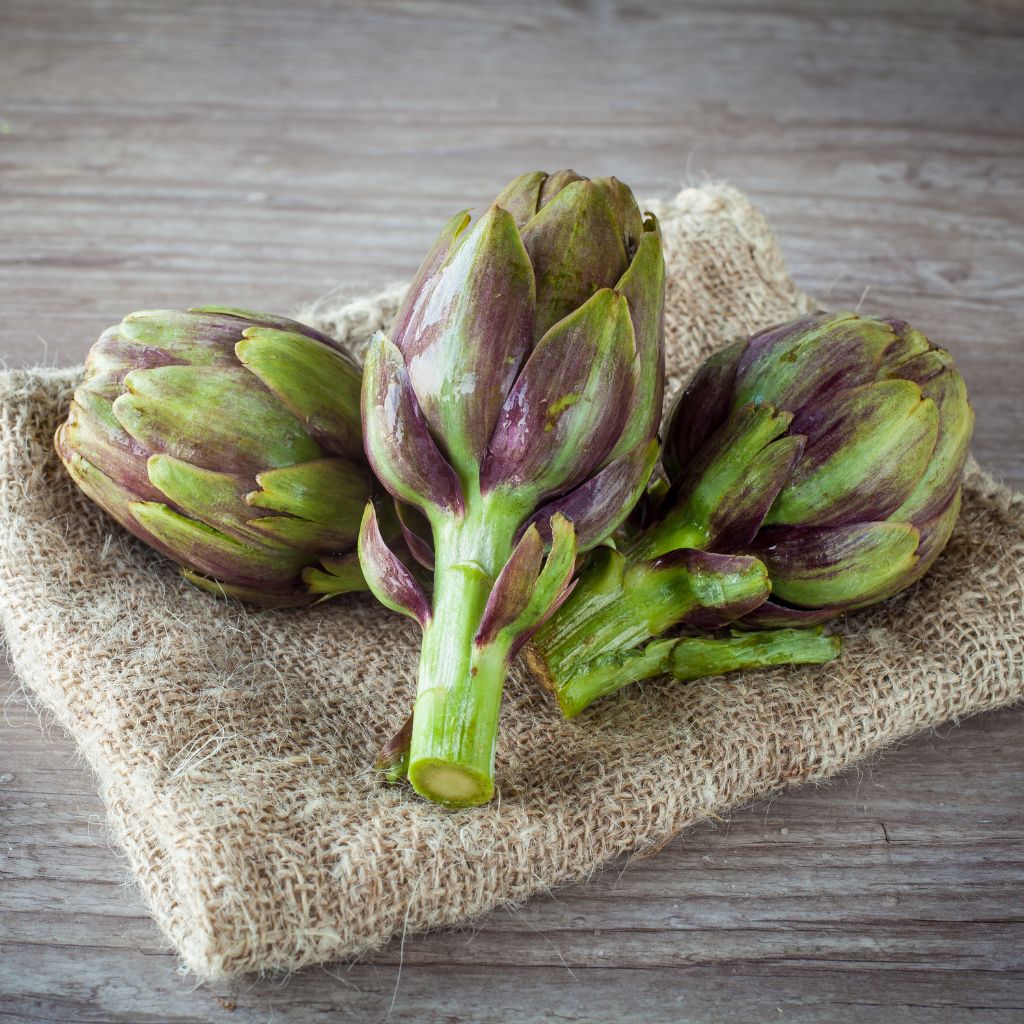
The artichoke is an ancient cultivated plant in the thistle family (Asteraceae). The edible part is a large, immature flower bud with thick green or purple scales (bracts) that enclose a soft base and a creamy heart. Both the fleshy bracts and the heart have a delicate, slightly nutty flavor.

Advertisement: The page displays ads and contains advertising links (affiliate links). See our advertisers here.
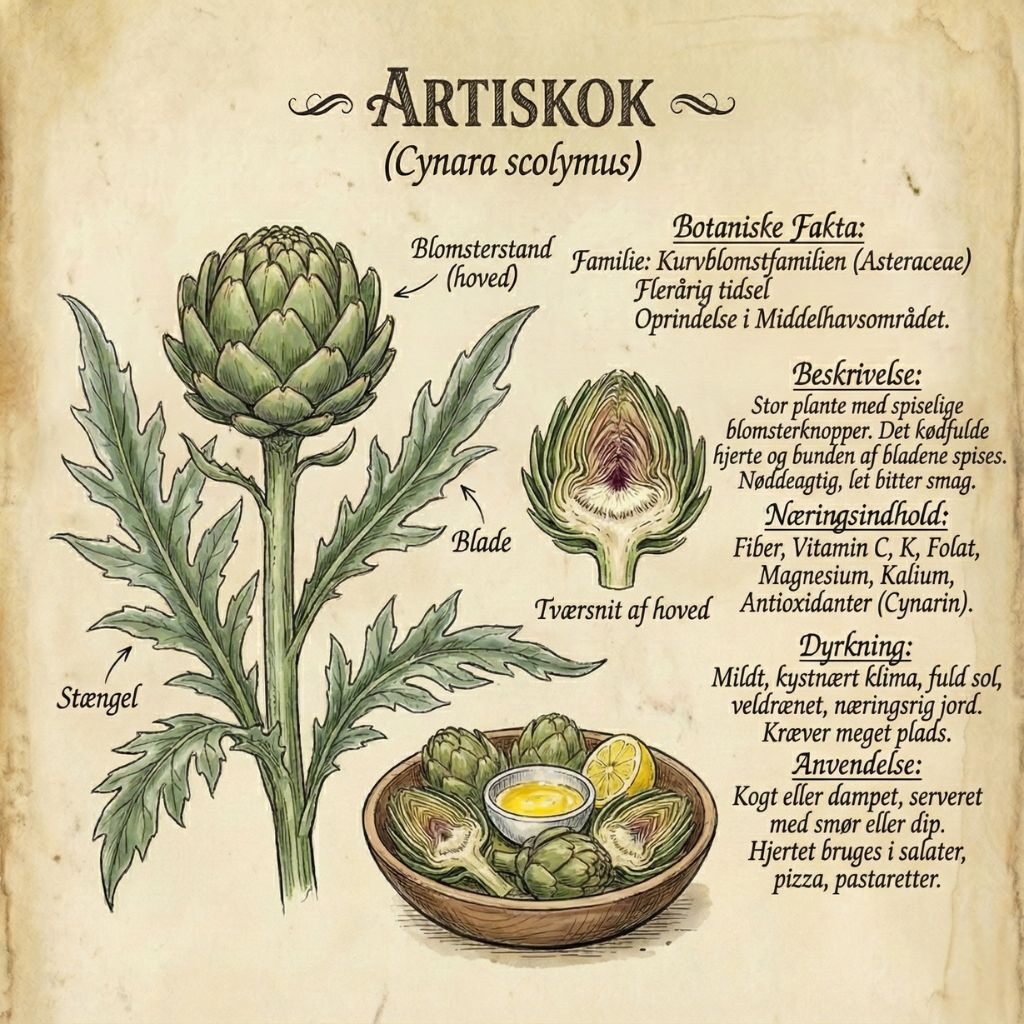
Botanically, the artichoke is a variant of the wild cardoon, Cynara cardunculus var. scolymus, and therefore belongs to the same family as thistles and dandelions. In this entry in our Food Encyclopedia, we take a closer look at the artichoke’s history, flavor, preparation, cultivation and health properties.
Estimated reading time: 8 minutes
History and Origin
The wild cardoon, from which the artichoke descends, grows along the Mediterranean coast. Historical and genetic data suggest that the artichoke was domesticated in Roman times – possibly in Sicily – and later spread throughout the Mediterranean region.
From Wild Cardoon to Cultivated Delicacy
Arab farmers played a key role in spreading the plant and developing selected varieties with softer flower buds. During the Renaissance, the artichoke was a sought-after delicacy at the Italian and French courts, and in the 1500s French colonists brought it to North America. In Denmark, the artichoke has been cultivated since the 1600s – first as an ornamental plant and later as a vegetable.
Flavor and Aroma
The artichoke’s fleshy bracts have a mild, slightly nutty flavor and a firm yet tender texture when properly cooked. The heart is especially creamy and juicy. The characteristic bitter note comes from plant compounds such as cynarin and silymarin, and it’s cynarin specifically that makes water taste sweet when you drink it right after eating artichoke.
Preparation has a major impact on the result. Overcooked artichokes turn mushy and fall apart, while undercooked buds can be tough and woody. The goal is a tender bract, where the fleshy part can easily be scraped off with your teeth, and a heart that’s creamy all the way through.
Culinary Uses
Artichokes are a versatile kitchen ingredient that can be prepared in many ways – both hot and cold. They feature in classic Mediterranean dishes and modern culinary creations, from whole steamed buds to marinated hearts in salads.
In Danish Cuisine
In Danish kitchens, the artichoke is most often used as a slightly festive vegetable. Whole boiled or steamed buds are served as a starter with a dip of butter, aioli or hollandaise, with the leaves plucked off one by one. Marinated artichoke hearts from a jar have become a regular feature on the tapas table, in salads and as a topping on pizza and in pasta.
Internationally
In the Mediterranean countries, the artichoke is a culinary classic. In Italy and Greece, whole buds are stuffed with breadcrumbs, cheese and herbs and baked, while small artichokes are grilled and served as antipasti alongside olives, cheese and charcuterie. Artichoke hearts also feature in creamy dips – such as the classic spinach-artichoke dip – and in purées with garlic and lemon for spreading on bread.
Preparation Methods
- Boiled or steamed: Boil or steam whole flower buds for 25-45 minutes, depending on size, until the outer leaves can easily be pulled off. Serve with melted butter, olive oil, aioli or hollandaise.
- Fried or sautéed: Cut artichokes into quarters or slices and fry them in olive oil with garlic and lemon juice until golden and crisp on the outside with a creamy interior.
- Oven-baked: Halve the buds, remove the choke and bake them with herbs, garlic and lemon slices until tender with a deep, caramelized flavor.
- Stuffed: Remove the innermost leaves and the choke, fill the cavity with breadcrumbs, cheese, herbs and oil, and bake the buds.
- Marinated: Artichoke hearts can be bought marinated or made at home and are great in salads, on pizza, in pasta and as a snack.
Preparation
A whole artichoke needs to be trimmed before cooking. It only takes a couple of minutes once you know the method, and a bowl of lemon water on hand keeps the cut surfaces from browning.
Total time: 15 minutes
- Choose and rinse
Choose heavy artichokes with tight, crisp leaves, and avoid ones that feel limp or dry. Rinse the artichoke under cold water.
- Prepare lemon water
Fill a bowl with water and squeeze the juice of one lemon into it. The lemon juice prevents the cut surfaces from discoloring.
- Trim the top and leaves
Cut 2-4 cm off the top with a sharp knife, remove the tough bottom leaves, and snip the tips off the remaining leaves with scissors to remove the thorns.
- Handle the stem
Cut off the stem, or peel it and keep it as an extra edible part.
- Remove the choke
If you want to cook the hearts, cut the artichoke in half lengthwise; remove the purple inner leaves and scrape away the fuzzy choke with a spoon. Place the pieces in the lemon water.
For whole artichokes, boiling and steaming preserve the most nutrients. Boil them in lightly salted water with lemon juice added for 25-45 minutes, or steam them over a couple of centimeters of water with the lid on. Steamed artichokes have a more concentrated flavor and hold their texture better. They can also be grilled, fried or baked for a different texture.
Nutrition and Health
Nutrients
Artichokes are nearly fat-free, low in sodium and rich in fiber. A medium cooked artichoke (about 120 g) contains around 64 kcal, 3.5 g protein, 14 g carbohydrate, under 1 g fat and roughly 7 g dietary fiber. They also provide folate, vitamin K and C, as well as magnesium, manganese and potassium.
- Calories: approx. 53 kcal per 100 g (cooked)
- Protein: approx. 2.9 g per 100 g
- Dietary fiber: approx. 5.4 g per 100 g
- Key micronutrients: folate, vitamin K, vitamin C, magnesium, manganese and potassium
Artichokes also contain inulin, a prebiotic soluble fiber that serves as food for beneficial gut bacteria, as well as antioxidants such as cynarin, silymarin and polyphenols.
Health Benefits
- Cardiovascular health: Dietary fiber and antioxidants can help lower cholesterol levels, and potassium helps regulate blood pressure.
- Digestion and satiety: Inulin and fiber promote a healthy gut flora, and the low calorie density provides lasting fullness.
- Liver and bile: Cynarin stimulates bile production and is traditionally associated with supporting liver function and digestion.
A few things to be aware of: Artichokes contain fermentable carbohydrates (FODMAPs), which can cause bloating in people with a sensitive stomach. Since the plant belongs to the daisy family, people with allergies to other asters (such as dandelion or chamomile) should be aware of possible cross-reactions. The buds are rich in vitamin K, so people on blood-thinning medication should keep their vitamin K intake consistent, and artichoke extract should be avoided in cases of gallstones or bile duct obstruction. This section is not medical advice.
Growing in Denmark
The artichoke is a perennial thistle, but in the Danish climate it’s usually grown as an annual or with thorough winter protection. It needs a long, warm season to form buds, so the plants are started early indoors.
Growing Conditions
The artichoke thrives in full sun with 6-8 hours of light a day and in deep, well-drained, humus-rich soil with a pH between 6.5 and 7. The plant grows 80-150 cm tall and is hardy to around zone 6, but requires winter protection in cold areas. Buds form after roughly 150-200 days.
How to Grow Artichoke
Total time: 150-200 days
- Sow indoors
Sow seeds indoors 8-12 weeks before the last expected frost in nutrient-rich seed-starting soil.
- Cold treatment
Give the young plants a period of cold (vernalization) so they form flower buds already in the first year.
- Transplant outdoors
Plant out in a sunny spot after the last frost in deep, well-drained, humus-rich soil with a pH of 6.5-7.
- Care
Water evenly and give the plant plenty of space; it grows 80-150 cm tall and needs feeding throughout the season.
- Harvest
Harvest the flower buds from June to August, while they’re still firm and closed – before they open into flower.
Storage
In the Fridge
Fresh, untreated artichokes are best stored in the refrigerator in a perforated bag, where they’ll keep for up to a week. You can sprinkle a little water on the buds to keep them fresh. The sooner they’re used, the better the flavor and texture.
Freezing and Preserving
- Cooked artichoke hearts can be frozen and used directly in dishes later.
- Hearts can be preserved in oil or brine and will then keep in the refrigerator for several weeks.
- Trimmed raw artichokes stay pale in lemon water until they’re ready to be cooked.
Try This Recipe
Marinated artichoke hearts are among the very best toppings for Italian bread and pizza, where their mild, nutty flavor plays off olive oil, garlic and parmesan. Bake an airy, crispy base for your artichokes with our recipe for Potato focaccia in the air fryer – crispy Italian bread with rosemary and sea salt, and top it with artichoke, cheese and fresh herbs.
Equipment and Products
If you don’t have fresh artichokes on hand, ready-made marinated hearts are an easy shortcut for salads, pizza and tapas alike. Try Grilled Artichoke Ibsa, tender grilled artichokes ready to use straight from the jar.
Frequently Asked Questions
No. The common (globe) artichoke is the flower bud of Cynara cardunculus var. scolymus in the daisy family. Jerusalem artichoke, on the other hand, is the tuber of the sunflower species Helianthus tuberosus. The two plants are not related.
You eat the fleshy base of the outer bracts as well as the creamy heart. The fuzzy choke in the middle is removed, and the tough leaf tips are trimmed off. The stem can be peeled and eaten as an extra part.
Whole artichokes are boiled for 25-45 minutes depending on size, or steamed for 30-40 minutes. They’re done when the outer leaves can easily be pulled off.
Fresh artichokes are stored untreated in the refrigerator in a perforated bag for up to a week. Cooked artichoke hearts can be frozen or preserved in oil or brine.
Most people can enjoy artichokes, but those with FODMAP sensitivity or an allergy to the daisy family should be cautious. People on blood-thinning medication should keep their vitamin K intake consistent.
Facts About Artichoke
| Field | Value |
|---|---|
| English name | Artichoke |
| Latin name | Cynara cardunculus var. scolymus |
| Family | Daisy family (Asteraceae) |
| Plant type | Perennial thistle; often grown as an annual in Denmark |
| Height | 80-150 cm |
| Hardiness | Hardy to about zone 6; requires winter protection in cold areas |
| Light | Full sun (6-8 hours daily) |
| Soil | Deep, well-drained, humus-rich soil; pH 6.5-7 |
| Sow/plant | Seeds are sown indoors 8-12 weeks before the last frost; transplanted after frost |
| Flowering/harvest | Buds form after 150-200 days; harvest June-August |
| Calories per 100 g | approx. 53 kcal (cooked) |
| Flavor | Delicate, slightly nutty flavor with a sweet aftertaste |
| Culinary uses | Fried, steamed, stuffed, marinated, in dips, on pizza, in pasta and salads |
| Cooking time | 25-45 minutes (boiling); 30-40 minutes (steaming) |
| Storage | Untreated in the refrigerator for up to a week; hearts can be frozen or preserved |
