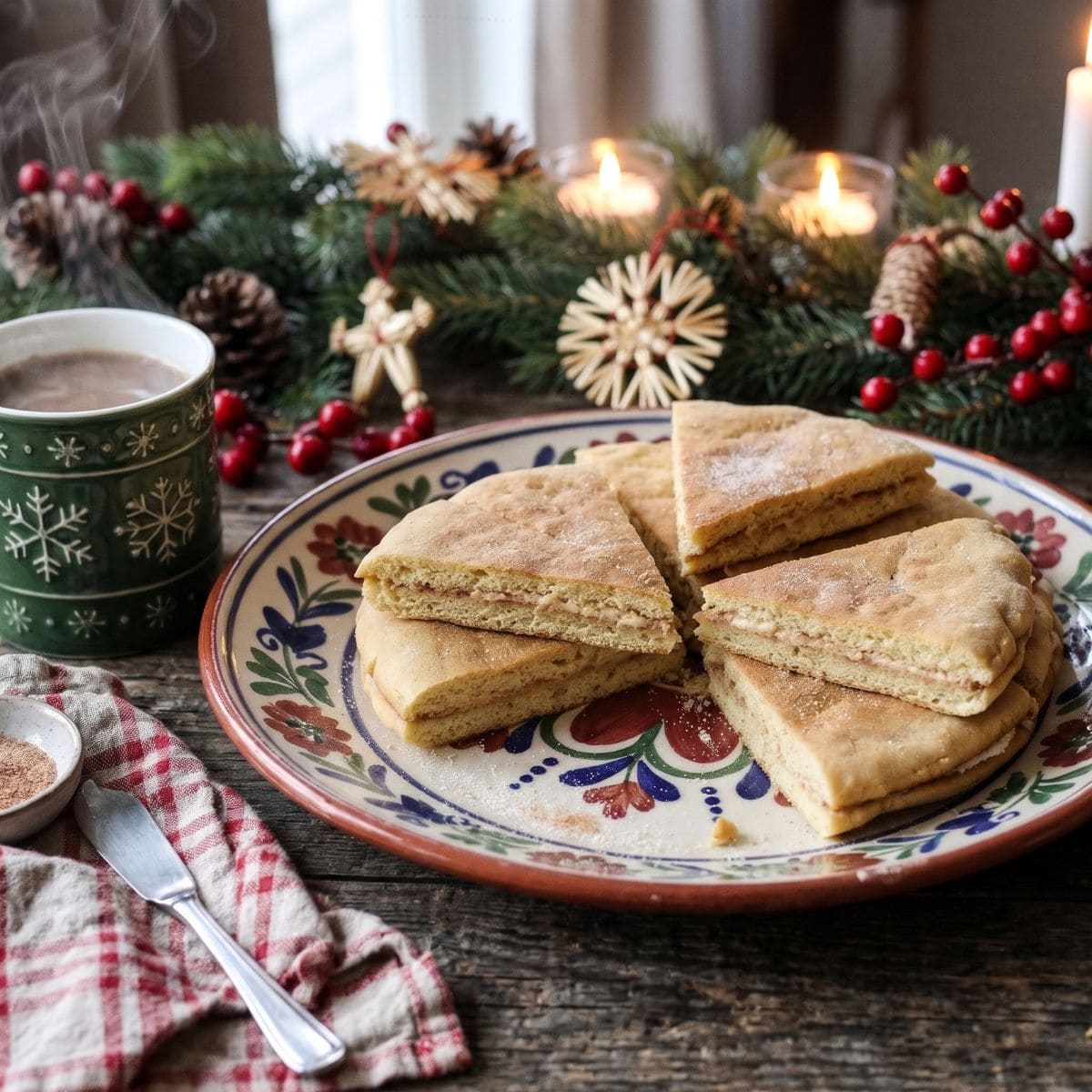
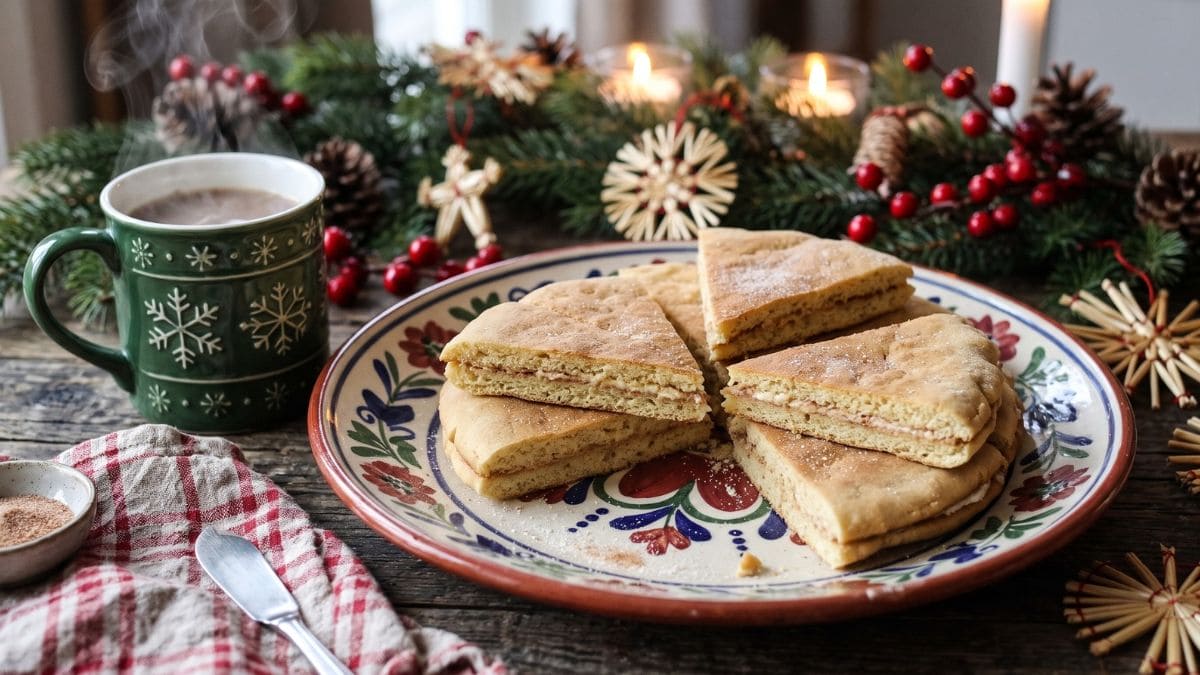
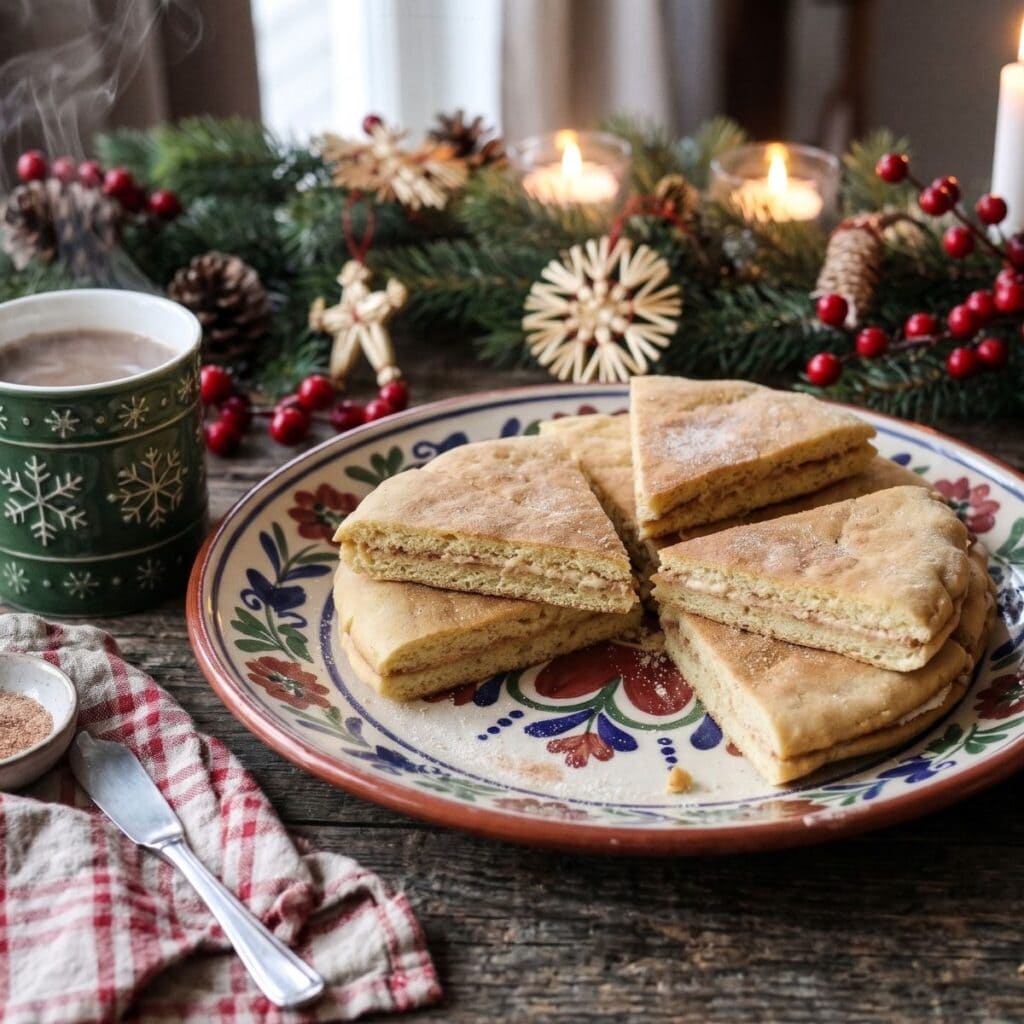
Tykklefse – or tjukklefse, as they are also called in Norway – are thick, sweet lefse made from a soft kefir dough. They are sandwiched together in pairs with a buttercream of butter, sugar and cinnamon and cut into triangles, and the result is far more like a soft cake than bread. Forget all about thin potato lefse; this is pure baking for coffee time.
In the air fryer, I bake one lefse at a time on a piece of baking paper cut to fit the bottom of the basket. The oven can stay cold, and I have full control over the colour, which is the whole secret: the lefse should be pale and soft, not golden and crisp.
Estimated reading time: 4 minutes
Table of Contents
Why I love tykklefse in the air fryer
Tykklefse are surprisingly well suited to an air fryer. A lefse of about 17 centimetres lies flat in the basket with a little space around it, and the hot air bakes it evenly, so it rises nicely and turns tender without drying out. While one is baking, I roll out the next, and that way the whole batch of dough becomes four lefse in one calm, steady flow at the kitchen counter.
I also like that the dough can be made well ahead. It needs to rest in the cold for at least an hour and is happy to stay in the fridge overnight, so the next day all that is left is rolling out, baking and the buttercream.
The difference between the air fryer and the oven
In Norway, many people bake tykklefse in the oven or on a lefsetakke – a large, flat griddle. The oven has to heat up fully, even though only four lefse need baking, whereas the air fryer is ready in no time and gives each lefse its own round. Always place the lefse on the baking paper before the paper goes into the basket. Baking paper on its own in a hot air fryer can blow up into the heating element.
My kitchen test of tykklefse
I baked the tykklefse in my Philips HD9880 Combi XXL at 170 °C, and 7 minutes per lefse was spot on. By then the lefse has risen, it springs back when lightly pressed, and it has only taken on a pale golden tone. Four lefse means 28 minutes in the basket, and with about half an hour of preparation and an hour of chilling time for the dough, you should allow 118 minutes, or just under two hours, from start to finish.
The first time, I left a lefse in the basket until it was golden. It went dry at the edge and cracked when I came to assemble it, so since then I have stuck to pale lefse. Prick each lefse all over with a fork so it does not puff up into large bubbles. If the underside is still doughy after 7 minutes, turn the lefse over and give it 1 more minute. If you have a small or narrow basket, divide the dough into 6 pieces, roll out smaller lefse and keep an eye on them from 6 minutes.
Put each lefse under a clean tea towel as soon as it comes out of the basket. The steam trapped under the cloth is what keeps the lefse soft and tender.
Tips and tricks from the author: Morten Jensen
Common mistakes and how to avoid them
The classic mistake is baking the lefse for too long. As soon as they take on colour, they turn dry and crisp instead of soft, so stick to 170 °C and 7 minutes, and take them out while they are still pale. The next mistake is rolling out the dough too early. It is soft and slightly sticky, and without at least an hour in the fridge it sticks to both the work surface and the rolling pin, whereas cold dough and a light dusting of flour make the job easy. The third mistake is spreading on the cream while the lefse are still warm – it melts and runs out at the sides. Let them cool completely under the tea towel before you assemble them.
How to serve tykklefse
Tykklefse taste best at room temperature, when the buttercream is soft. Chill the assembled lefse for 15 minutes before cutting them, and the triangles will be neater. This is how I serve them:
- With a cup of black coffee or tea in the afternoon
- On the cake table at a birthday alongside other home baking
- With a glass of cold milk for the kids
- With 1 tsp vanilla sugar in the buttercream for a rounder flavour
- With icing sugar instead of sugar if you want the cream completely smooth
Storage and reheating
Tykklefse can be stored in the fridge for up to 3 days in an airtight container. They are not suitable for reheating because the buttercream melts, so take them out of the fridge a little before serving instead. If you want to bake ahead, they can be frozen for up to 3 months. Thaw them in the fridge overnight.
Tykklefse are good proof that the air fryer can bake soft and tender too, as long as you hold back on the colour. Roll them out, bake them pale and tuck them under the cloth – and you have a piece of Norway ready for afternoon coffee.
FAQ
Tykklefse are thick, sweet lefse made from wheat flour and kefir and are most like a soft cake. Lomper are thin, unsweetened potato flatbreads and are used more like bread, for example wrapped around a sausage.
Yes, buttermilk works well. The dough will be a little softer, though, so dust with a little extra flour when you roll out the lefse.
Yes, for up to 3 months. Thaw them in the fridge overnight and take them out a little before serving.

Recipe
Tykklefse in the Air Fryer
Cooking Guide
Keep the screen on and follow the recipe step by step while you cook.
Step 1:
Avoid the screen turning off while you cook.
Step 2:
Start the guide and follow the recipe one step at a time.
Cost of the dish
Prices may vary depending on where you shop.
Our estimate is based on average food prices for the current year 2026.
Estimated price for the whole dish:
Airfryer size
All our recipes are tested in a Philips HD9880 Combi XXL
Does the recipe fit my Airfryer?
If you’re unsure, you can always reduce by one serving in the recipe, or click the 0.5x button.
You can also Ask the AI Chef
It’s easy! Just press the Ask the AI Chef button you see at the bottom.
Recommended equipment
- 1 Air fryer
- 1 Kitchen scale
- 1 Small saucepan
- 1 Mixing bowl
- 1 Whisk
- 1 Ladle
- 1 Plastic wrap
- 1 Rolling pin
- 1 Parchment paper (for air fryer)
- 1 Turner
- 1 Kitchen towel
- 1 Small bowl
- 1 Offset spatula
- 1 Cutting board
- 1 Sharp knife
Shopping list
Ingredients


How to make it
Preparation
- Melt 30 g butter in a small saucepan over a low heat, and let it cool slightly.
- Whisk 150 ml kefir, 50 g sugar and 2 tbsp golden syrup together in a mixing bowl until the sugar has almost dissolved. Then whisk in the melted butter.
- Stir the flour mixture into the kefir mixture with a wooden spoon until the dough comes together and is soft and slightly sticky. Do not stir more than necessary – that way the lefse will be tender.
- Cover the bowl with cling film and let the dough rest in the fridge for at least 1 hour, preferably overnight. The cold dough is much easier to roll out.
Cooking in the air fryer
- Preheat the air fryer to 170 °C fan.
- Divide the dough into 4 equal pieces, and cut a piece of baking paper to fit the bottom of the basket.
- Roll out a piece of dough on a floured work surface into a round lefse, about ½ cm thick and 17 cm in diameter. It should lie flat in the basket with a little space around it – if your basket is smaller, make the lefse correspondingly smaller.
- Prick the lefse well all over with a fork so it does not puff up into large bubbles in the air fryer.
- Bake the lefse at 170 °C for 7 minutes, until it has risen, springs back when lightly pressed and is only pale golden. It must not turn brown – otherwise it becomes dry and crisp instead of soft.
Assembly
- Beat 60 g butter, 50 g sugar and 1 tsp cinnamon together in a small bowl into a fluffy buttercream while the lefse cool. The butter should be soft so the cream is easy to spread.
- Spread the buttercream evenly over 2 of the cooled lefse with a palette knife. Place the other 2 lefse on top and press them together lightly.
- Cut each pair into 8 triangles with a sharp knife on a chopping board.
- Serve the tykklefse at room temperature – ideally with a cup of coffee.
Our notes for the recipe
Bake the lefse pale at 170 °C – if they take on colour, they turn dry and crisp instead of soft. Put them under the tea towel as soon as they come out of the basket; the steam keeps them soft. If the underside is still doughy after 7 minutes, turn the lefse over and give it 1 more minute. Let the lefse cool completely before the cream goes on, otherwise it will melt. Thick and sweet:
Tykklefse is a thick, sweet Norwegian lefse made from wheat flour and kefir, and it is most like a soft cake. It is something entirely different from thin potato lefse. Variation:
Stir 1 tsp vanilla sugar into the buttercream, or use icing sugar instead of sugar if you want the cream completely smooth. If you use buttermilk instead of kefir, the dough will be a little softer – dust with a little extra flour when you roll it out. Serving:
The recipe makes 4 lefse, which become 2 pairs and 16 triangles – 4 per serving. Chill the assembled lefse for 15 minutes before cutting them, and the cuts will be neater. Take them out of the fridge a little before serving. Portion size:
If you have a small or narrow basket, divide the dough into 6 pieces and roll out smaller lefse. Keep an eye on them from 6 minutes.
Your notes for the recipe
Nutrition per serving (Guideline)
Important about shelf life and nutrition
Nutrition per serving (guideline): Calculations are based on data from the United States Department of Agriculture (USDA). Shelf life (guideline): Shelf life data is provided, as far as possible, by public institutions, including national food authorities. Our information is therefore only indicative, and it is your responsibility to obtain and calculate accurate information about shelf life and nutrition for all recipes on airfryerkogebogen.dk
Easily share the recipe with others:
Via email or on Facebook
Open the recipe on your phone
Scan the QR code with your phone and get the recipe directly on your mobile while you cook.

Author
Airfryerkogebogen.dk