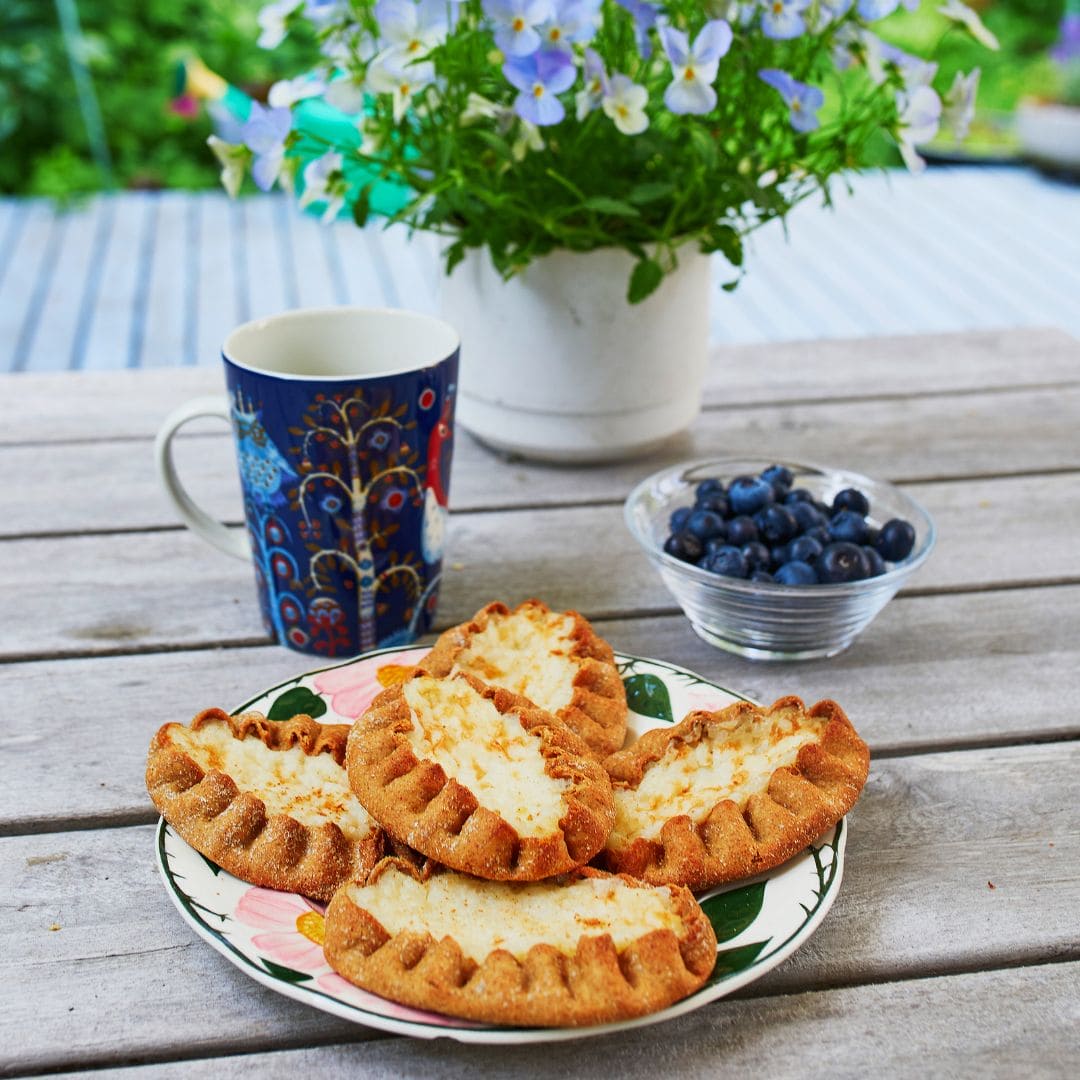
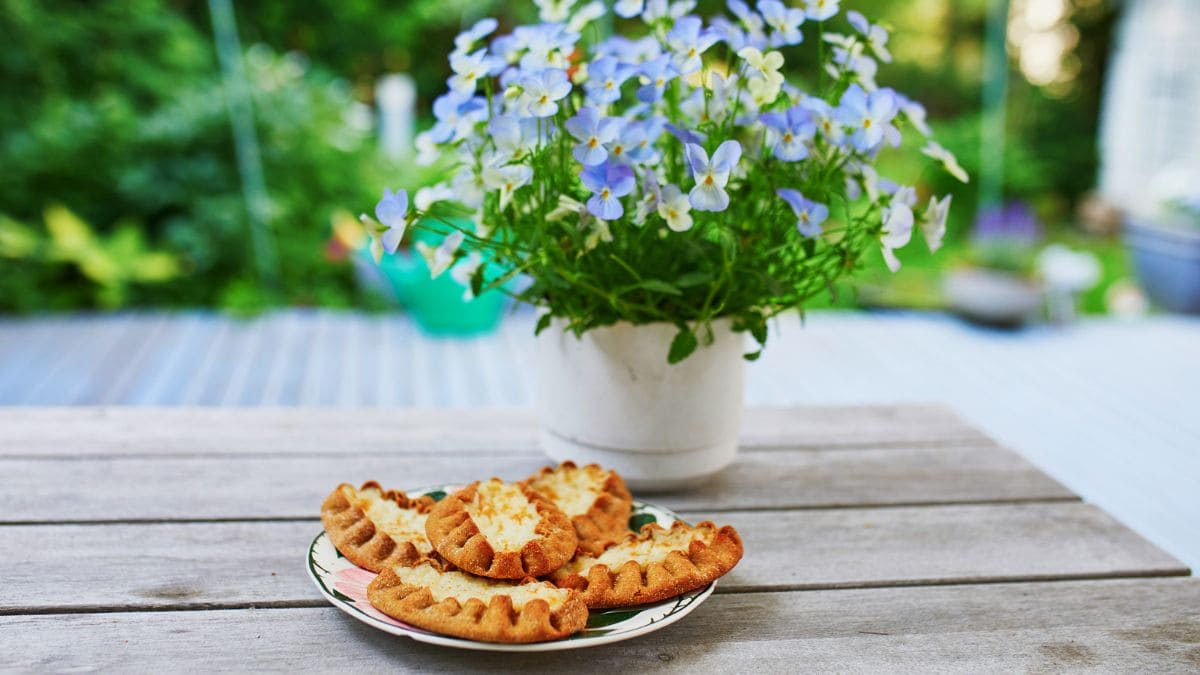
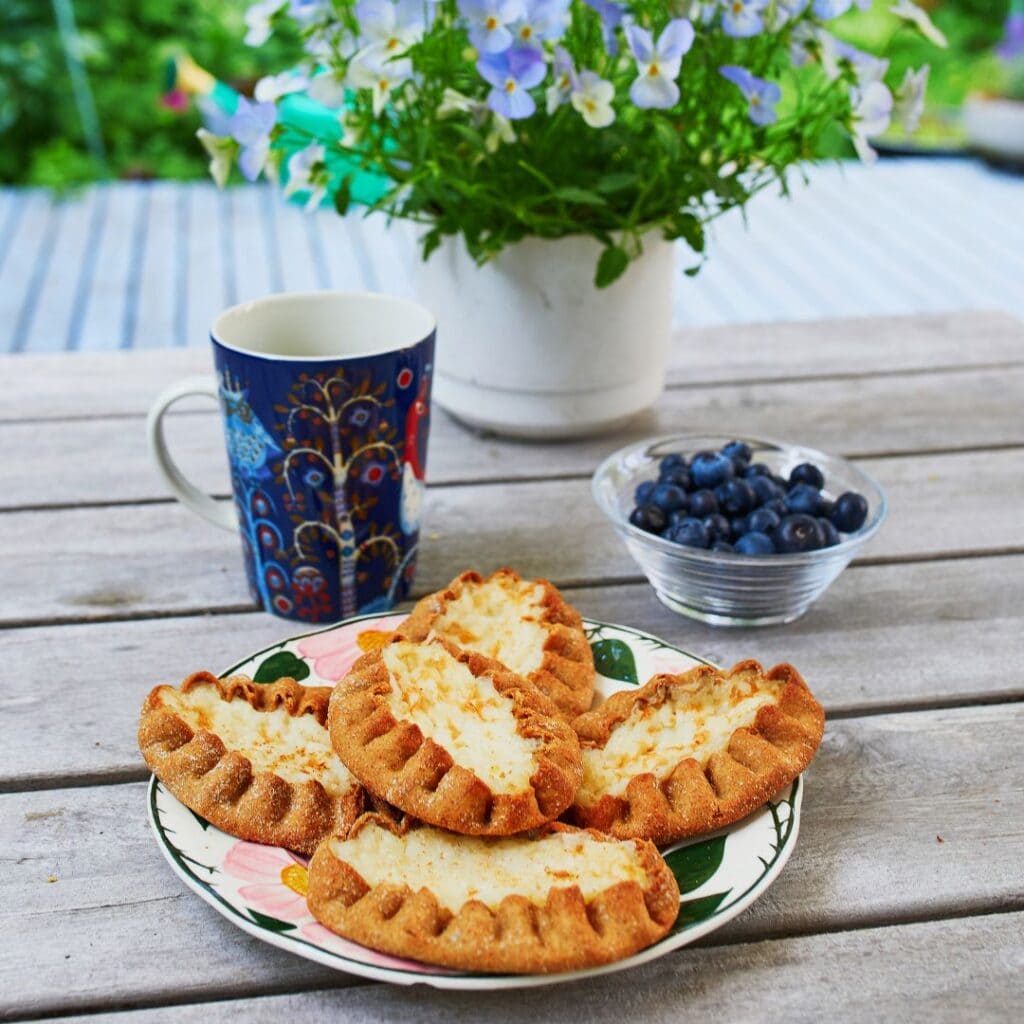
Karelian pasties, or karjalanpiirakka, are something completely different from the pirozhki most Danes know. No minced meat, no sweet dough, and no deep-fat fryer. Instead, a paper-thin rye dough is folded around a layer of soft, unsweetened rice porridge, and the edges are crimped together with your fingers, so each one turns out slightly different from its neighbour. They are savoury pastries with a crispy edge and a creamy centre, and in Finland they are eaten for breakfast, with afternoon coffee, and as a snack all year round.

Advertisement: The page displays ads and contains advertising links (affiliate links). See our advertisers here.
The air fryer is an obvious place to bake them. The dry, circulating heat hits the rye edge directly, while the filling stays soft. The whole process takes 89 minutes, but only 14 of those are baking time – the rest is dough, porridge, and the cooling time needed before the porridge can be spread without tearing the dough.
Estimated reading time: 4 minutes
Table of Contents:
Why I love Karelian pasties in the air fryer
What drew me to them is the contrast. The rye dough has neither yeast nor fat – just rye flour, water and salt – and is rolled so thin that you can almost see through it. In the heat, the edge turns crispy and slightly bitter from the rye, playing off the rice porridge, which is mild, salted and creamy. Two very simple components that only become interesting together.
In a conventional oven, that effect needs scorching heat, which is hard to control in an ordinary home. The air fryer gives me 200°C close to the food with air in constant motion, so the edges set quickly while the centre does not dry out. I can also bake in small batches and adjust after the first batch.
Why the rye dough needs to be rolled so thin
The dough is a shell, not a loaf of bread. Roll it too thick, and the edge turns hard and floury instead of crispy, tipping the balance between shell and filling the wrong way. Rye flour has almost no gluten, so the dough does not spring back – it stays exactly as you roll it. That is an advantage here, where the edge should be at its thinnest right where it needs to be folded in.
My kitchen test: Karelian pasties
I have baked them in my Philips XXL at 200°C, and 14 minutes is when they need to come out. Earlier than that, the edge is still pale and a little chewy; at 14 minutes it has picked up the dark spots that give it bite, without the rye turning burnt and bitter. The most important lesson was to respect the cooling time. The 30 minutes the porridge needs to rest is not wasted time: warm porridge is runny and tears a hole in the thin dough, while cooled porridge can be spread out with a spoon. The first time I skipped it, two of the pasties ended up with their filling in the basket. With 89 minutes in total, 45 of which go to preparation, I cook the porridge the evening before.
Brush the pasties with melted butter the moment they come out of the basket. That is where the edge gets its shine and final flavour – and it needs to be hot enough to soak up the butter.
Tips and tricks from the author: Morten Jensen
The typical mistakes and how to avoid them
The first mistake is too much porridge. A thin layer looks sparse, but the filling rises during baking, and an overfilled pasty splits open and spills over – stick to an even layer that stays below the edge. The second is letting the pasties overlap in the basket because they are small and there seems to be room. Air needs to move around each one, otherwise they steam instead of turning crispy, and two batches are better than one. The third is forgetting the butter at the end. The rye shell dries out quickly in the airflow, and without brushing while the pasties are hot, it turns dull and lacklustre instead of glossy.
How to serve Karelian pasties
Traditionally, munavoi belongs on top – egg butter made from chopped hard-boiled eggs stirred into soft butter – but the pasties can carry more than that:
- Munavoi spread on while the pasty is warm, so the butter melts into the porridge
- Cold-smoked salmon or gravlax with a sprig of dill, for a more generous spread
- Slices of firm cheese and pickled red onion on a savoury breakfast table
- Buttermilk or plain yoghurt on the side, as many Finns drink with it
Storage and reheating
The pasties keep for two days in a closed container at room temperature. Do not put them in the fridge – the cold makes the rye shell tough. Reheat them in the air fryer at 200°C until the edge turns crispy again; it only takes a couple of minutes, and it does not work in the microwave, where they turn soft all the way through. They freeze well: freeze them individually, and warm them straight from frozen. I always make egg butter fresh.
Karelian pasties reward patience more than technique. Roll thin, let the porridge cool completely, and brush with butter at the end – that way you get edges that turn crispy, and a centre that stays creamy. Serve them warm, and let the egg butter melt on its own.
Frequently asked questions
Karelian pasties, karjalanpiirakka, have a thin, unsweetened rye dough and a rice porridge filling, and they are baked open with crimped edges. The pirozhki most people know from Eastern Europe are closed, often made of wheat dough and filled with meat, cabbage or mushrooms – and they are typically deep-fried.
You can, but it becomes a different dish. The rye flour gives the slightly bitter flavour and the crispy shell that characterise karjalanpiirakka. With wheat flour, the dough becomes more elastic and chewier, and the edge loses its crispness.
14 minutes at 200°C in this recipe. The whole process takes 89 minutes, because the rice porridge needs to be cooked and cooled for 30 minutes before it can be spread on the dough. If you bake in two batches, you can check the second batch a little earlier, because the air fryer is already hot.

Recipe
Karelian pasties in the air fryer
Cooking Guide
Keep the screen on and follow the recipe step by step while you cook.
Step 1:
Avoid the screen turning off while you cook.
Step 2:
Start the guide and follow the recipe one step at a time.
Cost of the dish
Prices may vary depending on where you shop.
Our estimate is based on average food prices for the current year 2026.
Estimated price for the whole dish:
Airfryer size
All our recipes are tested in a Philips Airfryer 2000 Series NA230/00 – 6.2 L
Does the recipe fit my Airfryer?
If you’re unsure, you can always reduce by one serving in the recipe, or click the 0.5x button.
You can also Ask the AI Chef
It’s easy! Just press the Ask the AI Chef button you see at the bottom.
Recommended equipment
- 1 Air fryer
- 1 Pot - Thick-bottomed
- 1 Rolling pin
- 1 Mixing bowl
- 1 Bagepapir (til airfryer)
- 1 Brush
Shopping list
Ingredients
Rye dough
- 150 g rye flour (Fine)

- 50 g wheat flour
- 1.5 dl water (Lukewarm)
- 0.5 tsp salt
- 2 tbsp rye flour (For rolling out)


Rice porridge filling
- 1.5 dl pudding rice
- 2.5 dl water
- 5 dl whole milk
- 0.5 tsp salt
- 10 g butter


Glaze
- 25 g butter (Melted)
- 0.5 dl whole milk
Egg butter (munavoi)
- 2 pcs eggs
- 75 g butter (Softened)
- 1 pinch salt

How to make it
Rice porridge filling
- Bring 1.5 dl pudding rice to the boil with 2.5 dl water in a thick-bottomed pot. Let the rice simmer covered for 5 minutes, until the water has been absorbed.
- Add 5 dl whole milk and 0.5 tsp salt, and let the porridge simmer over low heat for about 30 minutes, stirring regularly, until thick and creamy. The porridge should be unsweetened.
- Stir 10 g butter into the finished porridge, and let it cool completely for about 30 minutes. Cold porridge is essential, otherwise the rye base will turn soft during baking.
Rye dough
- Knead 150 g rye flour, 50 g wheat flour and 0.5 tsp salt together with 1.5 dl water into a firm, pliable dough. The dough should be dry enough not to stick to your hands.
- Divide the dough into 12 equal pieces, and roll out each piece into a thin oval about 12 cm across, using 2 tbsp rye flour for dusting. The dough should be rolled so thin that it is almost see-through.
Shaping and cooking in the air fryer
- Spread a thin layer of cold rice porridge over the middle of each dough oval, leaving a border of about 2 cm all the way around.
- Fold the long edges in over the filling, and pinch the edge together with your fingers in tight, small pleats, so the pasties get their classic crimped edge.
- Preheat the air fryer to 200°C.
- Place the pasties in a single layer on baking paper in the basket, and bake them for 12-14 minutes at 200°C, until the rye edge is crispy and the filling has golden spots. Bake in two to three batches depending on the size of your air fryer.
- Stir 25 g butter together with 0.5 dl whole milk, and brush the pasties generously while they are still hot. Leave them under a tea towel for 5 minutes, so the edge softens slightly.
Egg butter and serving
- Hard-boil 2 pcs eggs for 8 minutes, cool them in cold water, and peel them.
- Mash the eggs finely with 75 g butter and 1 pinch salt into a spreadable egg butter.
- Serve the pasties warm with a dollop of egg butter on top.
Our notes for the recipe
Roll the rye dough as thin as you possibly can. The thin, crispy rye edge is what sets a real karjalanpiirakka apart from a heavy pastry base. The porridge needs to be completely cold before you spread it on the dough, otherwise the base will soak up moisture and turn soft. Variation:
In Finland, the pasties are also made with mashed potato or mashed carrot instead of rice porridge. Use the same amount of filling and the same method, as long as the filling is thick enough to stay in place on the dough. Serving:
Serve warm with egg butter, and add cold-smoked salmon, cucumber or a slice of cheese if you like. The pasties are savoury pastries, not sweet, so they work equally well on the breakfast table and for lunch. Portion size:
If your air fryer is smaller, you can make the dish in two batches.
Your notes for the recipe
Nutrition per serving (Guideline)
Important about shelf life and nutrition
Nutrition per serving (guideline): Calculations are based on data from the United States Department of Agriculture (USDA). Shelf life (guideline): Shelf life data is provided, as far as possible, by public institutions, including national food authorities. Our information is therefore only indicative, and it is your responsibility to obtain and calculate accurate information about shelf life and nutrition for all recipes on airfryerkogebogen.dk
Easily share the recipe with others:
Via email or on Facebook
Open the recipe on your phone
Scan the QR code with your phone and get the recipe directly on your mobile while you cook.

Author
Airfryerkogebogen.dk