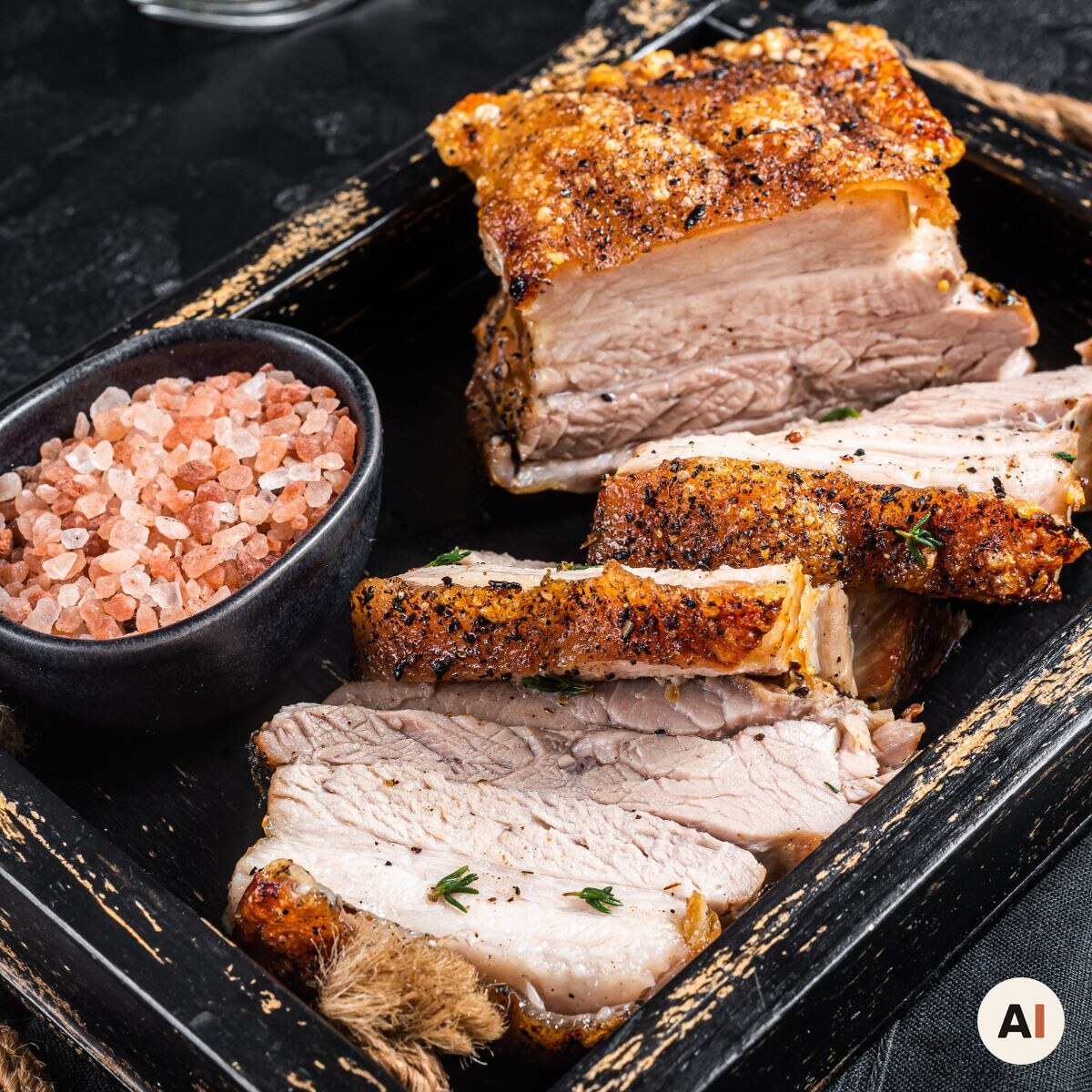
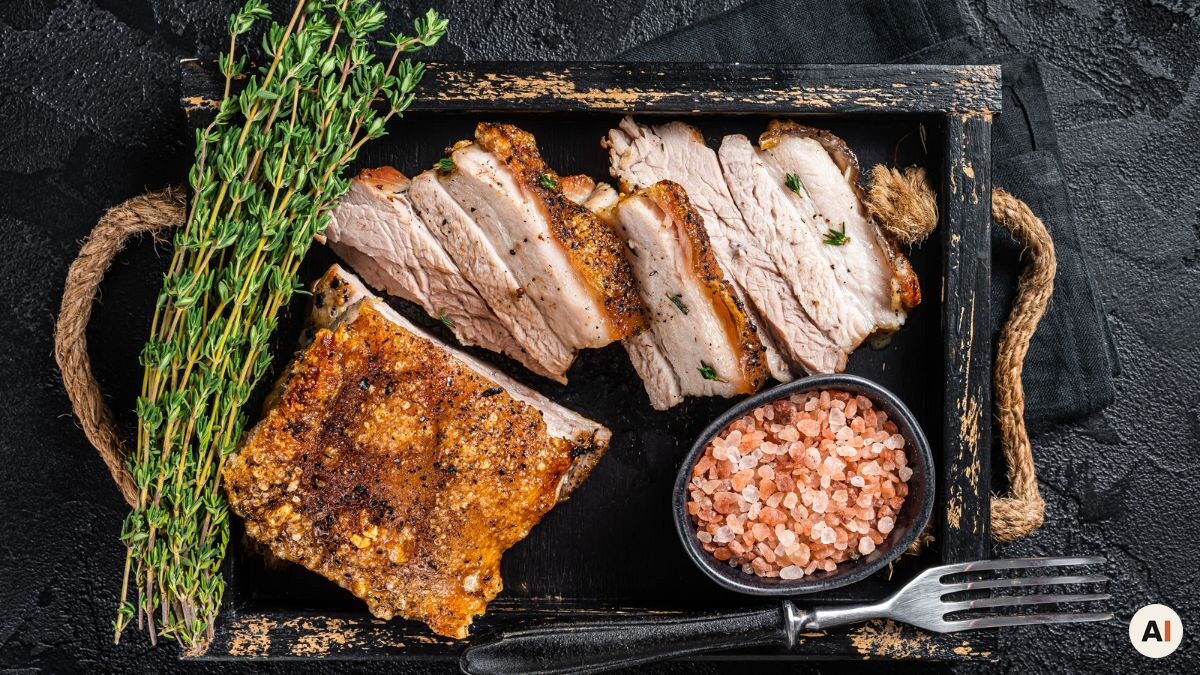
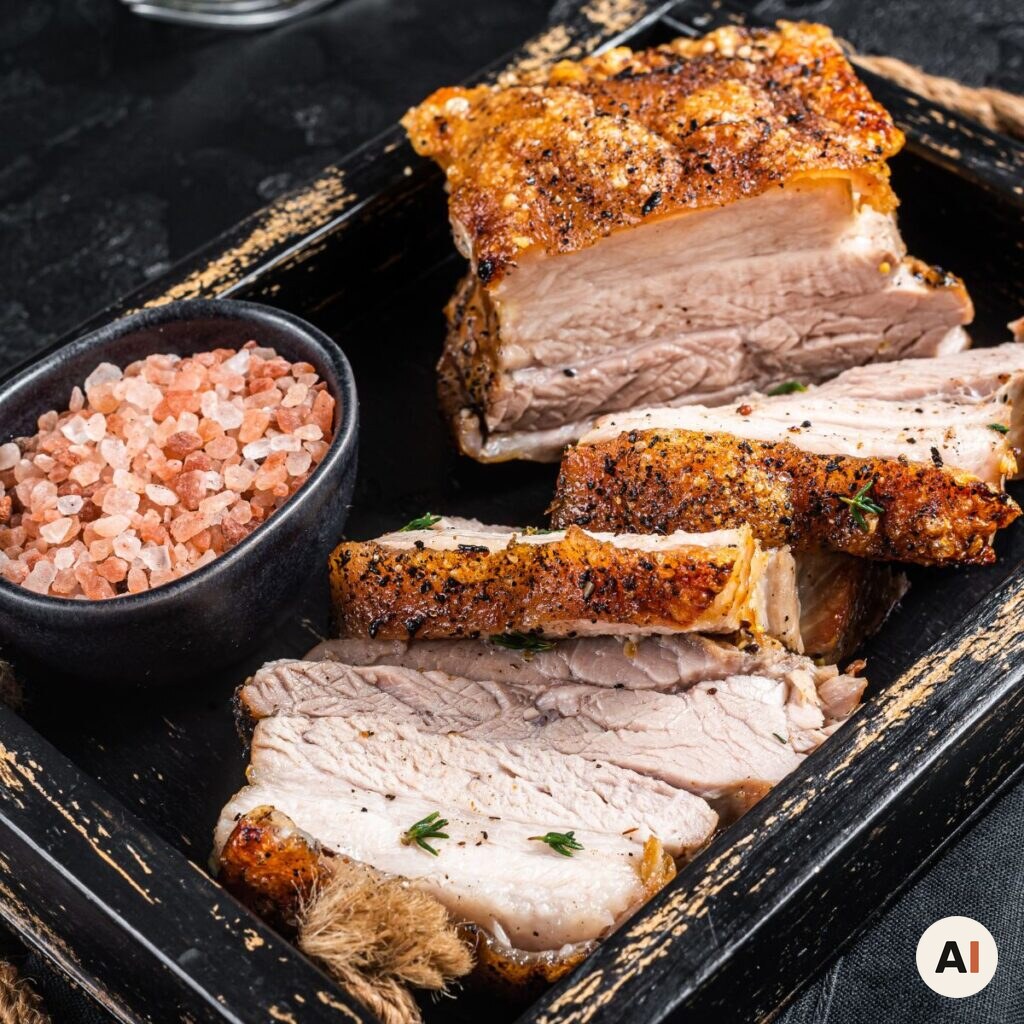
Juleribbe is Norway’s answer to the Danish flæskesteg (roast pork with crackling): a piece of pork belly with the ribs on, where the rind puffs up and crunches while the meat underneath turns tender and juicy in its own fat. In Norway, juleribbe is on the table on Christmas Eve in a great many homes, and once you’ve tasted it, you’ll understand why.
Here I make the whole juleribbe in the air fryer. The pork belly is first steamed under tightly crimped foil so the meat turns tender, then roasted without foil – finishing at high heat so the crackling pops from edge to edge. It takes a little planning, because the meat needs to be salted and left in the fridge overnight, but the actual work is manageable – and the oven is free for everything else the Christmas dinner requires.
Estimated reading time: 4 minutes
Table of Contents
Why I love juleribbe in the air fryer
The best thing about juleribbe in the air fryer is the crackling. The circulating hot air dries the surface quickly, and it is precisely dry rind that puffs up and pops. The heat is close by, so the last few minutes at high heat go straight to the rind, and you don’t have to chase soft patches under the grill of a large oven.
At the same time, the juleribbe doesn’t take up room in the oven, and because the meat is steamed in a covered dish first, you also get rich pan juices that become the gravy.
Why the juleribbe is both steamed and roasted
Many Norwegian recipes cover the pork belly with foil for the first part of the cooking, and the method suits the air fryer perfectly. Under the foil, the meat gets moist heat, so the fat starts to melt and the connective tissue turns tender without the rind taking on colour. Afterwards, you remove the foil, pat the rind dry and let the dry heat do the rest. If you skip the steaming, the rind can burn before the meat is done.
My kitchen test of juleribbe
I tested the juleribbe in my Philips HD9880 Combi XXL with a 1.2 kg piece of pork belly that had been salted and chilled uncovered overnight. The juleribbe got 40 minutes under tightly crimped foil at 180 °C, then 30 minutes without foil at 180 °C and finally 10-15 minutes at 200 °C until the crackling had puffed up all over. The thermometer should read at least 75 °C in the thickest part of the meat, and the tip must not touch a bone. After 10 minutes’ rest uncovered, the meat was tender and juicy, and the crackling was still crunchy. The actual preparation only takes 20 minutes – the rest is waiting time in the fridge and 95 minutes of cooking.
Pat the rind completely dry when the foil comes off, and make sure the piece lies flat in the dish. Dry, level rind is the whole secret behind a juleribbe that crunches in every single bite.
Tips and tricks from the author: Morten Jensen
The typical mistakes and how to avoid them
The first mistake is scoring the rind incorrectly. The cuts should go all the way through the rind and down to the fat in squares of approx. 2 x 2 cm, but not into the meat, or the meat juices will run out. The second mistake is wet or uneven rind: moisture from the steaming stops it from puffing up, and if the piece sits unevenly, the lower side turns soft. Pat the rind completely dry, and level the piece with a small ball of foil under the lower side. The third mistake is loose foil and too little space. Crimp the foil tightly around the edge of the dish so the fan can’t lift it, and make sure there are at least 3-4 cm between the rind and the heating element. If the dish starts smoking, pour a splash of water into the bottom – never over the rind.
How to serve juleribbe
Juleribbe calls for the classic sides, and cranberry jam makes a fine substitute for the lingonberries traditionally served in Norway:
- Boiled waxy potatoes
- Hot gravy made from the pan juices in the dish
- Cranberry jam, which gives the same fresh tartness as lingonberries
- Surkål (Norwegian sweet-and-sour cabbage) or red cabbage
- Medister sausage (a spiced Scandinavian pork sausage), if you want to serve it the Norwegian way
Storage and reheating
Keep leftover juleribbe covered in the fridge for up to 3-4 days. Reheat the slices in the air fryer at 170 °C for 5-7 minutes until the meat is heated through. The juleribbe can be frozen for up to 3 months; thaw it in the fridge overnight before reheating.
Juleribbe in the air fryer takes a little patience and a night in the fridge, but the reward is crackling that crunches and juicy meat that is tender right down to the bone. Try it this Christmas – it might just become a new tradition in your home.
FAQ
The juleribbe is first steamed for 40 minutes under tight foil at 180 °C, then roasted for 30 minutes without foil at 180 °C, and finally gets 10-15 minutes at 200 °C until the crackling pops. The core temperature should be at least 75 °C, and the piece should rest for 10 minutes before you carve it.
The rind only puffs up into crackling when it is dry and lies flat. Pat it thoroughly dry once the foil is off, and tuck a small ball of foil under the lower side if the piece sits unevenly. If it pops unevenly, turn the dish half a turn and give it a few extra minutes at 200 °C.
Ask your butcher for a piece of pork belly with the ribs on but without the loin – the equivalent of Norwegian tynnribbe. A piece of approx. 1.2 kg makes 4 servings, and it needs to be able to lie flat in a shallow dish of approx. 20 x 15 cm that fits in the basket.

Recipe
Juleribbe in the Air Fryer
Cooking Guide
Keep the screen on and follow the recipe step by step while you cook.
Step 1:
Avoid the screen turning off while you cook.
Step 2:
Start the guide and follow the recipe one step at a time.
Cost of the dish
Prices may vary depending on where you shop.
Our estimate is based on average food prices for the current year 2026.
Estimated price for the whole dish:
Airfryer size
All our recipes are tested in a Philips HD9880 Combi XXL
Does the recipe fit my Airfryer?
If you’re unsure, you can always reduce by one serving in the recipe, or click the 0.5x button.
You can also Ask the AI Chef
It’s easy! Just press the Ask the AI Chef button you see at the bottom.
Recommended equipment
- 1 Air fryer
- 1 Sharp knife - or a craft knife for the rind
- 1 Cutting board
- Paper towel
- 1 Plate
- 1 Oven-safe dish - shallow, approx. 20 x 15 cm – must fit in the basket
- Aluminum foil
- Oven mitts
- 1 Meat thermometer
- 1 Measuring cup
- 1 Spoon
- 1 Small saucepan
- 1 Whisk
- 1 Pot
Shopping list
Ingredients
- 1200 g pork belly (with rind and bones, without the loin (Norwegian tynnribbe) – one piece of approx. 20 x 15 cm)
- 1 tbsp coarse salt

- 1 tsp black pepper (freshly ground)
- 2 dl water (for steaming)


Gravy


To serve
- 1 kg potatoes (waxy, peeled)
- 1 dl cranberry jam


How to make it
Preparation (the day before)
- Pat 1200 g pork belly dry with kitchen paper. Score the rind into squares of approx. 2 x 2 cm with a sharp knife – all the way through the rind and down to the fat, but not into the meat.
- Rub 1 tbsp coarse salt and 1 tsp black pepper well into the cuts and all over the meat side.
- Place the pork belly rind side up on a plate, and leave it uncovered on the bottom shelf of the fridge overnight (approx. 12 hours) so the salt can penetrate and the rind dries out.
Cooking in the air fryer
- Preheat the air fryer to 180 °C (fan).
- Place the pork belly rind side up in the ovenproof dish, and pour 2 dl water into the bottom of the dish. The water should only just cover the bottom.
- Cover the dish with aluminium foil, and crimp the foil tightly around the edge so there are no loose flaps that the fan could lift up towards the heating element.
- Place the dish in the basket, and steam the juleribbe at 180 °C for 40 minutes.
- Lift the dish out of the basket with oven gloves, and remove the foil carefully – hot steam will escape. Pour the pan juices into a measuring jug, and save them for the gravy.
- Pat the rind completely dry with kitchen paper. If the pork belly sits unevenly, tuck a small ball of foil under the lower side so the rind lies flat.
- Return the dish to the basket without the foil, and roast the juleribbe at 180 °C for 30 minutes. Don’t turn it over – the rind should face up the whole time.
- Turn the air fryer up to 200 °C, and roast for another 10-15 minutes until the rind puffs up into crackling and is crisp all over. Keep an eye on it for the last few minutes so it doesn’t get too dark.
- Check the core temperature with a meat thermometer in the thickest part of the meat, without the tip touching a bone. It should be at least 75 °C – if not, keep roasting at 180 °C a few minutes at a time.
Gravy
- Make the gravy while the juleribbe roasts: skim the fat off the pan juices in the measuring jug with a spoon, and heat 2 tbsp pork fat in a small saucepan over medium heat.
- Whisk 2 tbsp plain flour into the fat, and let it cook for about a minute until it takes on a little colour.
- Top up the skimmed pan juices with 2 dl water to make approx. 4 dl in total, and stir in 1 tbsp veal stock. Whisk the liquid into the flour mixture a little at a time so the gravy turns out smooth.
Serving
- Boil 1 kg potatoes in lightly salted water for 15-20 minutes until tender, while the juleribbe roasts.
- Let the juleribbe rest uncovered for 10 minutes – covering it with foil will make the crackling soft again. Then cut it into slices between the ribs.
- Serve the slices with the potatoes, the hot gravy and 1 dl cranberry jam.
Our notes for the recipe
The rind only puffs up into crackling when it is dry and lies flat. Pat it thoroughly dry after steaming, and level the pork belly with a ball of foil under the lower side. If the crackling puffs up unevenly, turn the dish half a turn and give it 2-3 extra minutes at 200 °C. There should be at least 3-4 cm between the rind and the heating element. If the dish starts smoking, pour a splash of water into the bottom – never over the rind. Choosing the meat:
Ask your butcher for a piece of pork belly with the ribs on but without the loin – the equivalent of Norwegian tynnribbe. Choose a piece that can lie flat in a dish that fits in your air fryer basket. Variation:
You can salt the pork belly up to 2 days in advance – the salt penetrates further, and the rind gets even drier. For a more rounded gravy, stir in a splash of cream at the end. Serving:
Juleribbe is served with boiled potatoes, gravy and cranberry jam, which gives the same fresh tartness as lingonberries in the Norwegian version. Surkål (Norwegian sweet-and-sour cabbage) or red cabbage also goes well with it. Portion size:
A 1.2 kg piece makes 4 servings together with the sides. If you have an air fryer with two baskets, you can cut the piece in half and use a dish with half the water in each basket. If your air fryer is smaller, choose a smaller piece and check the core temperature a little earlier.
Your notes for the recipe
Nutrition per serving (Guideline)
Important about shelf life and nutrition
Nutrition per serving (guideline): Calculations are based on data from the United States Department of Agriculture (USDA). Shelf life (guideline): Shelf life data is provided, as far as possible, by public institutions, including national food authorities. Our information is therefore only indicative, and it is your responsibility to obtain and calculate accurate information about shelf life and nutrition for all recipes on airfryerkogebogen.dk
Easily share the recipe with others:
Via email or on Facebook
Open the recipe on your phone
Scan the QR code with your phone and get the recipe directly on your mobile while you cook.

Author
Airfryerkogebogen.dk