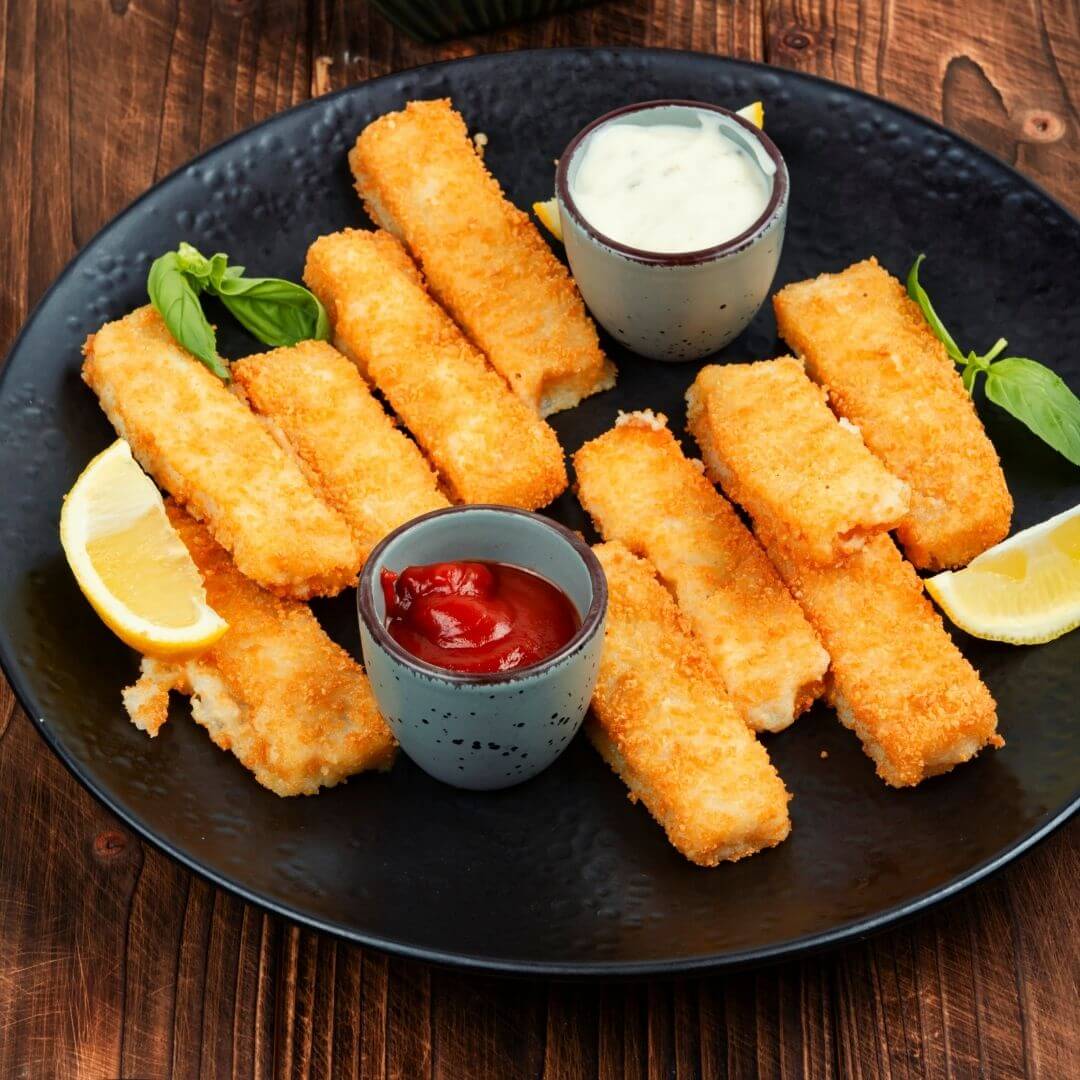

Fish fingers are one of those dishes that save the day. They sit ready in the freezer, need no thawing, and they’re usually the one thing everyone at the table can agree on. The only problem is that they rarely turn out properly crispy: in the oven the coating often ends up pale and a little dry, and in the pan it soaks up fat.

Advertisement: The page displays ads and contains advertising links (affiliate links). See our advertisers here.
The airfryer solves both problems at once. The hot air circulates all the way around the coating, so the breadcrumbs turn golden and crunchy while the fish inside stays juicy. The whole batch is ready in 22 minutes from freezer to plate — no oil, and no greasy frying pan to clean afterwards.
Estimated reading time: 6 minutes
Table of Contents:
Why I love fish fingers in the airfryer
There are three things in particular that make fish fingers an airfryer favourite for me. The speed: no preheating a whole oven, no thawing, no waiting around. The texture: the hot air hits the coating from every side at once, so you get the same crunchy surface all the way round instead of a crispy top and a soggy bottom. And the simplicity: no oil is needed, because the coating already contains the fat it takes to brown.
Then there’s the practical side. Fish fingers are one of the few dishes both kids and adults say yes to without hesitation, and with 12 minutes of cooking at 200 °C, you have time to stir together a remoulade and cut a lemon into wedges while the basket does the work.
The difference between airfryer and oven
A regular oven first has to heat all the way up, and then the fish fingers bake on a tray, where the underside steams against the baking paper. In the airfryer they sit on a perforated basket, so the air also hits from below. That’s the whole explanation for why 12 minutes at 200 °C is enough for a coating that’s crunchy all the way round. The rule of thumb generally holds: an airfryer takes about 20-30 percent less time than an oven for the same dish.
My kitchen test of fish fingers
I’ve run several batches of fish fingers through my Cosori Dual Blaze, and 200 °C for 12 minutes is the sweet spot, where the coating turns evenly golden brown without the fish inside going dry and mealy. I also tried a lower temperature over a longer time, but the result was paler and a touch chewy. High heat for a short time is clearly preferable when the coating needs to be crunchy.
With the preparation — the basket preheated, the fish fingers spread out in a single layer and a single flip along the way — the whole process comes in at 22 minutes from freezer to plate. If you’re cooking for more than four people, a Philips XXL is an advantage, because the larger basket gives room for more fish fingers in a single layer. Whichever model you use, the fish fingers need to be heated all the way through before serving.
A single layer with air in between is the one rule that really decides whether the coating turns out crispy or soggy.
Tips and tricks from the author: Morten Jensen
The typical mistakes and how to avoid them
The mistake that most often costs you the crispiness is an overcrowded basket. If the fish fingers lie on top of each other, the hot air can’t circulate, and steam forms between them, so the coating turns soggy — lay them in a single layer with air in between, and run two batches instead. The next mistake is thawing them first. Fish fingers are designed to go straight from frozen, and thawed fish releases liquid that makes the coating mushy and causes the fish fingers to fall apart when you turn them. The third is leaving them in longer hoping for more colour. After 12 minutes at 200 °C the coating is done, and every extra minute takes its toll on the fish inside. If you want a more golden surface, turn them an extra time along the way instead.
How to serve fish fingers
Fish fingers are a grateful dish, because they work just as well on the classic dinner plate as they do for a quick lunch. These are the combinations that most often end up on the table at my place:
- Homemade remoulade and a lemon wedge — the tangy contrast is the whole point
- Mashed potatoes and green peas for the classic everyday plate
- Coarse rye bread with remoulade and cucumber salad as a fish finger sandwich
- Coleslaw or a fresh salad with dill, if you want something lighter
- French fries from the airfryer, when it needs to be the kids’ favourite plate
Storage and reheating
Fish fingers are best fresh, but if you have some left over, they keep for two days in the fridge in an airtight container. Reheat them in the airfryer for a couple of minutes at 200 °C — that brings the crispiness back, which it never does in the microwave, where the coating just turns soft. Raw fish fingers should stay in the freezer until use: only take out the amount you need, and put the rest back straight away.
Fish fingers in the airfryer aren’t fine dining, and they don’t need to be. They deliver exactly what they promise: crispy coating, juicy fish, and a plate on the table before anyone gets round to asking when dinner’s ready. Give them room in the basket, and let the airfryer handle the rest.
FAQ
No. Fish fingers should be cooked straight from frozen. Thawed fish releases liquid that makes the coating soggy, and the fish fingers fall apart more easily when you turn them along the way.
No, it’s not necessary. The coating already contains the fat needed to brown at 200 °C. A very light spray of oil can be used if the coating looks very dry, but it’s not a requirement for a crispy result.

Recipe

Fish fingers in the Air Fryer
Cooking Guide
Keep the screen on and follow the recipe step by step while you cook.
Step 1:
Avoid the screen turning off while you cook.
Step 2:
Start the guide and follow the recipe one step at a time.
Cost of the dish
Prices may vary depending on where you shop.
Our estimate is based on average food prices for the current year 2026.
Estimated price for the whole dish:
Airfryer size
All our recipes are tested in a Philips Airfryer 2000 Series NA230/00 – 6.2 L
Does the recipe fit my Airfryer?
If you’re unsure, you can always reduce by one serving in the recipe, or click the 0.5x button.
You can also Ask the AI Chef
It’s easy! Just press the Ask the AI Chef button you see at the bottom.
Shopping list
Ingredients

How to make it
Preparation
Cooking in the air fryer
- Preheat the air fryer to 200 °C fan. Let it run for 3 minutes so the basket is thoroughly warm before you add the fish fingers — this gives the coating grip from the very first minute.
- Place 600 g fish fingers straight from frozen into the basket in a single layer with a little space between them. Brush them with 1 tsp Rapeseed oil if you like, for an extra crispy surface.
- Bake the fish fingers at 200 °C for 10-12 minutes. Turn them carefully after 6 minutes so the coating turns an even golden colour all over.
- Check that the fish fingers are heated through and golden brown. If the coating still looks pale, give them another 1-2 minutes at 200 °C.
Our notes for the recipe
Always place the fish fingers in a single layer with a little space between them. Stack them on top of each other and they’ll steam instead of fry, leaving the coating soggy. It’s better to run two batches than to overcrowd the basket. Straight from frozen:
The fish fingers don’t need to be thawed first. Thawed fish fingers release liquid during cooking and end up with a soggy coating — they go straight from the freezer to the basket. Variation:
Stir a tablespoon of chopped parsley and a little grated lemon zest into the remoulade for a fresher version, or tuck the fish fingers into a baguette with salad and remoulade for a fish finger sandwich. Serving:
Rye bread, air fryer potato wedges or a simple cucumber salad go well with this. Portion size:
If your air fryer is smaller, you can make the dish in two batches and keep the first batch warm at 80 °C.
Your notes for the recipe
Nutrition per serving (Guideline)
Important about shelf life and nutrition
Nutrition per serving (guideline): Calculations are based on data from the United States Department of Agriculture (USDA). Shelf life (guideline): Shelf life data is provided, as far as possible, by public institutions, including national food authorities. Our information is therefore only indicative, and it is your responsibility to obtain and calculate accurate information about shelf life and nutrition for all recipes on airfryerkogebogen.dk
Easily share the recipe with others:
Via email or on Facebook
Open the recipe on your phone
Scan the QR code with your phone and get the recipe directly on your mobile while you cook.

Author
Airfryerkogebogen.dk