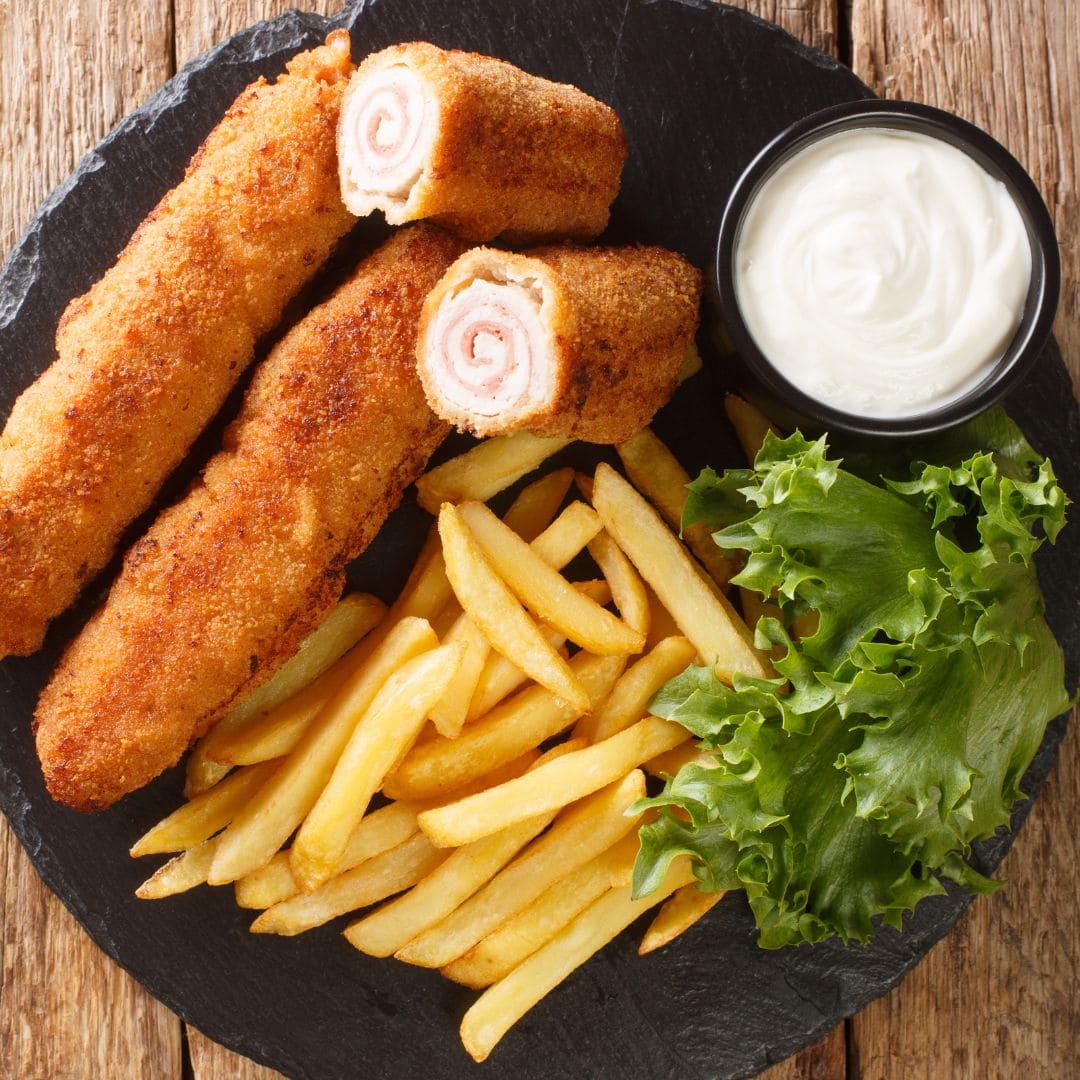
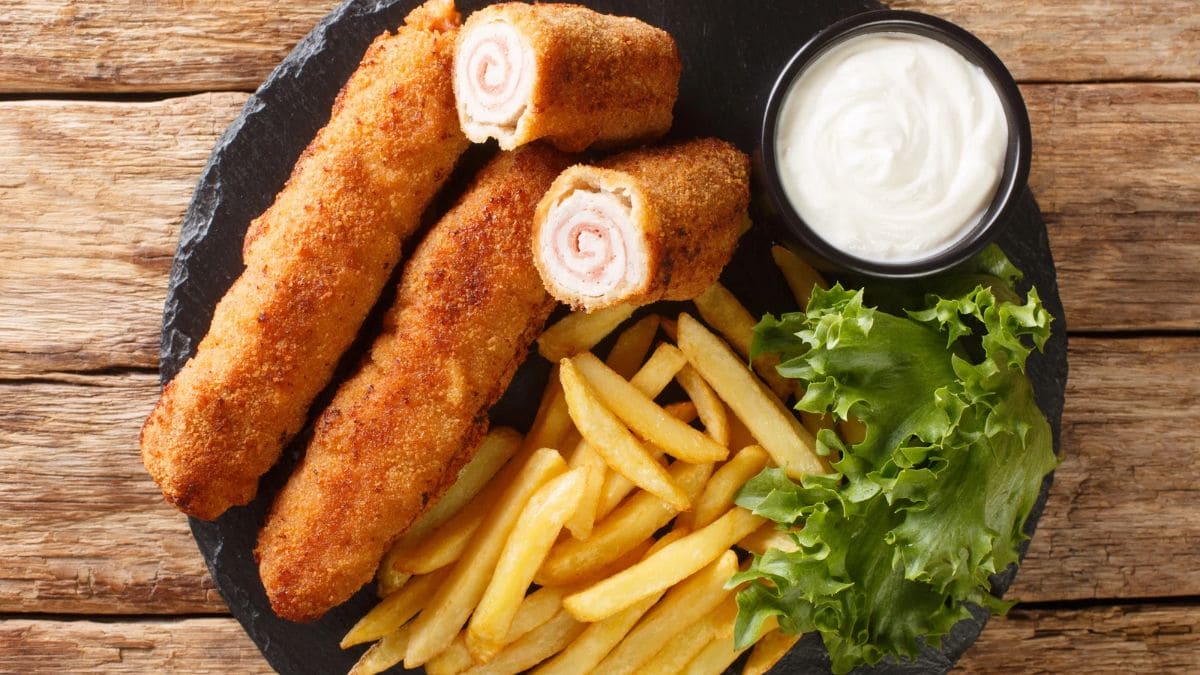
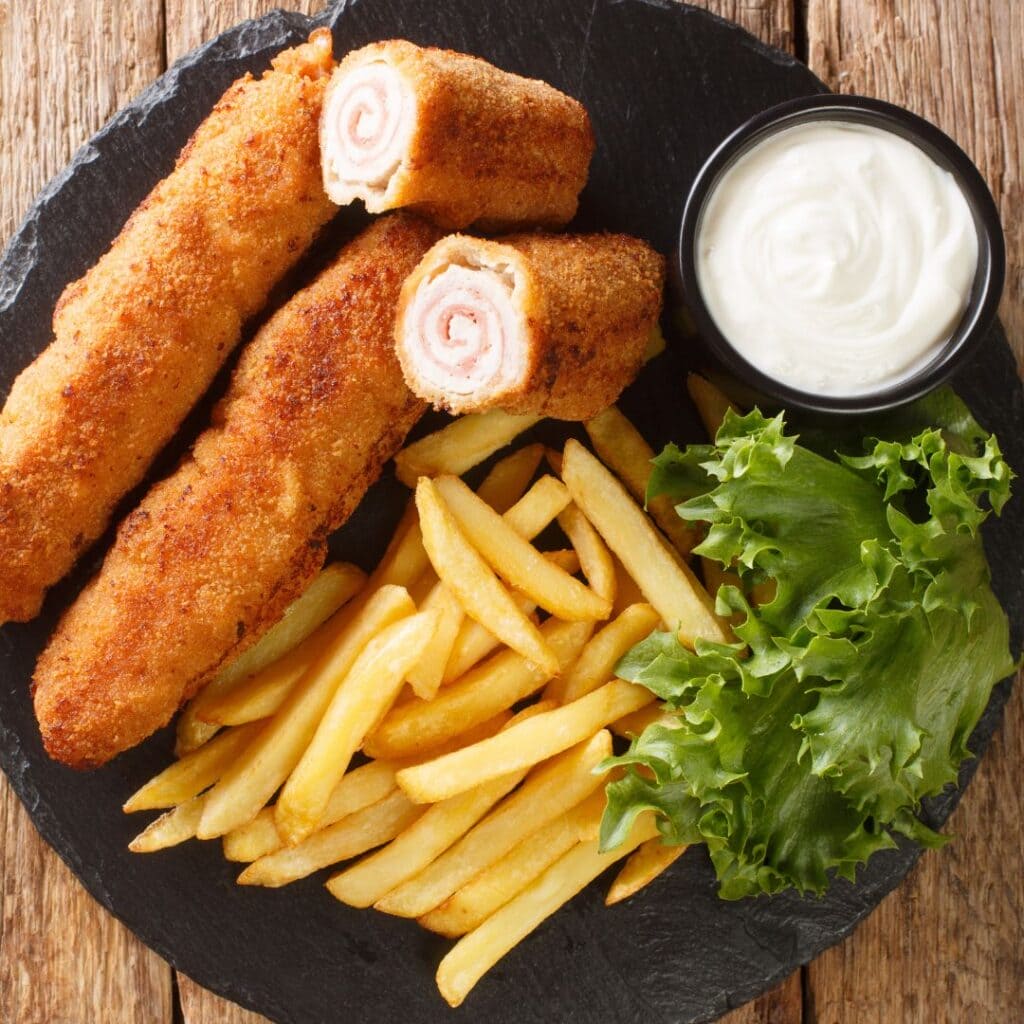
Flamenquines is Córdoba’s answer to the perfect meal: thin slices of pork loin pounded flat, rolled tightly around serrano ham, and breaded to a crispy, golden-brown crust. In Andalusia, they show up on the table as a tapa, as lunch with fries, or as something you eat standing at the bar with a cold glass in hand.

Advertisement: The page displays ads and contains advertising links (affiliate links). See our advertisers here.
Traditionally they’re deep-fried in a pot of oil — and that’s exactly why the air fryer is such a great idea here. You get the same crackling crust without the liter of oil, without the greasy kitchen, and without having to stand over a pot. 14 minutes at 190°C, and the rolls come out crispy all the way around.
Estimated reading time: 4 minutes
Table of Contents:
Why I Love Flamenquines in the Air Fryer
A flamenquín needs three things in place: a crust that crackles, a rich ham aroma, and meat that’s still juicy. Deep-frying delivers that, but it costs a liter of oil and a kitchen that smells for two days. In the air fryer, the hot air circulates around the entire roll, so the breadcrumbs dry out and turn crispy on every side — including the underside, which in a pot typically ends up soft against the bottom.
The second advantage is control. The oil in a pot drops in temperature every time you add a roll, while the air fryer holds a steady 190°C. That means the crust and the meat finish at the same time, instead of you having to choose between a pale shell and a dry center.
The Difference Between a Deep Fryer and an Air Fryer
The deep fryer gives a slightly darker, more uneven color, and it softens the crust the moment the roll lands on a plate. The air fryer gives an even, golden crust that stays crispy longer, because there’s no excess oil sitting in the breadcrumbs. In return, you’ll need to help the color along with a bit of oil spray — without it, white patches of flour and crumbs will remain.
My Kitchen Test of Flamenquines
I’ve made flamenquines countless times in my Cosori Dual Blaze, and the recipe here is the version that works every time: 190°C for 14 minutes with a single flip about halfway through. The whole process takes 44 minutes from counter to plate, and 30 of those minutes go into prep — pounding the meat flat, rolling it tight, and breading it. The core temperature hit 70°C, which is exactly where the pork loin is cooked through but still juicy. If the rolls sit closer than a centimeter apart, expect a couple of extra minutes, since the air can’t circulate properly.
Always place the roll seam-side down in the basket. The weight of the meat keeps the edge closed while the coating sets — so it won’t unfold along the way.
Tips and tricks from the author: Morten Jensen
The Common Mistakes and How to Avoid Them
The classic mistake is skipping the pounding step. A five-millimeter slice of pork loin won’t roll tightly, and the result is a thick sausage where the crust turns dark long before the center is hot — pound the slices out to two to three millimeters between two layers of plastic wrap, and the roll ends up both thinner and faster to cook. The next mistake is loose rolling: air between the meat and the ham makes the roll pop open in the basket, so roll it tight and press the edge together before breading. And then there’s the breading itself. Many people dip in flour, egg, and breadcrumbs and place the rolls straight into the air fryer, but dry breadcrumbs never turn golden. A light layer of oil spray over the entire surface is the difference between pale and crispy.
How to Serve Flamenquines
In Córdoba, they rarely arrive alone on the plate. Here’s what goes well with them:
- Fries and a dollop of aioli — the most Andalusian combination there is
- Tomato salad with red onion, oregano, and a generous dose of olive oil
- Fried green peppers or padrón peppers with flaky salt
- A cold bowl of salmorejo or gazpacho as a starter
- Sliced on a board as a tapa with a cold beer on the side
Storage and Reheating
Finished flamenquines keep for two to three days in the fridge in a sealed container. Always reheat them in the air fryer rather than the microwave: a quick trip through the hot air gives the crust its crunch back, while the microwave makes it chewy and soggy. You can also bread the rolls the day before and leave them uncooked in the fridge — they actually become a bit easier to handle once the coating has set. Unbreaded, frozen rolls keep for three months and need to thaw completely before going into the basket.
Flamenquines is one of those dishes where the air fryer isn’t just an easier alternative, but actually a better method. Roll tight, bread thoroughly, spray with oil, and place seam-side down — and Córdoba’s most beloved tapa is on the table without a single drop of frying oil.
FAQ
No, the traditional version from Córdoba is just pork loin and serrano ham. Many people today make them with a stick of firm cheese like gouda in the middle, and it tastes great — but it’s a modern addition, not the original.
Flamenquines are rolled: the meat is pounded flat and rolled tightly around the filling. A San Jacobo is flat like a sandwich, with the filling sandwiched between two layers of meat. Same breading, two very different shapes.
14 minutes at 190°C with a single flip halfway through. Aim for a core temperature of 70°C, so the pork loin is cooked through without drying out.

Recipe
Flamenquines in the Air Fryer
Cooking Guide
Keep the screen on and follow the recipe step by step while you cook.
Step 1:
Avoid the screen turning off while you cook.
Step 2:
Start the guide and follow the recipe one step at a time.
Cost of the dish
Prices may vary depending on where you shop.
Our estimate is based on average food prices for the current year 2026.
Estimated price for the whole dish:
Airfryer size
All our recipes are tested in a Philips Airfryer 2000 Series NA230/00 – 6.2 L
Does the recipe fit my Airfryer?
If you’re unsure, you can always reduce by one serving in the recipe, or click the 0.5x button.
You can also Ask the AI Chef
It’s easy! Just press the Ask the AI Chef button you see at the bottom.
Recommended equipment
- 1 Air fryer
- 1 Kødhammer
- 1 Cutting board
- 1 Knife
- 3 Dyb tallerken - For breading
- 1 Brush
- 1 Meat thermometer
Shopping list
Ingredients


Breading
- 75 g plain flour

- 2 pcs eggs (Beaten)
- 150 g breadcrumbs (Panko works well for extra crunch)
- 2 tbsp olive oil (For brushing)


How to make it
Preparation
- Place 8 slice pork loin between two sheets of cling film and pound them to 3-4 mm with a meat mallet or the bottom of a heavy saucepan. The thinner the meat is, the tighter you can roll it.
- Lay 8 slice Serrano ham on top of the meat, one slice per piece, and arrange 120 g gouda in sticks along one edge. Roll the meat tightly around the filling so the seam ends up underneath.
- Set out three deep plates. Put 75 g plain flour in the first, beat 2 pcs eggs together in the second, and spread 150 g breadcrumbs in the third.
- Brush the rolls lightly all over with 2 tbsp olive oil. The oil gives the golden, crispy crust without deep-frying.
Cooking in the air fryer
- Preheat the air fryer to 190 °C fan.
- Place the rolls in the basket seam-side down with space between them so the heat can circulate. If they don’t fit in a single layer, cook them in two batches.
- Bake the Flamenquines at 190 °C for 14 minutes. Turn them carefully after 8 minutes so they turn evenly golden all over.
- Check with a meat thermometer that the core temperature is 70 °C. If the rolls are thick, give them 2-3 minutes more.
Our notes for the recipe
Pound the meat really thin, and roll tightly. The rolls should sit seam-side down in the basket, so the heat seals them and the cheese stays inside the roll instead of ending up at the bottom of the basket. The traditional version:
In Córdoba, Flamenquines are usually made entirely without cheese, using only pork loin and Serrano ham. Leave out the cheese if you want the original — the rest of the recipe stays the same. Variation:
Flamenquines are rolled meat and shouldn’t be confused with San Jacobos, where ham and cheese are sandwiched between two flat slices of meat. If you have extra meat, you can bread a couple of flat versions alongside and taste the difference. Serving:
Serve as tapas with aioli and lemon wedges, or as a lunch dish with fries from the air fryer. Portion size:
If your air fryer is smaller, you can make the dish in two batches.
Your notes for the recipe
Nutrition per serving (Guideline)
Important about shelf life and nutrition
Nutrition per serving (guideline): Calculations are based on data from the United States Department of Agriculture (USDA). Shelf life (guideline): Shelf life data is provided, as far as possible, by public institutions, including national food authorities. Our information is therefore only indicative, and it is your responsibility to obtain and calculate accurate information about shelf life and nutrition for all recipes on airfryerkogebogen.dk
Easily share the recipe with others:
Via email or on Facebook
Open the recipe on your phone
Scan the QR code with your phone and get the recipe directly on your mobile while you cook.

Author
Airfryerkogebogen.dk