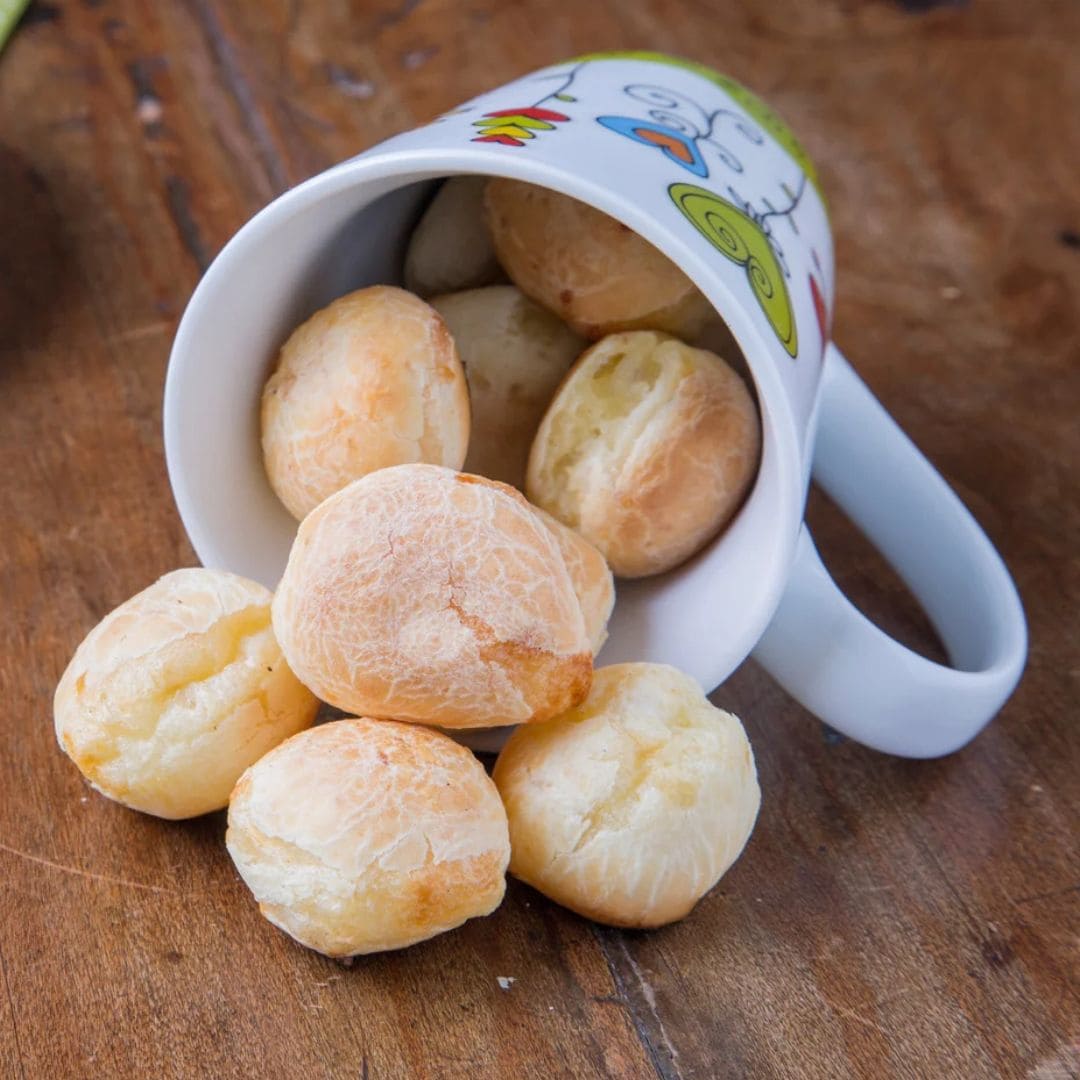
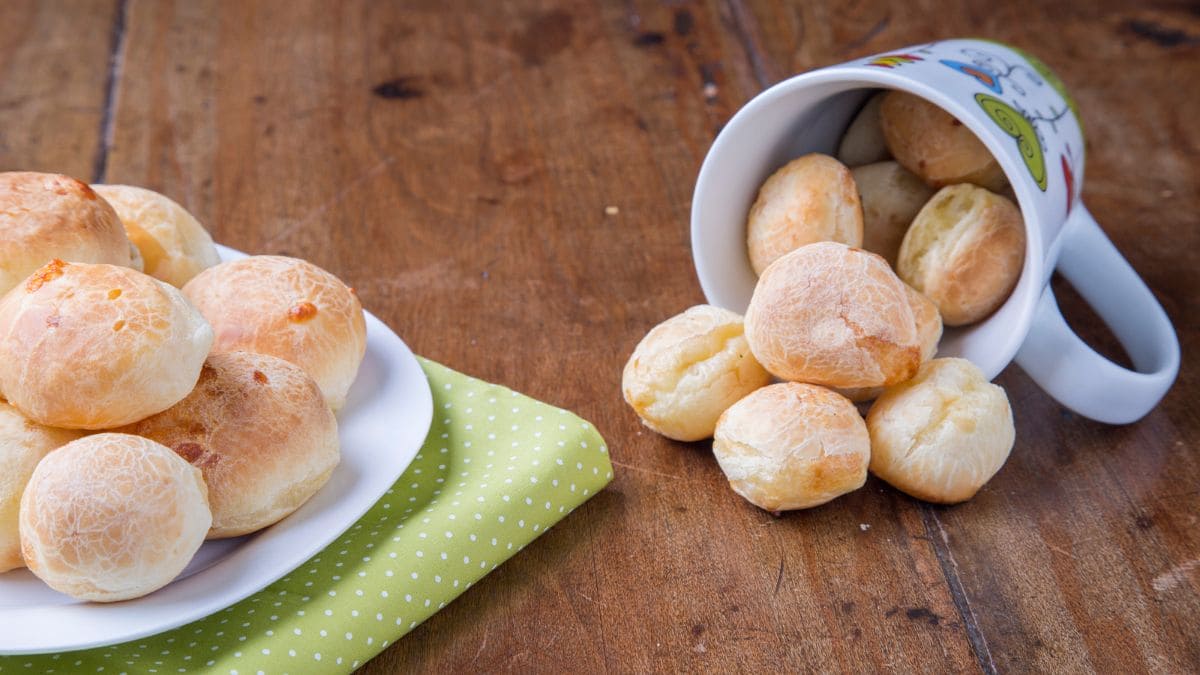
Pão de queijo in the air fryer has become a regular fixture on my breakfast table at weekends. These small Brazilian cheese buns come from the state of Minas Gerais, where they are eaten with the morning coffee and as a snack. The dough is not made with wheat flour but with tapioca starch, which is scalded with boiling milk and oil before the egg and grated cheese are worked in. The result is a thin, crisp crust and a chewy, almost elastic centre with plenty of cheese flavour.

Advertisement: The page displays ads and contains advertising links (affiliate links). See our advertisers here.
The Brazilian cheese queijo minas is hard to find in Denmark, so I use Parmesan, which gives a rich, slightly nutty flavour. The air fryer’s circulating heat gives the balls an even, golden surface, and you don’t need to switch on the oven. On top of that, the buns are naturally gluten-free.
Estimated reading time: 4 minutes
Table of Contents
Why I love pão de queijo in the air fryer
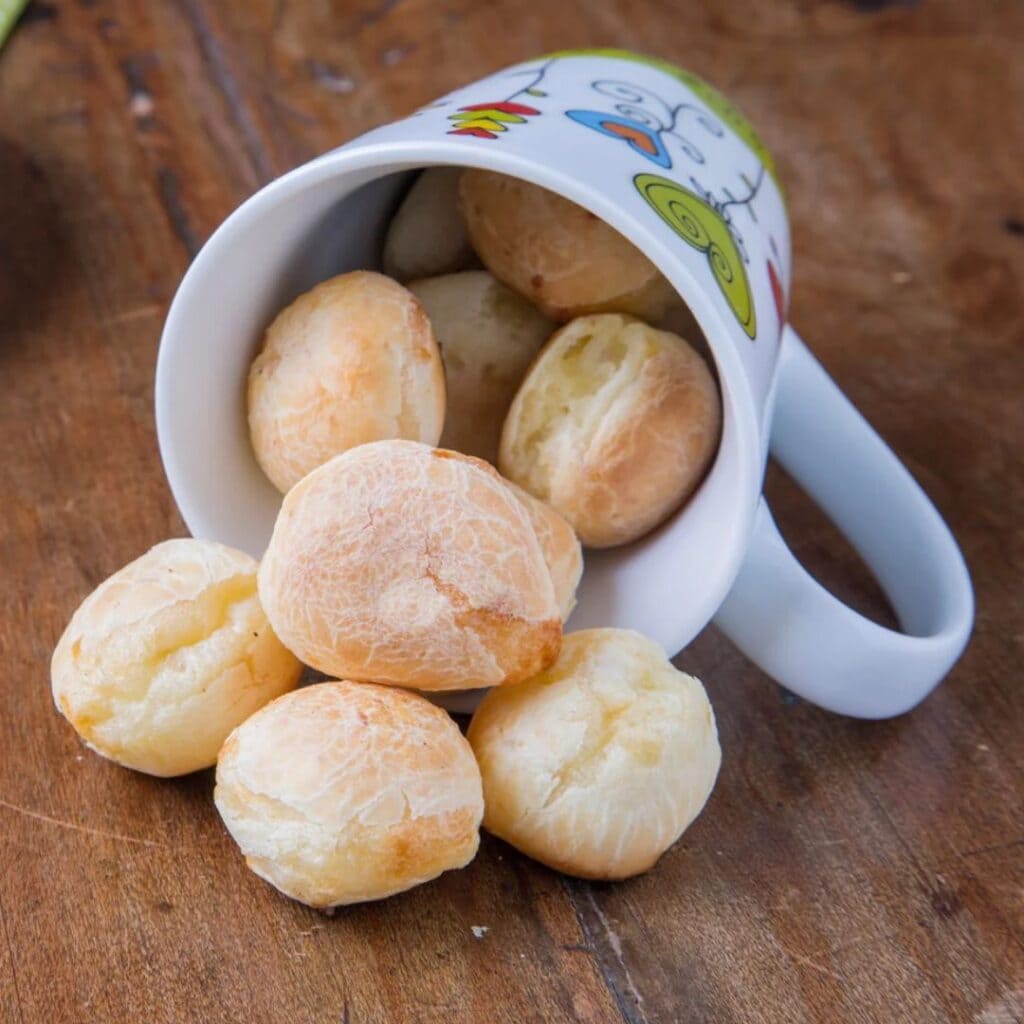
I love the contrast in pão de queijo. When you break a warm bun in half, the crust crackles lightly, and inside you find a soft, chewy crumb with a distinct cheese flavour. It is something completely different from an ordinary cheese bread.
They are also easy to make. There is neither yeast nor rising time, and the recipe makes about 24 pieces, so there is enough for the whole family.
The scalding gives the chewy centre
The secret is the scalding. When the boiling mixture of milk, oil and salt is poured over the tapioca starch all at once, the starch gelatinises and the whole thing turns into a lumpy, rubbery mass. It looks wrong the first time you do it, but it is precisely this mixture that gives the chewy, elastic centre that wheat flour can never give. Let the mixture cool for about 10 minutes before the egg goes in, and then knead in the Parmesan until the dough is soft, pliable and slightly sticky.
My kitchen test of pão de queijo
I tested the recipe in my Philips XXL, where half of the balls can sit with 2-3 cm between them. At 180 °C, 14 minutes per batch is the sweet spot: the buns rise nicely, become firm on the outside and lightly golden, while the centre stays soft and chewy. I keep the basket closed for the first 10 minutes and only turn the buns if the underside is pale. With about 30 minutes of preparation and two batches of 14 minutes each, the whole thing takes about 58 minutes.
In my Cosori Dual Blaze, which has heating elements both above and below the basket, the underside gets more colour, but I still check the bottom after 10 minutes. If the buns are pale when the time is up, they get 1-2 minutes more at 180 °C.
Pour the milk mixture over the tapioca starch while it is still boiling, and stir straight away. Without proper scalding, the buns will never get the chewy centre that makes pão de queijo something special.
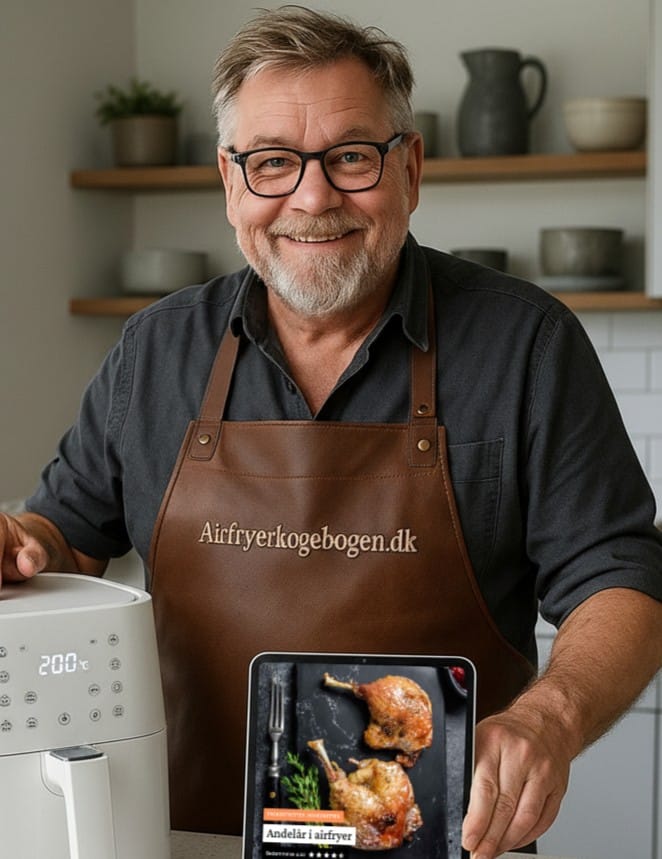
Tips and tricks from the author: Morten Jensen
The typical mistakes and how to avoid them
The first mistake is letting the milk mixture cool down before it is poured over the starch. Then the starch is not scalded, the dough is hard to bring together, and the buns lose their chewy centre. So bring the mixture all the way to the boil, and pour it over all at once. The second mistake is adding the egg while the mixture is still too hot, so that it sets in small lumps. Give the mixture about 10 minutes, until it is lukewarm, before the egg is stirred in. The third mistake is packing the balls too close together and opening the basket too early. The buns rise and grow together if they sit close, so keep 2-3 cm between them, and leave the basket closed for the first 10 minutes.
How to serve pão de queijo
Pão de queijo tastes best warm, while the centre is still soft and chewy. Allow about six pieces per person, and serve them, for example:
- With a cup of strong coffee, the way Brazilians do
- Split open and spread with butter or jam
- With a slice of ham on the side at the brunch table
- Together with fresh fruit and yoghurt for a light breakfast
Storage and reheating
Baked pão de queijo keeps in an airtight bag at room temperature for up to 2-3 days. Warm them in the air fryer at 160 °C for 2-3 minutes, and they become soft and fresh again. The baked buns can also be frozen for up to 3 months and warmed straight in the air fryer without thawing. If you would rather have freshly baked buns, freeze the raw balls on a tray, and put them in a bag once they are frozen. They are baked straight from frozen at 180 °C for 18-20 minutes.
Pão de queijo is a little piece of Brazil that is easy to bake at home. With scalded tapioca starch, good cheese and the even heat of the air fryer, you get cheese buns with a crisp crust and a chewy centre that disappear quickly from the breakfast table.
FAQ
Yes. Pão de queijo is made with tapioca starch instead of wheat flour, so the buns are naturally gluten-free. If you are baking for someone with coeliac disease, check that the starch is labelled gluten-free.
No, potato starch does not give the same chewy texture, and tapioca pearls cannot be used either. Tapioca starch is also sold as tapioca flour in Asian supermarkets.
In Brazil, queijo minas is used, but Parmesan is a good alternative in Denmark. If you want a milder flavour, you can use half Parmesan and half aged Gouda. For a fully vegetarian version, choose an Italian hard cheese made with microbial rennet, as genuine Parmigiano Reggiano is made with animal rennet.

Recipe
Pão de queijo in the Air Fryer
Cooking Guide
Keep the screen on and follow the recipe step by step while you cook.
Step 1:
Avoid the screen turning off while you cook.
Step 2:
Start the guide and follow the recipe one step at a time.
Cost of the dish
Prices may vary depending on where you shop.
Our estimate is based on average food prices for the current year 2026.
Estimated price for the whole dish:
Airfryer size
All our recipes are tested in a Philips Airfryer 2000 Series NA230/00 – 6.2 L
Does the recipe fit my Airfryer?
If you’re unsure, you can always reduce by one serving in the recipe, or click the 0.5x button.
You can also Ask the AI Chef
It’s easy! Just press the Ask the AI Chef button you see at the bottom.
Shopping list
Ingredients


How to make it
Preparation
- Finely grate 100 g Parmesan and set it aside.
- Put 150 ml whole milk, 50 ml neutral oil and 0.5 tsp salt in a small saucepan and bring the mixture to the boil.
- Put 250 g tapioca starch in a mixing bowl. Pour the boiling milk mixture over it all at once and stir straight away with a large spoon until all of the starch is moistened. The mixture will become lumpy and rubbery – it is the scalding that gives the chewy centre.
- Let the mixture cool for about 10 minutes, until it is lukewarm, so the egg does not set when it goes in.
- Add 1 pcs egg and stir it in thoroughly until the mixture is glossy and well combined.
- Knead the grated Parmesan into the dough with your hands for 2-3 minutes, until the dough is soft, pliable and slightly sticky. If it is too dry to come together, knead in 1-2 tbsp more milk.
- Shape the dough into about 24 balls of about 25 g each (about 3 cm in diameter) with lightly oiled hands.
Cooking in the air fryer
- Preheat the air fryer to 180 °C fan.
- Line the basket with baking paper for air fryers and place half of the balls in it with 2-3 cm between them, so they have room to rise.
- Bake the balls at 180 °C for 14 minutes. Keep the basket closed for the first 10 minutes so they can rise undisturbed, then turn them gently if the underside is pale.
- Check that the balls have risen, are firm on the outside and lightly golden. If they are still pale, give them 1-2 minutes more at 180 °C.
- Repeat with the rest of the balls at 180 °C for 14 minutes.
Serving
- Serve pão de queijo warm while the centre is still soft and chewy.
Our notes for the recipe
The milk mixture must be boiling when it is poured over the tapioca starch. The scalding gelatinises the starch, and it is this – not wheat flour – that gives pão de queijo its chewy, elastic centre. Use a kitchen scale if you can, so the balls end up the same size and bake evenly. Tapioca starch:
Also sold as tapioca flour or tapioca starch in Asian supermarkets. In Brazil, people use polvilho doce or the soured polvilho azedo, which gives a slightly airier bun. Potato starch does not give the same chewy texture, and tapioca pearls cannot be used. Variation:
In Minas Gerais, the cheese queijo minas is used, which has been swapped for Parmesan here. You can also use half Parmesan and half aged Gouda for a milder flavour. If the dish needs to be fully vegetarian, choose an Italian hard cheese made with microbial rennet, as genuine Parmigiano Reggiano is made with animal rennet. Serving:
Eat pão de queijo warm for breakfast or brunch with a cup of coffee, ideally with butter, jam or a slice of ham on the side. The recipe makes about 24 pieces, which is about 6 per portion. Freeze raw balls:
Freeze the shaped balls on a tray, and put them in a bag once they are frozen. Bake them straight from frozen at 180 °C for 18-20 minutes. Portion size:
The recipe is designed for two batches in an ordinary air fryer. If your air fryer is smaller, you can make the dish in three batches, and if you have an air fryer with two baskets, you can bake it all at once.
Your notes for the recipe
Nutrition per serving (Guideline)
Important about shelf life and nutrition
Nutrition per serving (guideline): Calculations are based on data from the United States Department of Agriculture (USDA). Shelf life (guideline): Shelf life data is provided, as far as possible, by public institutions, including national food authorities. Our information is therefore only indicative, and it is your responsibility to obtain and calculate accurate information about shelf life and nutrition for all recipes on airfryerkogebogen.dk
Easily share the recipe with others:
Via email or on Facebook
Open the recipe on your phone
Scan the QR code with your phone and get the recipe directly on your mobile while you cook.

Author
Airfryerkogebogen.dk