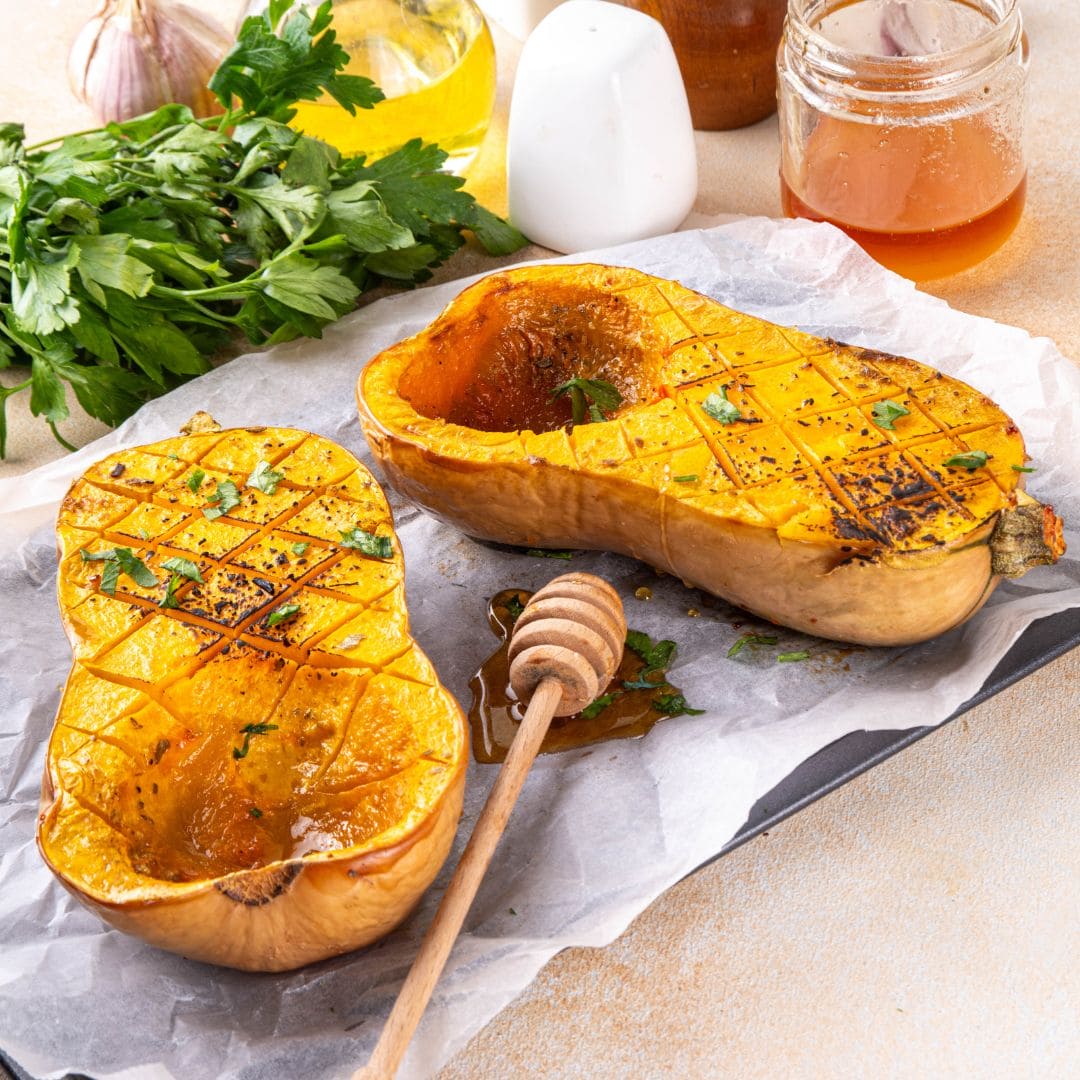
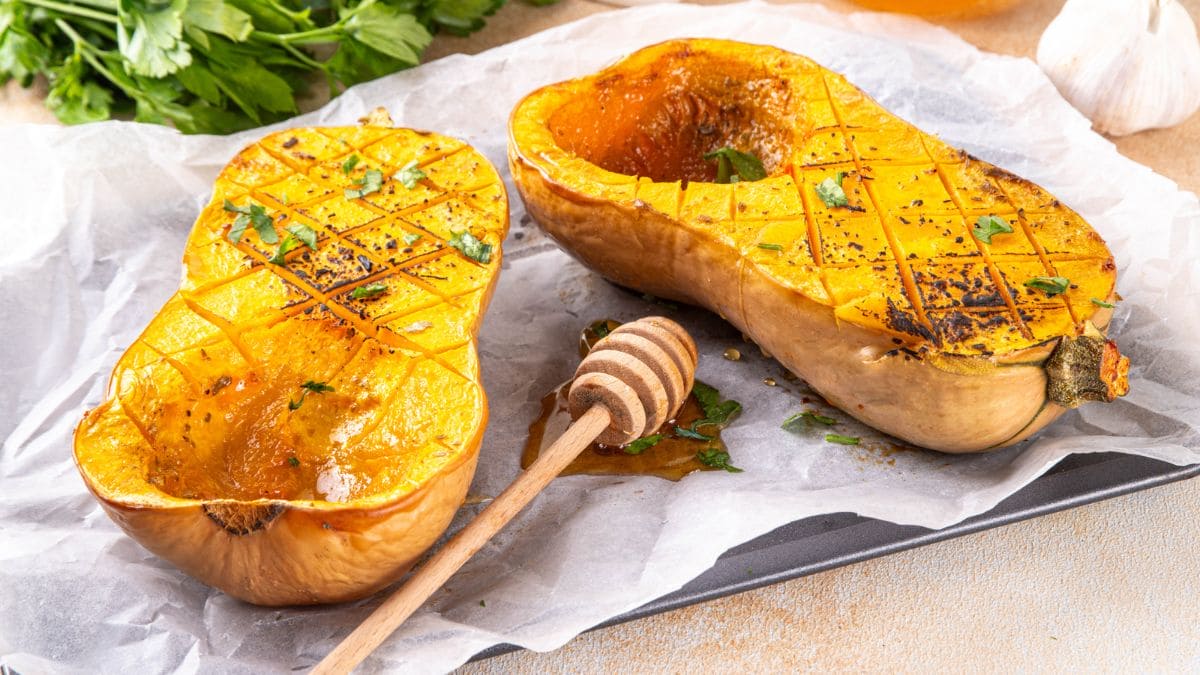
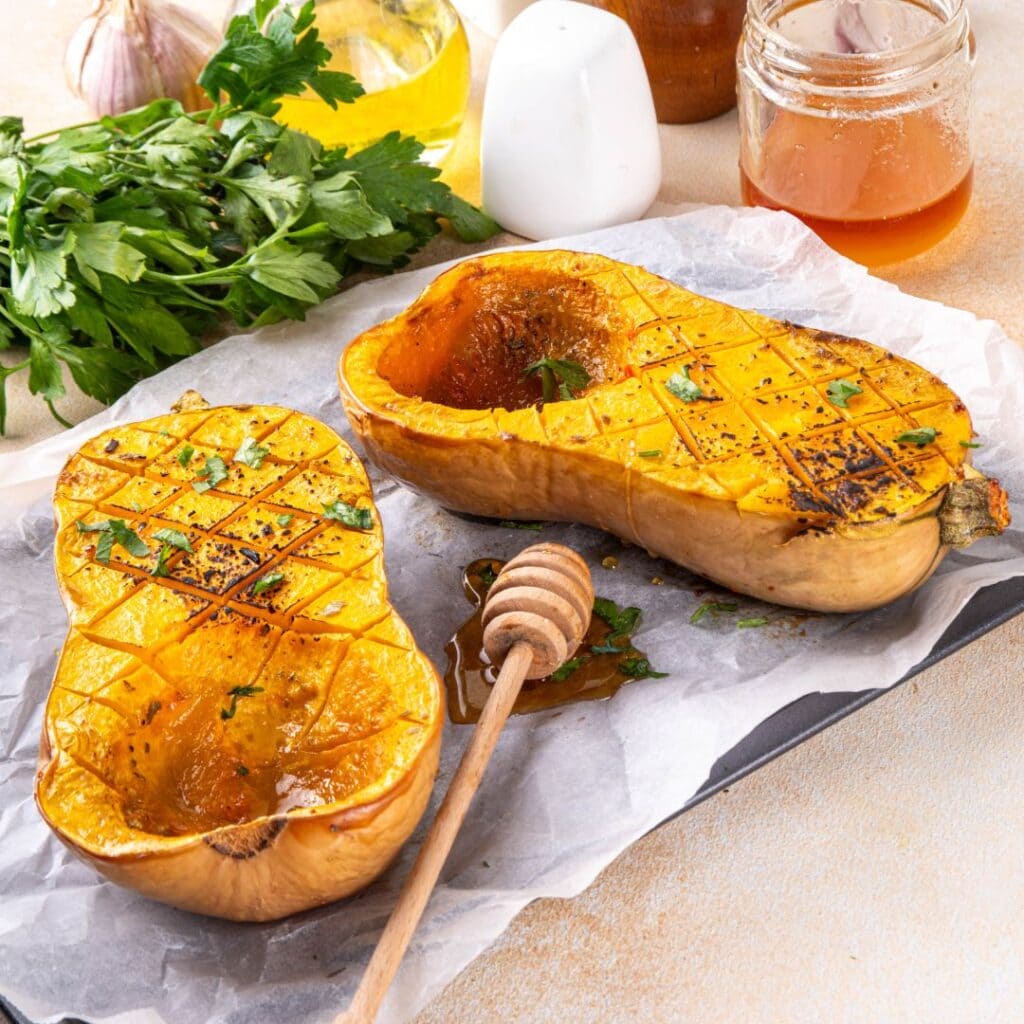
Butternut squash is one of autumn’s most rewarding vegetables, and in the air fryer it becomes exactly as tender and subtly sweet as it should be. I halve it lengthways, scrape out the seeds and score the flesh in a tight cross-hatch pattern, so that butter, flaky salt and cinnamon can work their way right down into the squash. Finally I brush maple syrup over it, and it just has time to caramelise into a glossy glaze before the halves reach the table.

Advertisement: The page displays ads and contains advertising links (affiliate links). See our advertisers here.
The whole dish takes 40 minutes, 30 of which are spent in the air fryer at 190 °C, so you can make the rest of the meal in the meantime. The result is a side dish that goes just as well with roast pork and duck as with a vegetarian dinner.
Estimated reading time: 4 minutes
Table of Contents
Why I love Butternut Squash in the air fryer
Butternut squash has a nutty sweetness and flesh that becomes almost creamy when it gets enough heat. In the air fryer, the hot air circulates close around the halves, so the cut surface gets colour and lightly caramelised edges, while the flesh turns soft all the way through. The tight cross-hatch pattern is the key: every little square gets its own share of butter and spices, and the heat penetrates faster.
Cinnamon may sound like a baking spice, but together with butter and flaky salt it brings out the squash’s natural sweetness without turning the dish into a dessert. If you want more of a kick, you can add a pinch of chilli flakes or a little ground nutmeg along with the cinnamon, and if you are out of maple syrup, honey can be used instead.
What the air fryer does better than the oven
A conventional oven takes longer to heat up, and you heat a large space for a small dish. The air fryer’s compact chamber and powerful airflow work directly on the cut surface, while the skin acts as a natural bowl that collects the butter and juices. The only limitation is the space in the basket, which is why a small squash is the best choice.
My kitchen test of Butternut Squash
I tested the recipe in my Cosori Dual Blaze, where the heating elements at the top and bottom give an even heat all the way around the halves. After 25 minutes at 190 °C with the cut side up, the flesh was almost tender and the edges were golden. Then the maple syrup went on, and after 5 more minutes at the same temperature the glaze was glossy and lightly caramelised. From the moment I rinsed the squash until it was on the table, 40 minutes had passed: 10 for preparation and 30 in the air fryer.
The thick neck section is always the last part to become tender, so that is where I insert the knife. If it slides through easily, the squash is done. If you feel resistance, give it another 3-5 minutes at 190 °C.
Don’t forget the butter in the cavity. When the squash is done, butter and maple syrup have collected where the seeds were, and it is the best sauce you can spoon over the flesh just before serving.
Tips and tricks from the author: Morten Jensen
Common mistakes and how to avoid them
The first mistake happens with the knife. If you cut through the skin when you score the cross-hatch pattern, the halves no longer hold together, and the butter runs out into the basket instead of down into the flesh. Keep about 1.5 cm between the cuts, and stop just before the skin. The second mistake is brushing on the maple syrup too early. The syrup is full of sugar and burns quickly in the hot air, so it should only go on for the last 5 minutes.
The third mistake is turning the halves during cooking, because then the butter and cinnamon fall out of the scores. Keep the cut side facing up the whole time, and if the surface takes on too much colour before the flesh is tender, simply lower the temperature to 170 °C for the rest of the cooking time.
How to serve Butternut Squash
Cut each half in two crosswise so that you get four pieces, and serve the squash hot in one of these ways:
- As a side dish for roast pork or roast duck, where the sweetness balances the fatty meat
- Alongside chicken or game with a good gravy
- As part of a vegetarian dinner with a grain salad and a dollop of Greek yoghurt
- With a sprinkle of toasted pecans or pumpkin seeds for extra crunch
Storage and reheating
Leftovers can be stored in the fridge in an airtight container for up to 3 days. Reheat them in the air fryer at 160 °C for 5-7 minutes, until they are heated through. The squash can also be frozen for up to 3 months; thaw it in the fridge overnight before you heat it. After freezing, the flesh becomes a little softer, so thawed leftovers are ideal for mash or soup.
Cross-hatched butternut squash looks great on the table without requiring much work. With butter, cinnamon and a final layer of maple syrup, you get a tender and subtly sweet side dish that suits both weekday dinners and special occasions. Try it for your next Sunday dinner.
FAQ
The halves are cooked at 190 °C for 25 minutes, brushed with maple syrup and cooked for 5 minutes more. That makes 30 minutes in the air fryer and 40 minutes in total, including the preparation.
No. When the squash is cooked in halves, the skin should stay on, so that the halves keep their shape and the butter stays in the flesh. At the table, you take the flesh straight from the skin with a spoon.
Choose a small squash of no more than about 1 kg, so that the two halves can lie flat next to each other in the basket. If your air fryer is too small for both, cook the halves one at a time.

Recipe
Butternut Squash in the Air Fryer
Cooking Guide
Keep the screen on and follow the recipe step by step while you cook.
Step 1:
Avoid the screen turning off while you cook.
Step 2:
Start the guide and follow the recipe one step at a time.
Cost of the dish
Prices may vary depending on where you shop.
Our estimate is based on average food prices for the current year 2026.
Estimated price for the whole dish:
Airfryer size
All our recipes are tested in a Philips Airfryer 2000 Series NA230/00 – 6.2 L
Does the recipe fit my Airfryer?
If you’re unsure, you can always reduce by one serving in the recipe, or click the 0.5x button.
You can also Ask the AI Chef
It’s easy! Just press the Ask the AI Chef button you see at the bottom.
Recommended equipment
- 1 Air fryer
- 1 Cutting board
- 1 Chefs knife
- 1 Small knife
- 1 Spoon
- 1 Small saucepan
- 1 Brush
Shopping list
Ingredients
- 1 pcs butternut squash (small, about 900 g)
- 30 g butter

- 1 tsp flaky salt
- 1 tsp ground cinnamon
- 2 tbsp maple syrup


How to make it
Preparation
- Rinse 1 pcs butternut squash and cut off the stalk. Place the squash on the cutting board and halve it lengthways with the chef’s knife, cutting through both the neck and the round base.
- Scrape the seeds and the stringy fibres out of the cavity with a spoon, so that only the firm flesh is left.
- Score the cut surface in a tight cross-hatch pattern with a small knife, about 1.5 cm between the cuts. Cut almost all the way down to the skin, but never through it, so the halves hold together and the butter stays in the scores.
- Melt 30 g butter in a small saucepan over low heat.
- Brush the melted butter over the cut surfaces so that it runs down into the scores. Sprinkle evenly with 1 tsp flaky salt and 1 tsp ground cinnamon.
Cooking in the air fryer
- Preheat the air fryer to 190 °C fan.
- Pull out the basket and brush 2 tbsp maple syrup evenly over the cut surfaces. Cook for a further 5 minutes at 190 °C, until the syrup has caramelised lightly.
- Insert a knife into the thick neck section. If it slides through easily, the squash is done. If you meet resistance, cook for another 3-5 minutes at 190 °C.
Serving
- Cut each half in two crosswise, giving you 4 pieces, and spoon the butter and syrup that have collected in the cavity over the flesh. Serve straight away.
Our notes for the recipe
Choose a small squash of no more than about 1 kg, so the two halves can lie flat side by side in the basket. The tight cross-hatch pattern is the key: butter, salt and cinnamon work their way right down into the flesh, and the heat reaches it faster. The thick neck section is the last part to become tender, so that is where you check with the knife. If the surface takes on too much colour before the flesh is tender, lower the temperature to 170 °C for the rest of the cooking time. Why the syrup goes on at the end:
Maple syrup contains a lot of sugar and burns quickly in the hot air. If it is brushed on only in the final minutes, it has time to caramelise into a glossy glaze without turning bitter. Variation:
Add a pinch of chilli flakes or a little ground nutmeg along with the cinnamon. Feel free to sprinkle with toasted pecans or pumpkin seeds when serving. Honey can be used instead of maple syrup. Serving:
Goes well as a side dish with roast pork, duck, chicken and game, or as part of a vegetarian dinner with a grain salad and a dollop of Greek yoghurt. Portion size:
If your air fryer is too small for both halves, cook them one at a time.
Your notes for the recipe
Nutrition per serving (Guideline)
Important about shelf life and nutrition
Nutrition per serving (guideline): Calculations are based on data from the United States Department of Agriculture (USDA). Shelf life (guideline): Shelf life data is provided, as far as possible, by public institutions, including national food authorities. Our information is therefore only indicative, and it is your responsibility to obtain and calculate accurate information about shelf life and nutrition for all recipes on airfryerkogebogen.dk
Easily share the recipe with others:
Via email or on Facebook
Open the recipe on your phone
Scan the QR code with your phone and get the recipe directly on your mobile while you cook.

Author
Airfryerkogebogen.dk