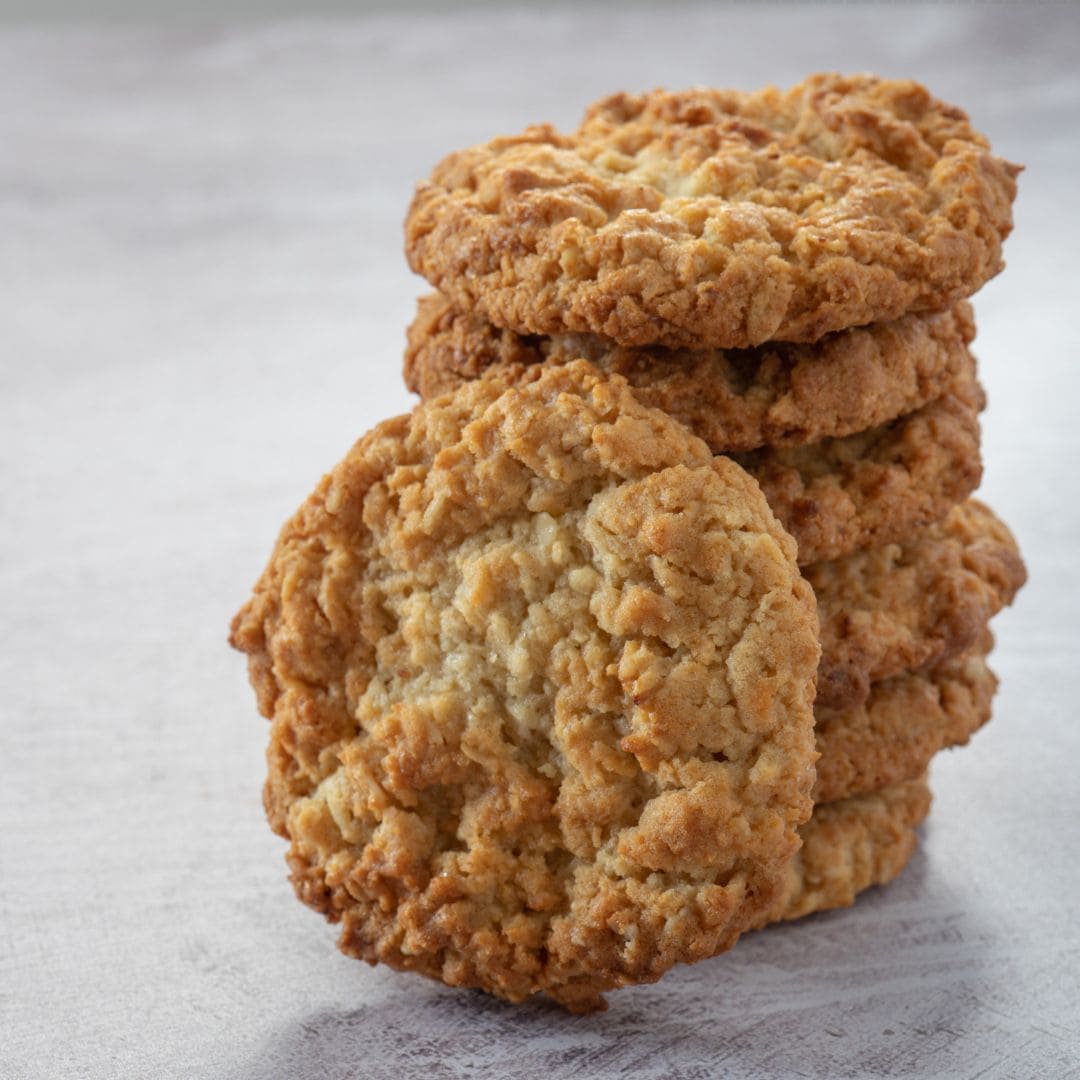
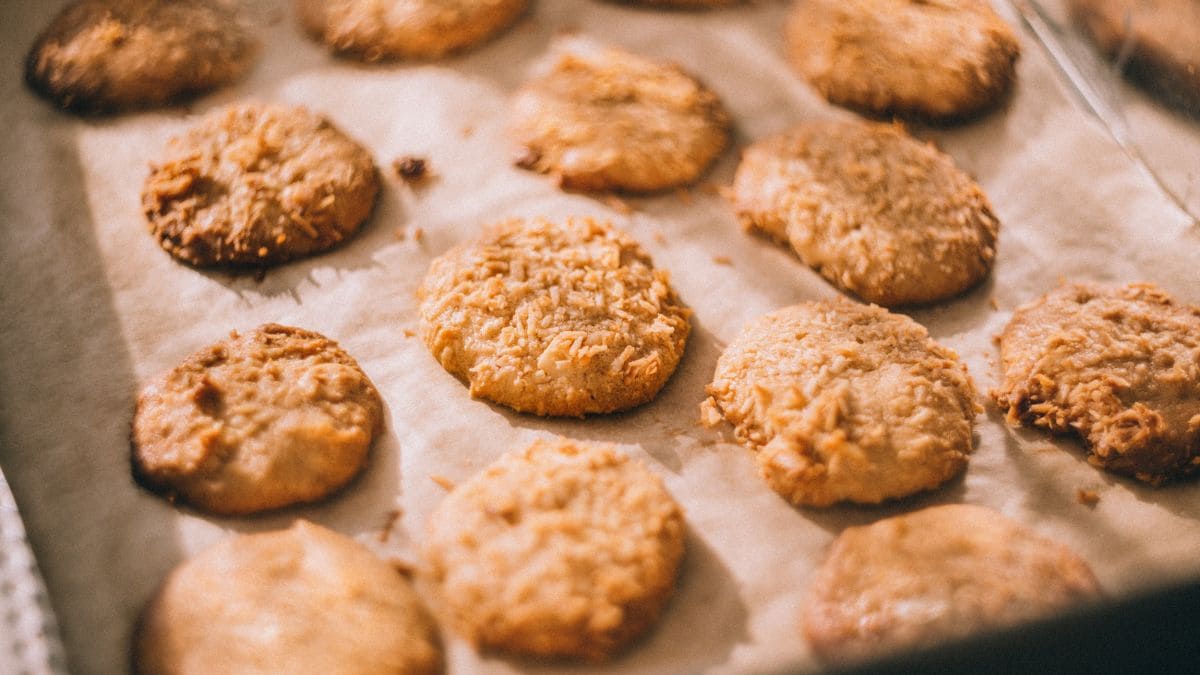
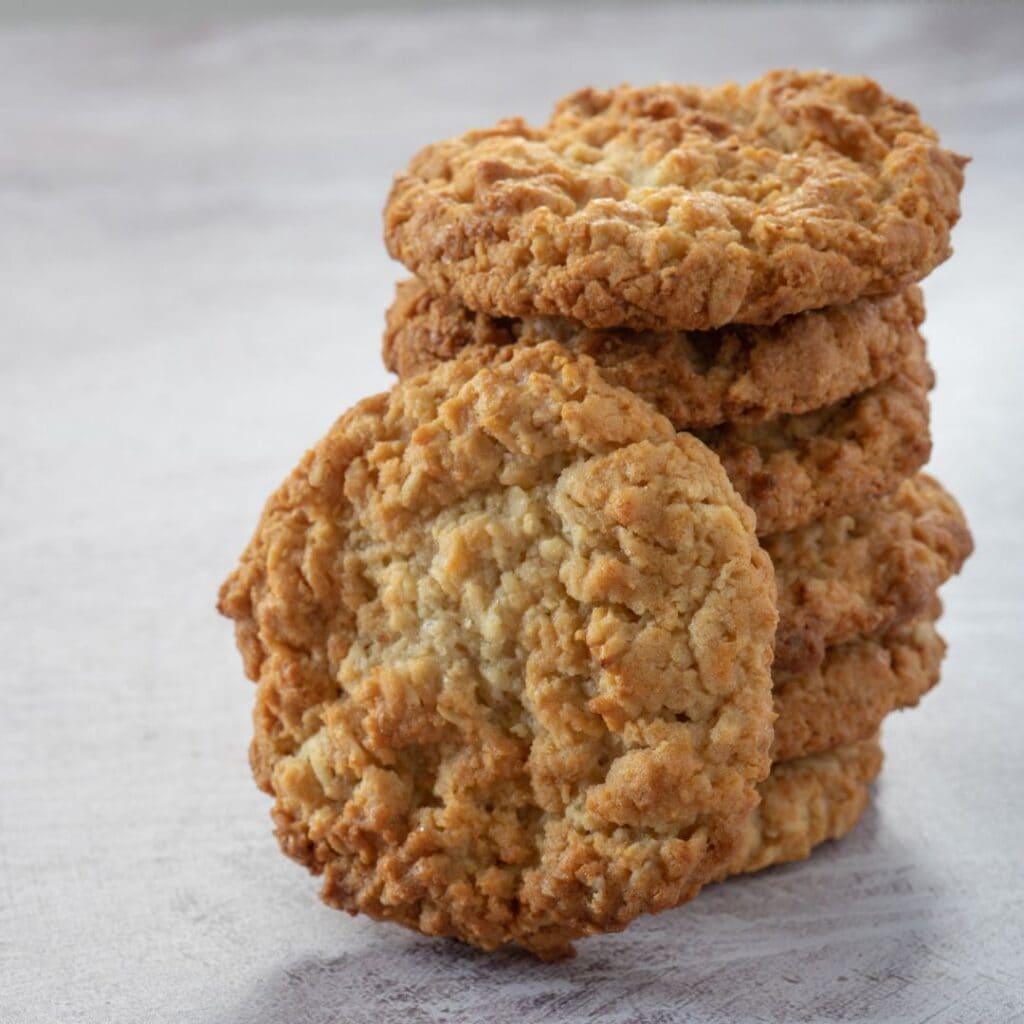
Anzac Biscuits are sweet, golden oat biscuits from Australia and New Zealand, named after the soldiers who fought for the two countries in the First World War. They are made with rolled oats, coconut, butter and syrup – completely without eggs – and get their light, crisp texture from bicarbonate of soda, which foams up in the warm butter mixture. The name stays as it is: they are called Anzac Biscuits, not cookies, and they have nothing to do with the soft American biscuits.

Advertisement: The page displays ads and contains advertising links (affiliate links). See our advertisers here.
In the air fryer you bake them in 3 batches at 160 °C, and each batch takes just 8 minutes. The result is biscuits that are crisp at the edges and slightly chewy in the middle, with a flavour of caramel and coconut. Here I share what I have learned, the most common mistakes and ideas for serving.
Table of Contents
Why I love Anzac Biscuits in the air fryer
What I like most about Anzac Biscuits is how little it takes. The dough is stirred together with a large spoon – no mixer, no eggs and no resting time. Butter and light syrup are melted together, bicarbonate of soda dissolved in boiling water is stirred in, and the foaming mixture binds rolled oats, plain flour, sugar and desiccated coconut into a grainy dough.
The history is just as good as the flavour. Anzac stands for Australian and New Zealand Army Corps, and according to tradition the biscuits were baked without eggs so that they would keep for a long time. In Australia and New Zealand they are eaten especially around Anzac Day on 25 April.
The difference between an air fryer and an oven
In the oven you can bake a whole tray at a time, but then a large oven has to be heated up for a small portion. The air fryer is preheated in a few minutes, and the circulating hot air gives an even, golden surface on every biscuit in the basket. You bake in smaller batches of 5-6 biscuits at a time, but each batch takes only 8 minutes.
My kitchen test of Anzac Biscuits
I have tested Anzac Biscuits in my Cosori Dual Blaze, where heating elements both above and below give an even colour on the top and underside. I preheated to 160 °C and baked 5-6 flattened balls at a time on baking paper cut to fit, with at least 3 cm between them. After 8 minutes the biscuits were golden brown all over but still completely soft – they only turn crisp as they cool. With 3 batches of 8 minutes, that came to 24 minutes of baking time, and with 15 minutes of preparation and 10 minutes of cooling, all 16 biscuits were ready after 49 minutes.
I also tried out the baking time: if you take the biscuits out after 7 minutes, they turn extra chewy in the middle, and if you give them 1 minute more than the 8 minutes, they turn crisp all the way through. Keep an eye on them from 6 minutes, because air fryers bake differently.
Take the biscuits out while they are still soft. Let them stand for 2 minutes in the basket, then move them to a wire rack – the crispness only comes once they have cooled completely.
Tips and tricks from the author: Morten Jensen
The typical mistakes and how to avoid them
The first mistake is placing the biscuits too close together. The dough spreads out during baking, and without at least 3 cm between them they merge into one big cake, so it is better to bake an extra batch. The second mistake is baking them until they feel firm. The biscuits are always soft when freshly baked, so go by the colour and take them out when they are golden brown. The third mistake concerns the baking paper: loose baking paper must never lie in the air fryer during preheating, because it can be sucked up towards the heating element. Cut it to fit the bottom of the basket and only lower it in together with the biscuits.
How to serve Anzac Biscuits
Anzac Biscuits are served cold, once they have cooled completely and turned crisp. Here are my best suggestions:
- With a cup of tea or coffee – the classic way to serve them
- Crumbled over vanilla ice cream as a crunchy topping
- With a glass of cold milk as an afternoon snack
- On the cake table together with other biscuits
Storage and reheating
Anzac Biscuits stay crisp in an airtight tin at room temperature for up to 2 weeks. They do not need reheating, but if they have gone soft, you can crisp them up in the air fryer at 150 °C for 2-3 minutes and let them cool on a rack. You can also freeze them in an airtight container for up to 3 months and thaw them at room temperature.
Anzac Biscuits in the air fryer show that the simplest recipes are often the best: few ingredients, no eggs and a biscuit that stays crisp for days. Bake a batch and fill the biscuit tin.
FAQ
They are meant to be. The biscuits are completely soft when freshly baked and only turn crisp once they have cooled. Let them stand for 2 minutes in the basket, then let them cool completely on a wire rack for at least 10 minutes.
Yes. The original is made with golden syrup, which can be hard to find in Denmark, and light syrup gives almost the same caramel flavour. The recipe here uses 2 tbsp light syrup.
Allow 5-6 biscuits per batch, with at least 3 cm between them, as they spread out during baking. The recipe makes 16 biscuits, which are baked in 3 batches of 8 minutes at 160 °C. In a small air fryer you can bake 4 at a time in four batches.

Recipe
Anzac Biscuits in the Air Fryer
Cooking Guide
Keep the screen on and follow the recipe step by step while you cook.
Step 1:
Avoid the screen turning off while you cook.
Step 2:
Start the guide and follow the recipe one step at a time.
Cost of the dish
Prices may vary depending on where you shop.
Our estimate is based on average food prices for the current year 2026.
Estimated price for the whole dish:
Airfryer size
All our recipes are tested in a Philips Airfryer 2000 Series NA230/00 – 6.2 L
Does the recipe fit my Airfryer?
If you’re unsure, you can always reduce by one serving in the recipe, or click the 0.5x button.
You can also Ask the AI Chef
It’s easy! Just press the Ask the AI Chef button you see at the bottom.
Recommended equipment
- 1 Air fryer
- 1 Large bowl
- 1 Small pot
- 1 Small bowl
- 1 Ladle
- 1 Kitchen scale
- 1 Measuring spoons
- 1 Parchment paper
- 1 Offset spatula
- 1 Cooling rack
Shopping list
Ingredients
- 50 g rolled oats (Coarsely rolled)

- 75 g plain flour
- 75 g sugar
- 40 g desiccated coconut
- 70 g butter
- 2 tbsp light syrup
- 0.5 tsp bicarbonate of soda
- 1 tbsp water (Boiling)


How to make it
Preparation
- Combine 50 g rolled oats, 75 g plain flour, 75 g sugar and 40 g desiccated coconut thoroughly in a large bowl.
- Melt 70 g butter and 2 tbsp light syrup in a small saucepan over a low heat, stirring until the mixture is smooth. Take the pan off the heat.
- Put 0.5 tsp bicarbonate of soda in a small bowl, pour 1 tbsp water, freshly boiled, over it, and stir until the powder has dissolved.
- Immediately pour the dissolved bicarbonate of soda into the warm butter mixture and stir. The mixture foams up vigorously, and that is exactly what it should do.
- Pour the foaming butter mixture over the dry ingredients and stir until everything is moistened and comes together into a grainy, slightly sticky dough. If the dough crumbles too much to be shaped, stir in 1 tsp cold water.
- Shape the dough into 16 balls the size of a walnut, using about 1 tablespoonful of dough for each. Press the balls down lightly so they are about 1 cm thick.
Cooking in the air fryer
- Preheat the air fryer to 160 °C fan.
- Bake the biscuits at 160 °C for 8 minutes, until golden brown all over. Keep an eye on them from 6 minutes, as air fryers bake differently.
- Pull out the basket and let the biscuits stand for 2 minutes so they firm up – they are completely soft when freshly baked. Then transfer them to a wire rack with a palette knife.
- Repeat with the rest of the balls, so that you bake 3 batches in total, 8 minutes each at 160 °C. The baking paper can be reused.
Serving
- Let the biscuits cool completely on the wire rack for at least 10 minutes. They only turn crisp once they are cold.
- Serve the Anzac Biscuits with a cup of tea or coffee, and store the rest in an airtight tin.
Our notes for the recipe
Never put loose baking paper in the air fryer during preheating – it can be sucked up towards the heating element. The paper should only go in together with the biscuits. The biscuits are completely soft when they come out and only turn crisp as they cool. If you want them extra chewy in the middle, take them out after 7 minutes; give them 1 more minute if you want them crisp all the way through. Syrup and bicarbonate of soda:
The original is made with golden syrup, which can be hard to find in Denmark. Light syrup gives almost the same caramel flavour. Bicarbonate of soda dissolved in boiling water makes the warm butter mixture foam up, and that makes the biscuits light and crisp – entirely without eggs. Variation:
Replace half of the sugar with soft brown sugar for a deeper caramel flavour and a slightly chewier biscuit. Serving:
Anzac Biscuits are sweet oat biscuits, served cold with tea or coffee. They also taste good crumbled over vanilla ice cream. Portion size:
The recipe makes 16 biscuits, so 4 per serving. In a small air fryer you can bake 4 at a time in four batches. About the name:
Anzac stands for Australian and New Zealand Army Corps, and the biscuits are named after the Australian and New Zealand soldiers of the First World War. The name stays as it is: they are called Anzac Biscuits – not cookies – and have nothing to do with American biscuits.
Your notes for the recipe
Nutrition per serving (Guideline)
Important about shelf life and nutrition
Nutrition per serving (guideline): Calculations are based on data from the United States Department of Agriculture (USDA). Shelf life (guideline): Shelf life data is provided, as far as possible, by public institutions, including national food authorities. Our information is therefore only indicative, and it is your responsibility to obtain and calculate accurate information about shelf life and nutrition for all recipes on airfryerkogebogen.dk
Easily share the recipe with others:
Via email or on Facebook
Open the recipe on your phone
Scan the QR code with your phone and get the recipe directly on your mobile while you cook.

Author
Airfryerkogebogen.dk