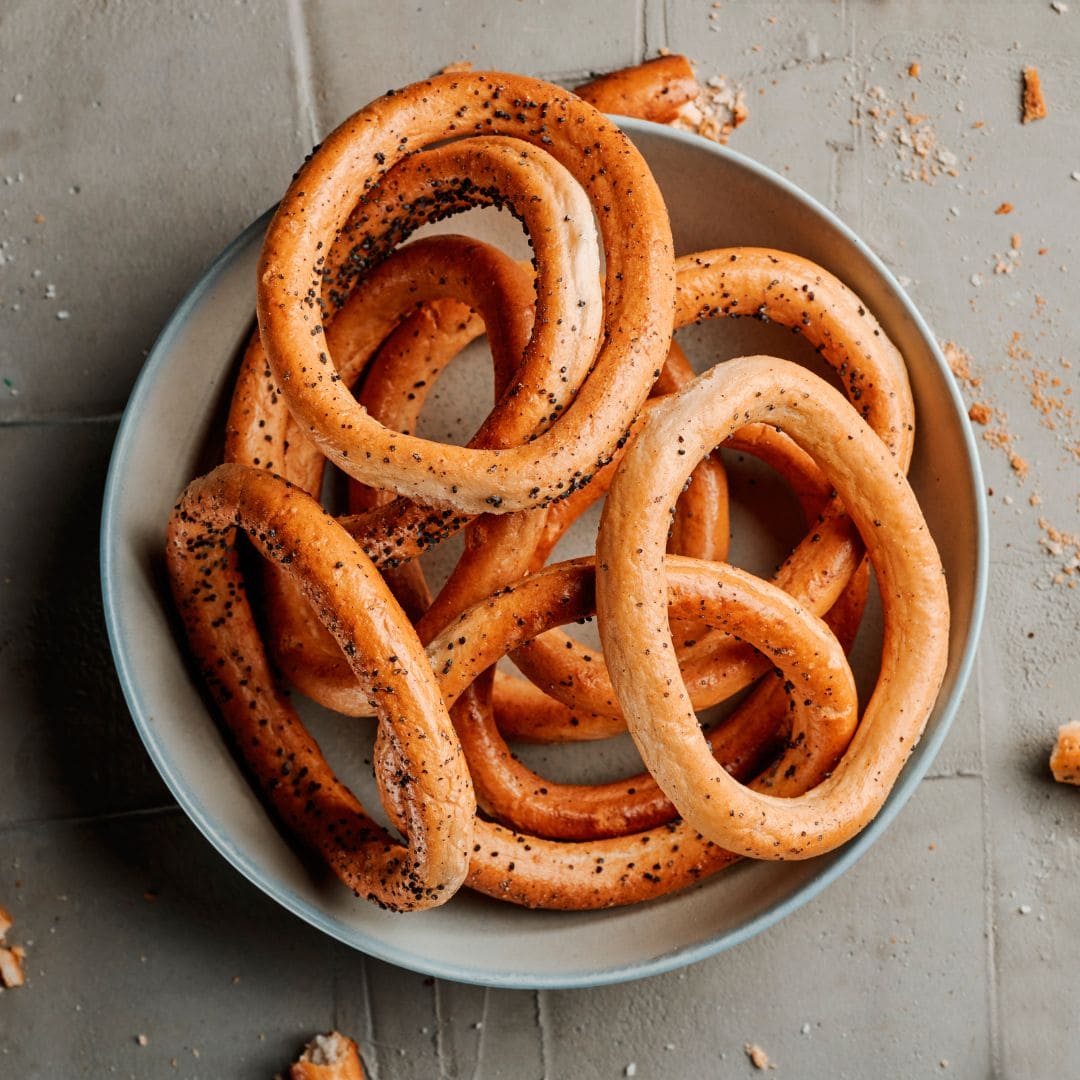
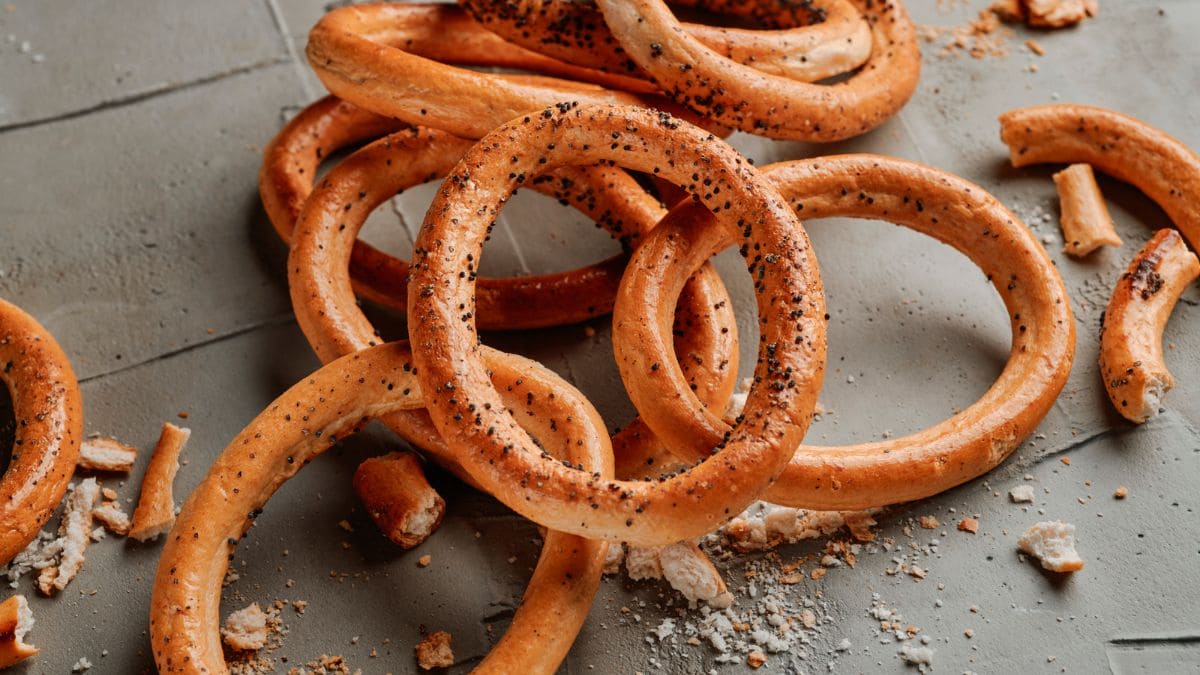
Covrigi are Romania’s answer to the best street food baking has to offer: large, soft pretzels with a glossy, salted crust, sold from kiosks and bakery stalls all over the country. The dough is rolled into long strands, twisted and closed into a ring — and it’s precisely that ring shape that sets them apart from the German pretzel with its crossed arms. Before baking, the pretzels get a brief dip in boiling baking-soda water, which gives them their dark sheen and the characteristic light bite on the surface.

Advertisement: The page displays ads and contains advertising links (affiliate links). See our advertisers here.
In the airfryer, they turn out surprisingly good. The concentrated heat colors the surface quickly, while the crumb inside stays airy and chewy in just the right way. At 170 °C, baking is done in 14 minutes, and you can start a new batch while the first one is still steaming.
Estimated reading time: 4 minutes
Table of Contents
Table of Contents:
Why I love large Romanian salt pretzels in the airfryer
Salt pretzels belong to the kind of baking where the difference between great and forgettable lies in the crust. An ordinary roll bakes dry, while covrigi retain their moisture inside, because the baking-soda bath seals the surface before the heat reaches the crumb. It’s that contrast — crackling salt on the outside, soft and elastic inside — that makes them worth baking yourself.
The airfryer hits that point better than a regular oven in many kitchens, because the air circulates tightly around the pretzel. You don’t need to preheat a big oven or use a whole baking sheet for three pieces of baking, and you can bake one batch at a time, as they become ready to go in.
The difference between covrigi and German pretzels
Both are made from a simple yeast dough, and both get a bath in baking-soda water, but the shape sets them apart. The pretzel has crossed arms and a thick belly, while covrigi are twisted into an open ring with an even thickness all the way around. That also means covrigi bake more evenly — there’s no thick center section that’s still raw once the arms have turned dark. The topping varies by region: coarse salt, sesame or poppy seeds, and often a mix of them.
My kitchen test of large Romanian salt pretzels
I’ve baked them in my Philips XXL, which is the airfryer I use for all yeast baking, because the basket can fit two large pretzels without them touching each other. 170 °C for 14 minutes is the sweet spot where the crust is dark and glossy while the crumb is still moist. Turn the heat up higher, and the salt and sesame will burn long before the center is done.
The whole process takes about 99 minutes from start to finished pretzel, but only 25 of those are active work — kneading, rolling and twisting. The hour of proofing time is non-negotiable — I’ve tried cutting it short, and the result is a denser, heavier crumb that resembles a bread roll more than a real covrig. The baking-soda water needs to be boiling when the pretzel goes in, and the dip has to be brief: it should turn glossy, not cook through.
Lift the pretzel out of the baking-soda water with a slotted spoon, and let it drain completely before it goes into the basket. Water on the underside gives a pale, gummy bottom, no matter how good the rest of the crust turns out.
Tips and tricks from the author: Morten Jensen
The typical mistakes and how to avoid them
The most common mistake is leaving the pretzels in the baking-soda water too long. The surface goes slack and takes on a soapy aftertaste, and the dough starts to give way at the twist — keep the dip brief, and lift them out as soon as they change color. The next mistake is impatience with proofing: if the dough doesn’t get its full hour, the crumb turns dense, and the pretzels barely rise in the airfryer. And then there’s the basket. Pack three or four pretzels tightly together, and they’ll rise into each other and brown unevenly, because the air can’t reach all the way around. Better to bake in two batches with good spacing — the second batch bakes anyway while you eat the first.
How to serve large Romanian salt pretzels
In Romania, covrigi are eaten just as they are, preferably warm and straight from the bag. But they work just as well as part of a meal:
- With a bowl of hot soup, especially bean soup or a tangy ciorbă
- With salted butter and a slice of good cheese, while still warm
- As bread alongside a plate of cured sausage, olives and pickled vegetables
- Broken into pieces and dipped in tzatziki or a coarse eggplant salad
- With a cup of sweet coffee as an afternoon snack, just like they’re actually sold
Storage and reheating
Covrigi are best on the day they’re baked, since the crust softens overnight. Store them in a paper bag at room temperature, never in plastic, which makes the surface damp and chewy. The next day, you can give them a short stint in the airfryer at the same 170 °C until the crust turns crisp again; it only takes a couple of minutes, and they taste almost freshly baked. They can also be frozen in a zip-lock bag once completely cool, and thawed at room temperature before reheating.
Covrigi are one of those recipes where a single technical trick — the brief baking-soda bath — makes all the difference between a homemade roll and genuine street food. Try them once, and you’ll understand why Romanians buy them on their way to work every single morning.
FAQ
The shape. Covrigi are twisted into a closed ring with an even thickness, while the German pretzel has the characteristic crossed arms and a thick belly. The dough and the baking-soda bath are similar, but covrigi are often larger and generously sprinkled with coarse salt, sesame or poppy seeds.

Recipe
Large Romanian salt pretzels in the Air Fryer
Cooking Guide
Keep the screen on and follow the recipe step by step while you cook.
Step 1:
Avoid the screen turning off while you cook.
Step 2:
Start the guide and follow the recipe one step at a time.
Cost of the dish
Prices may vary depending on where you shop.
Our estimate is based on average food prices for the current year 2026.
Estimated price for the whole dish:
Airfryer size
All our recipes are tested in a Philips Airfryer 2000 Series NA230/00 – 6.2 L
Does the recipe fit my Airfryer?
If you’re unsure, you can always reduce by one serving in the recipe, or click the 0.5x button.
You can also Ask the AI Chef
It’s easy! Just press the Ask the AI Chef button you see at the bottom.
Recommended equipment
- 1 Air fryer
- 1 Mixing bowl
- 1 Stor gryde
- 1 Hulske
- 1 Bagepapir (til airfryer)
- 1 Cooling rack
Shopping list
Ingredients


How to make it
Dough
- Mix 400 g wheat flour, 7 g dry yeast, 1 tsp sugar and 1 tsp salt thoroughly in a mixing bowl.
- Add 250 ml lukewarm water and 2 tbsp olive oil, and knead the dough for 8-10 minutes, until it’s smooth and pulls away from the bowl. It should be firmer than a regular bread dough, so the pretzels hold their shape.
- Cover the bowl with a cloth and leave the dough to rise somewhere warm for 60 minutes, until it’s roughly doubled in size.
Shaping and baking soda bath
- Turn the dough out onto a lightly floured surface and divide it into 8 equal pieces.
- Roll each piece into a rope about 50 cm long. Fold the rope in half, twist the two halves around each other, and close the twist into a ring by pressing the ends firmly together. This closed ring is exactly what sets covrigi apart from a German pretzel.
- Bring 2 l water to the boil in a large pot and stir in 2 tbsp baking soda a little at a time — the water will foam up vigorously. Turn the heat down so the water just simmers.
- Dip one ring at a time in the baking soda water for 20-30 seconds, turning it as you go, and lift it out with a slotted spoon. Let it drain well.
Baking in the air fryer
- Preheat the air fryer to 170 °C.
- Line the basket with baking paper and poke a few holes in it so the air can circulate. Bake 2-3 pretzels at a time in a single layer at 170 °C for 14 minutes, until deeply golden brown. Turn them after 8 minutes so they get colour all the way round.
- Let the pretzels cool on a wire rack for at least 5 minutes, so the crust sets. Bake the rest the same way.
Our notes for the recipe
The baking soda bath gives the pretzels their dark, glossy crust and characteristic flavour. Dip them for just 20-30 seconds — any longer gives them a soapy aftertaste. Use a firm dough; a wet dough will lose its ring shape in the water. Variation:
Sprinkle with whole caraway seeds or roughly chopped walnuts instead of the seeds. For a sweet version, skip the coarse salt and sprinkle with cinnamon sugar instead. Serving:
Enjoy them warm, ideally with butter and a piece of firm cheese. They’re also great with a hearty bean soup. About the shape:
Covrigi are shaped into closed rings — that’s what sets them apart from the German pretzel, where the strands are crossed over each other. Portion size:
If your air fryer is smaller, you can bake 2 pretzels at a time. The dough is fine waiting on the counter in the meantime.
Your notes for the recipe
Nutrition per serving (Guideline)
Important about shelf life and nutrition
Nutrition per serving (guideline): Calculations are based on data from the United States Department of Agriculture (USDA). Shelf life (guideline): Shelf life data is provided, as far as possible, by public institutions, including national food authorities. Our information is therefore only indicative, and it is your responsibility to obtain and calculate accurate information about shelf life and nutrition for all recipes on airfryerkogebogen.dk
Easily share the recipe with others:
Via email or on Facebook
Open the recipe on your phone
Scan the QR code with your phone and get the recipe directly on your mobile while you cook.

Author
Airfryerkogebogen.dk