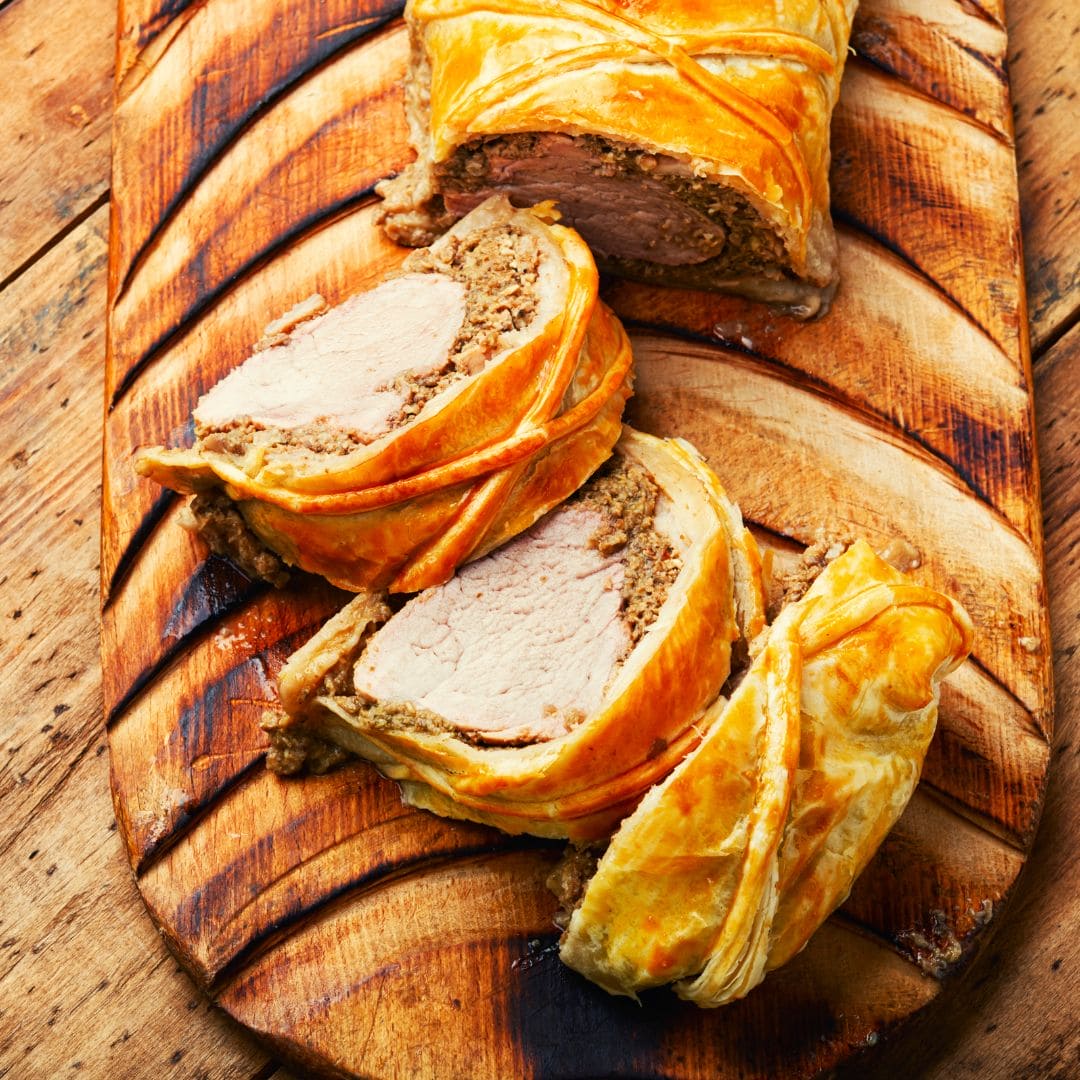
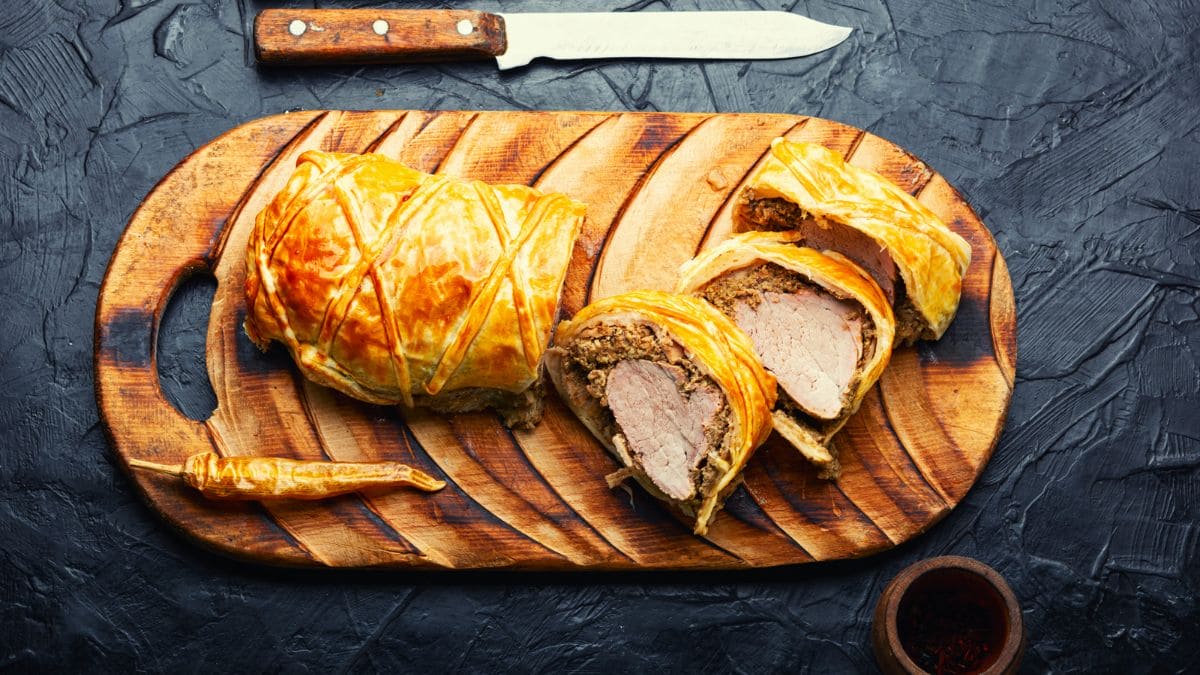
Pork Wellington in the air fryer is a festive dish that looks far more difficult than it is. A whole pork tenderloin is browned in a frying pan, brushed with Dijon mustard and wrapped in duxelles and dry-cured ham, before the whole thing is enclosed in puff pastry and brushed with egg. Duxelles is finely chopped button mushrooms, shallots and garlic, fried with thyme until all the moisture has evaporated. In the air fryer, the pastry turns golden and crisp all the way round, while the meat stays juicy inside.

Advertisement: The page displays ads and contains advertising links (affiliate links). See our advertisers here.
The secret is in the preparation: the filling must be dry, everything must be cold when it meets the pastry, and the meat thermometer decides when the dish is done. If you follow the three rules, you get beautiful slices with a crisp base – without switching on the big oven at all.
Estimated reading time: 4 minutes
Table of Contents
Why I love Pork Wellington in the air fryer
A Wellington is a weekend dish, but it does not have to be complicated. Much of the time is chilling time, when the fridge does the work, and the baking itself almost takes care of itself. The powerful hot air of the air fryer gives the puff pastry distinct, crisp layers, and when the parcel is turned over halfway through, the base turns crisp too. Pork tenderloin is also a rewarding choice: it is lean and tender, has a shape that is made for a long parcel, and costs far less than beef tenderloin.
The difference between Pork Wellington and Chicken Wellington
Pork tenderloin behaves differently from chicken. The tenderloin is one long, whole muscle with a thin tip, which is tucked under the meat so the roll is an even thickness along its whole length and cooks evenly. It is browned over high heat for flavour, and it is baked to a core temperature of 70 °C, at which the meat is still juicy. The flavour is also stronger than that of chicken, which is why the meat can stand up to sharp Dijon mustard, salty dry-cured ham and a dark, concentrated mushroom filling.
My kitchen test of Pork Wellington
I baked the Wellington in my Cosori Dual Blaze at 180 °C. It has a single basket with heating elements both above and below, and you can see it in the puff pastry, which takes on colour from both sides. I still turn the parcel over after 18 minutes, brush the base with the rest of the egg and give it 15-17 minutes more. In my test, the meat thermometer showed 70 °C in the middle of the meat after 35 minutes in total, and after 10 minutes of resting the slices were juicy, without the pastry having gone soft.
The finished Wellington is about 22 cm long, so measure the basket before you start. A large basket such as the one in the Philips XXL gives plenty of room, and if your basket is smaller, the Wellington can lie diagonally. Allow 125 minutes in total: 40 minutes of preparation, 50 minutes of chilling time and 35 minutes in the air fryer.
Duxelles is only done when it has stopped steaming and comes away from the pan. That patience is the whole difference between crisp and soft puff pastry.
Tips and tricks from the author: Morten Jensen
Common mistakes and how to avoid them
The most common mistake is wet duxelles. Mushrooms release a lot of moisture, and if it has not steamed off completely after 10-12 minutes in the pan, it ends up in the pastry – so keep frying until the mixture is completely dry and comes away from the pan. The next mistake is to wrap up warm meat and warm mushroom mixture, because the heat melts the layers of fat in the puff pastry, and then it will not rise into crisp layers. Let both cool completely, and do not skip the chilling time, not even the last 20 minutes before the parcel goes into the basket. The third mistake is baking by the clock. The thickness of the tenderloin determines the baking time, so insert the thermometer from the end until the tip sits in the middle of the meat, and take the Wellington out at 70 °C. If the pastry gets too dark along the way, you can turn the temperature down to 170 °C and bake a little longer.
How to serve Pork Wellington
Cut the Wellington into 8 slices with a bread knife, and serve them straight away. I keep the sides simple so the crisp pastry gets to play the starring role:
- Cream sauce or gravy to pour over the slices
- Crispy potatoes that can soak up the sauce
- Green beans, which add bite and colour to the plate
- A fresh salad as a contrast to the rich puff pastry
Storage and reheating
Leftovers are stored covered in the fridge for up to 3-4 days. Reheat the slices in the air fryer at 170 °C for 5-7 minutes, until the meat is heated through – this also brings some of the crispness back to the puff pastry. The Wellington can be frozen for up to 3 months; thaw it in the fridge overnight before reheating. If you want to stay one step ahead, the roll with ham and duxelles can be made the day before and kept in the fridge until it is time to wrap it in pastry.
Pork Wellington is the dish that makes your guests believe you have been in the kitchen all day. Keep the filling dry, the meat cold and your eyes on the thermometer, and the air fryer will do the rest.
FAQ
It is almost always caused by wet duxelles or a filling that had not cooled completely. Fry the mushroom mixture until completely dry, keep to the chilling times, and turn the Wellington over after 18 minutes so the base turns crisp as well.
The Wellington is done when the meat thermometer reads 70 °C in the middle of the meat. Insert the thermometer from the end, and let the Wellington rest uncovered for 10 minutes before you cut it into slices.
The finished Wellington is about 22 cm long and can lie diagonally in the basket. If the basket is too small, you can cut the tenderloin into two shorter pieces, wrap each in half a sheet of puff pastry and bake them in two batches.

Recipe
Pork Wellington in the Air Fryer
Cooking Guide
Keep the screen on and follow the recipe step by step while you cook.
Step 1:
Avoid the screen turning off while you cook.
Step 2:
Start the guide and follow the recipe one step at a time.
Cost of the dish
Prices may vary depending on where you shop.
Our estimate is based on average food prices for the current year 2026.
Estimated price for the whole dish:
Airfryer size
All our recipes are tested in a Philips Airfryer 2000 Series NA230/00 – 6.2 L
Does the recipe fit my Airfryer?
If you’re unsure, you can always reduce by one serving in the recipe, or click the 0.5x button.
You can also Ask the AI Chef
It’s easy! Just press the Ask the AI Chef button you see at the bottom.
Recommended equipment
- 1 Air fryer
- 1 Cutting board
- 1 Chefs knife
- 1 Food processor
- 1 Paper towel
- 1 Frying pan
- 1 Plate
- 1 Shallow dish
- 1 Plastic wrap
- 1 Brush
- 1 Small bowl
- 1 Parchment paper (for air fryer)
- 1 Turner
- 1 Meat thermometer
- 1 Bread knife
Shopping list
Ingredients
- 500 g pork tenderloin (1 whole tenderloin)

- 0.5 tsp salt
- 0.5 tsp black pepper (Freshly ground)
- 1 tbsp rapeseed oil (For browning)
- 1 tbsp Dijon mustard
- 8 slices dry-cured ham (About 100 g, e.g. Serrano or Parma ham)
- 1 sheet puff pastry (Ready-rolled, from the chilled section, about 275 g)
- 1 pcs egg (Beaten, for brushing)


How to make it
Preparation
- Chop 250 g button mushrooms, 2 pcs shallots and 1 clove garlic very finely – use short pulses in a food processor, or chop by hand with a chef’s knife on a chopping board. The mixture should be finely chopped, not puréed.
- Trim the sinew and silverskin from 500 g pork tenderloin, and pat the meat completely dry with kitchen paper. Season all over with 0.5 tsp salt and 0.5 tsp black pepper.
- Heat 1 tbsp rapeseed oil in a frying pan over high heat, and brown the tenderloin on all sides for 4-5 minutes in total, until it has a golden crust. Place it on a plate and let it cool.
- Melt 15 g butter in the same pan over medium-high heat. Add the chopped mushrooms, shallots and garlic, the leaves from 3 sprigs fresh thyme and 1 pinch salt, and fry for 10-12 minutes, stirring frequently. The duxelles is ready when all the moisture has evaporated and the mixture is completely dry and comes away from the pan – if it is wet, the puff pastry will turn soft.
- Spread the duxelles out in a thin layer on a shallow dish, and place it in the fridge for 10 minutes, until completely cold.
Assembly
- Lay a large piece of cling film on the worktop. Lay 8 slices dry-cured ham out on the film so the slices overlap slightly and form a rectangle of about 22 x 25 cm, and spread the cold duxelles in an even layer on top.
- Brush the cooled tenderloin with 1 tbsp Dijon mustard, and place it along one edge of the ham. Tuck the thin tip under the meat so the tenderloin is an even thickness along its whole length and no more than 20 cm long – the finished Wellington has to fit in the air fryer basket.
- Roll the ham and duxelles tightly around the meat using the cling film, and twist the ends of the film like a sweet wrapper so the roll becomes firm and even. Place the roll in the fridge for 20 minutes.
- Beat 1 pcs egg in a small bowl. Unroll 1 sheet puff pastry, unwrap the meat roll from the cling film, and place it along one long side of the pastry. Brush the edges of the pastry with a little of the egg, and roll the pastry tightly around the meat.
- Trim off the excess pastry so the seam overlaps by 2-3 cm and there is 3-4 cm of pastry at each end. Turn the roll seam side down, fold the ends under, and press all the joins firmly together so the parcel is completely sealed. Place it on a piece of baking paper.
- Brush the top and sides with egg, and score a light pattern in the pastry with the back of a knife without cutting all the way through. Save the rest of the egg, and place the Wellington in the fridge for 20 minutes so the pastry is completely cold when it goes in to bake.
Cooking in the air fryer
- Preheat the air fryer to 180 °C fan.
- Lift the Wellington into the basket on the baking paper, seam side down – place it diagonally if space is tight – and bake it for 18 minutes at 180 °C.
- Carefully turn the Wellington over with a spatula so the underside faces up, and brush it with the rest of the egg. Bake for another 15-17 minutes at 180 °C, until the pastry is golden and crisp all over.
- Insert the meat thermometer from the end so the tip sits in the middle of the meat. The Wellington is done when the core temperature reaches 70 °C. If it is not quite there, keep baking at 180 °C, 2-3 minutes at a time.
Serving
- Transfer the Wellington to a clean chopping board with the patterned side up, and let it rest uncovered for 10 minutes so the juices settle and the pastry stays crisp.
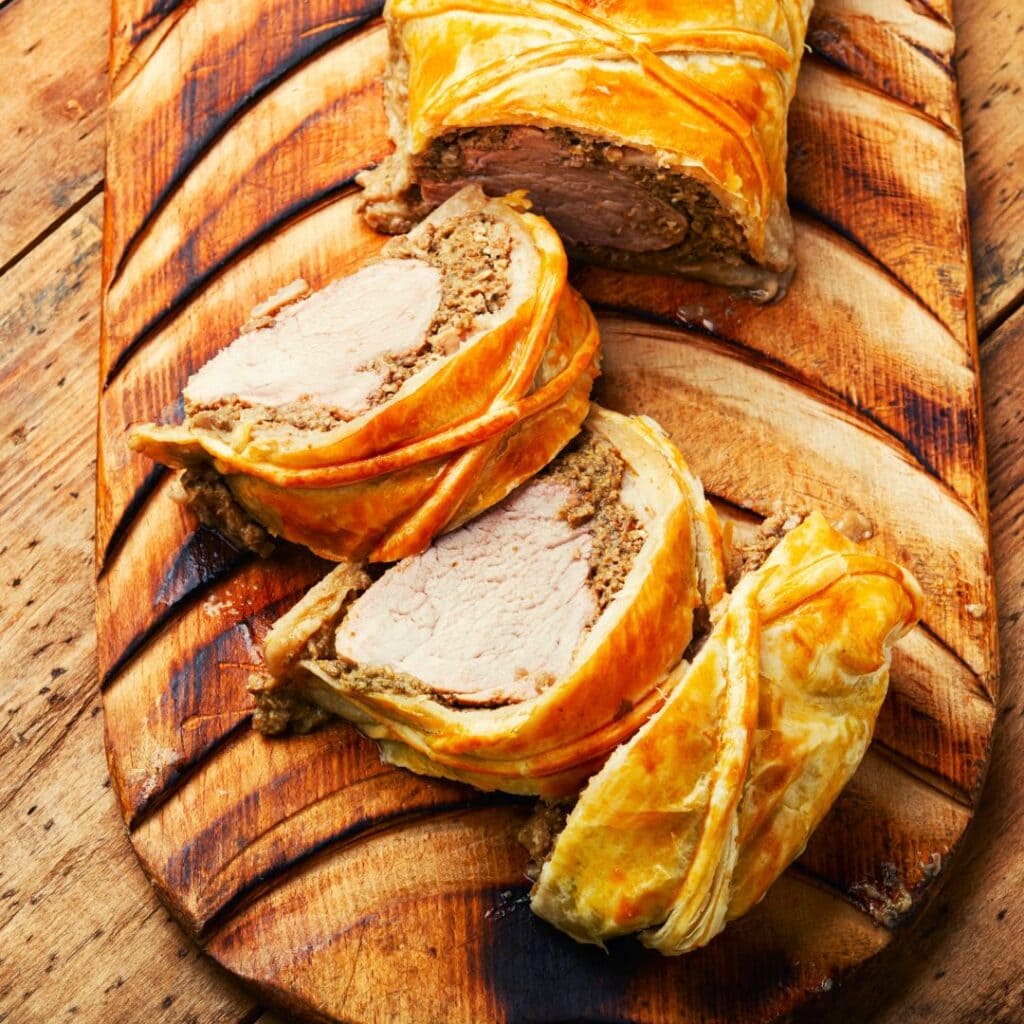
- Cut the Wellington into 8 slices with a bread knife, and serve straight away.
Our notes for the recipe
The duxelles must be cooked completely dry – it is ready when it no longer steams and comes away from the pan. Wet mushroom mixture and warm meat make the puff pastry soft, so let both cool completely and do not skip the chilling time. If the pastry gets too dark before the meat is done, you can turn the temperature down to 170 °C and bake a little longer. The roll with ham and duxelles can be made the day before and kept in the fridge until it is time to wrap it in pastry. Meat thermometer:
The thickness of the tenderloin determines the baking time, so trust the thermometer rather than the clock. Measure from the end into the centre of the meat, and take the Wellington out as soon as it reads 70 °C. Variation:
Use wholegrain mustard instead of Dijon mustard, or stir 1 tbsp finely chopped parsley into the cooled duxelles. Mixed mushrooms give more flavour, but they also need to be cooked completely dry. Serving:
Serve the slices with cream sauce or gravy, crispy potatoes and green beans or a fresh salad. Portion size:
Measure the basket before you start – the finished Wellington is about 22 cm long. If your air fryer is smaller, you can cut the tenderloin in two shorter pieces, wrap each in half a sheet of puff pastry and bake them in two batches.
Your notes for the recipe
Nutrition per serving (Guideline)
Important about shelf life and nutrition
Nutrition per serving (guideline): Calculations are based on data from the United States Department of Agriculture (USDA). Shelf life (guideline): Shelf life data is provided, as far as possible, by public institutions, including national food authorities. Our information is therefore only indicative, and it is your responsibility to obtain and calculate accurate information about shelf life and nutrition for all recipes on airfryerkogebogen.dk
Easily share the recipe with others:
Via email or on Facebook
Open the recipe on your phone
Scan the QR code with your phone and get the recipe directly on your mobile while you cook.

Author
Airfryerkogebogen.dk